
“The pandemic teaches us the need to re-discuss the Society-State equation”
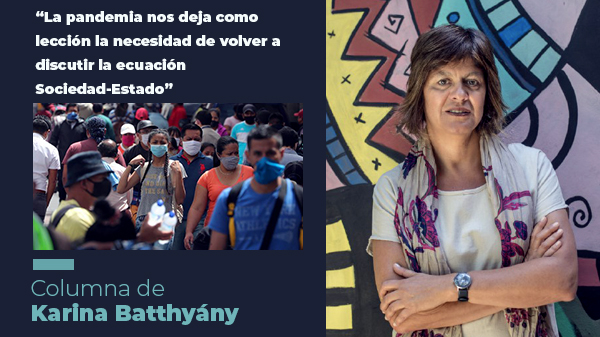
(Transcription of Karina Batthyány's Column)
(in InfoCLACSO – November 10, 2021)
Last week we discussed the topic of Care. So today we can move towards a slightly broader concept: Social Welfare and Social Protection, which is undoubtedly one of the central themes of the #Conference2022 in June, as we've been announcing in all the InfoCLACSO events.
-Actually, I think we need to start with Social Welfare, which incorporates the issues you're raising, but it's actually a broader topic. And when we talk about Social Welfare, we're really talking about policies, public policies in general, to try to support, reduce, or in some cases eliminate the risks that we all face throughout our lives. So, when we talk about Social Welfare, we're certainly talking about social security, as you mentioned; we're talking about health, as you also mentioned; we're talking about education, employment, and more recently, caregiving, and several other issues that make up these different areas or dimensions that we all need for our individual well-being (as people) and for our collective (social) well-being as a society.
This is a theme that will run through several key areas of our #Conference2022. And it's an issue that remains unresolved in Latin America, because our Latin American and Caribbean states have not yet achieved what are known as Welfare States. Some have come closer, others less; some are clearly lacking in terms of social welfare.
And why am I bringing this up? Because it has always been a very important topic, one where we have to discuss, or rather examine and analyze, the interplay between various agents that provide well-being. Which are the most well-known? The state, the market—if we look at the literature, 80% of the discussion on social welfare focuses on this: how much state and how much market in key areas like education, health, employment, and social security. But more recently, we have also incorporated other agents that provide well-being, for example: households, families, and communities. So, from the combination of how responsibility and activities related to social welfare are distributed, the different welfare or social protection frameworks emerge. And in Latin America, this is an absolutely crucial issue because, in many periods, states were reduced to a minimum; in that debate about how much state and how much market, the market often won: let's consider education and health.
And the pandemic made this issue abundantly clear, because even now, 18 months after the pandemic began, seemingly on the verge of emerging from it, when we look at the existing studies, we see that the responses of different countries worldwide, and also here in Latin America, are quite different depending on their pre-existing social welfare systems. For example, Uruguay, which is often cited as an example for many reasons, including its handling of the pandemic, helps us understand what happened there beyond its critical peak. This is due to the presence of strong welfare state structures, such as a very good healthcare system, to name just one. And this leads to the discussions you raise: How do we ensure this for everyone? One possibility is a basic income or citizen's income (it has different names), to guarantee that all people, regardless of their position in the labor market or their access to resources from other sources, can meet their basic needs, their minimum needs in terms of education, health, work, care, and so on.
-In that sense, Karina, it seems that this discussion is still difficult to move forward with, because while some governments in the region are proposing a minimal state, thinking about a basic income seems so many steps beyond what some governments, especially those on the right or center-right, could realistically achieve that it seems complex. But I understand that the landscape of Latin America and the Caribbean is mixed, because in some places something like this might be more readily conceivable.
Yes, it's clearly a time of both light and shadow, or crossroads as we like to call them at CLACSO, because some countries—Uruguay again—have returned to a neoliberal logic and, of course, cuts in social policies and social welfare programs. But there are also other countries that have resumed progressive paths or paths of more populist governments, and we observe this constantly, not only today, but always in Latin America and the Caribbean. The important thing, I think, is that the pandemic has taught us the need to revisit the Society-State equation, or State-Society, whichever you prefer, and place it at the center. And that's why this topic will be a very significant focus at the #Conference2022, one that cuts across other dimensions, because this Society-State equation will be present in the areas of Education, Gender, Health, and I could go on naming several more. I believe this topic is a current discussion in our region, and those attending our #Conference2022—social scientists, humanities scholars, members of social movements and organizations, and those in the field of public policy—will have much to contribute to this discussion. Why? Because what we ultimately want is to try to understand what happened, but above all, to build alternatives for the future.
-What we see in the records of many Latin American countries is that, for example, informal economies, lacking support, end up generating a series of very large problems and are generally not taken into account when accounting for a number of issues. How much could a basic income be a solution for these informal economies? And I don't want us to end this conversation without adding another thematic point—which you just mentioned—related to health. Because we know that in some countries public healthcare is free, while in others it is extremely expensive and almost impossible to access, especially for the poorest sectors of society. So, I'm thinking about informal economies, access to certain things or lack thereof—how does all of this factor into considering a possible basic income?
-The issue of informality is already a central element. Let's remember, as we've said in other columns of Info CLACSO: 52% of those who work for pay in our region do so in the informal sector (one out of every two, to be clear), and this already implies, as a starting point, an absence of social security of any kind: health coverage, future pension or retirement benefits. Therefore, we are talking about a phenomenon of enormous magnitude. And without a doubt, the idea of a citizen's income or basic income can be a solution, at least to access those minimum levels—the bare minimum—of social security or social protection. So it is an absolutely crucial factor. And regarding health systems, it became very clear during the pandemic, not only in Latin America but worldwide, that those countries with strong public health systems had better results. And when I say better results, I mean not only that fewer people were infected, but above all that there were fewer deaths. And I think that should give us all pause for thought.
If you would like to receive more information about CLACSO's training programs:
[widget id=”custom_html-57″]
to our email lists.

