
“The pandemic has exacerbated educational inequalities and affected the rights of girls and boys.”
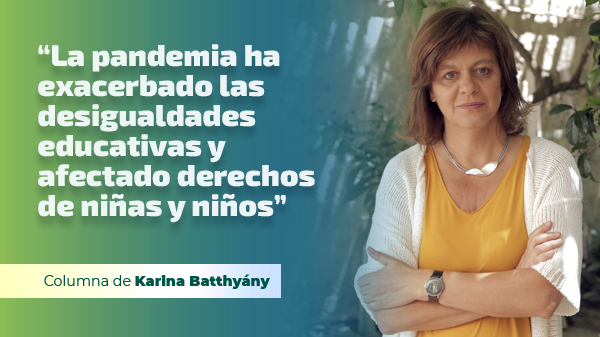
(Transcription of Karina Batthyány's Column)
(In InfoCLACSO – February 23, 2022)
How is the Ninth Conference shaping up, and what are the important steps being taken?
We are in a position to confirm at this time that we will have more than 3.500 participants in the working groups, we will have 180 panels, 38 forums and 14 master dialogues with representatives of the Social Sciences and Humanities at our #CLACSO2022 Conference.
We therefore estimate that it will be the most important – and also the most anticipated – reunion after this pandemic, and that we will be meeting at the headquarters of the UNAM (National Autonomous University of Mexico), University City, with around 6 people to do what we always do at CLACSO: to articulate debates, ideas, mobilizations, actions, towards the discussion of what is happening in Latin America and in the world with the theme of inequalities.
PANDEMIC, EDUCATION AND CHILDHOOD
Today I want to share with you some broader ideas from the UNICEF report, the United Nations Children's Fund, entitled "Avoiding a Lost Decade." This report was published to mark UNICEF's 75th anniversary, and it focused its efforts on the effects of COVID-19 on children. The title, "Avoiding a Lost Decade," asks us to identify the urgent measures needed to reverse the devastating impact of COVID-19 on children and young people.
The organization states that COVID-19 is the worst crisis for children since UNICEF was founded, that is, in its 75-year history.
UNICEF maintains that during the pandemic, the human rights of all children have been affected to a degree unseen in more than a generation. And it warns: if we do not take action, the world will face a lost decade for children, and the SDGs (Sustainable Development Goals) will become an impossible dream.
In less than two years, 100 million children have fallen into poverty, a 10% increase since 2019, before the pandemic. UNICEF also calculates child poverty using two interesting and different (but complementary) measures. On the one hand, it considers children living in households defined as economically poor, but on the other hand, it also works with the concept of multidimensional poverty, which we discussed in other InfoCLACSO events last year.
Multidimensional poverty, in this case, is operationalized by examining deprivations in some of the following areas: education, health, housing, nutrition, sanitation, and water. It then adopts the notion of childhood poverty based on these two criteria.
What are they telling us? Before the pandemic, around one billion children worldwide, and half of all children in developing countries, suffered at least one severe deprivation in education, health, housing, nutrition, sanitation, and clean water. In developing countries, UNICEF currently estimates that the percentage of children living in multidimensional poverty—that is, deprived of the elements I mentioned earlier—has increased from around 47% before the COVID-19 pandemic to 52% in 2021, the latest year for which data is available. This represents an additional 100 million children added to the already serious global phenomenon of child poverty.
This report also analyzes that, in the best-case scenario, it will take between seven and eight years to recover and return to pre-COVID-19 levels of child poverty. It's important to remember that those previous levels were extremely high. But it will take seven to eight years to get back to that point in 2019.
Furthermore, as we know, the unequal distribution of the impact of COVID-19 and the different paces at which recovery is taking place in different countries are deepened by inequality between countries and particularly affect children living in low-income or poorer regions.
The report also shows that some dimensions of the pandemic, such as education and health, were particularly affected by the impact on poverty. For example, regarding education, it discusses the impact of school closures during the first year of the pandemic. It's important to remember that in 2020, the pandemic was a virtually global phenomenon.
UNICEF estimates that during the strictest period of lockdowns and quarantines (March 2020 onwards), more than 1.500 billion students were out of school due to closures. Latin America and the Caribbean was the region most affected by school disruptions, with 80% of in-person instruction interrupted during the first year of the pandemic.
This combination of prolonged school closures and inadequate remote learning could result in a substantial loss of learning, exacerbating educational inequalities that already existed before the pandemic began.
The report highlights that the main factor in this phenomenon is inequality in access to digital technologies: globally, 2.200 billion children and young people aged 25 and under—that is, two-thirds of children and young people worldwide—do not have internet access at home. Therefore, throughout this period of education, including remote learning, we see these disparities and difficulties faced by the vast majority in accessing these technologies.
UNICEF also shows us that the crisis unleashed by COVID-19 had significant repercussions on the health of children and young people. According to this organization, 50 million children suffered from malnutrition in 2021, and that figure could still increase by another 9 million in 2022 due to the pandemic's impact on diets, nutrition services, and children's eating habits, which are often also linked to school attendance.
Furthermore, more than half of the countries experienced disruptions in the delivery of vaccines included in national immunization schedules. I'm not referring to the COVID-19 vaccine, but to routine childhood vaccinations. Some 23 million children missed out on essential vaccines, the highest figure since 2009.
As I mentioned, the report also dedicates a special section to health, and especially mental health, showing how disruptions to routines, education, and recreation, along with concerns about family income among responsible adults, have exposed many children and young people to situations with a negative impact on their mental health. Mental health conditions affect more than 13% of adolescents aged 10 to 19 worldwide. And while we may not know the true impact of this pandemic on children's mental health, according to a preliminary survey conducted by UNICEF in 21 countries in the first half of 2021, one in five young people reported often feeling depressed or having little interest in doing their usual activities as a result of all these situations we are describing.
We also know that there are other situations beyond the exceptional circumstances of the pandemic that affect the situation of children and young people, such as armed conflicts, conflict zones, and migration. To the entire picture I'm describing, we must add these other phenomena, which are not exceptional or associated with the pandemic.
We are at a crossroads where we really need to place the issues of well-being, social protection, and rights—in this case, the rights of children and young people—but rights in general at the center of our concerns.
If we truly want to emerge from this pandemic situation, and avoid this lost decade for children, or, as we saw last week, for women as well, we must commit to investing in social welfare, social protection, and public spending by states on welfare and social protection that includes everyone, in order to prevent these alarming setbacks, both in terms of well-being and the exercise of rights.
As always, the impact of inequality hits the same sectors hardest. While the "Stay at home" order was a possibility for some, for others it was not only impossible but also a form of abandonment, especially for children who had no access to any kind of online education.
Absolutely. Let's recall the data I just discussed regarding the availability of tools: the first is internet access – but it's not the only one – for distance learning, and the "Stay at home" order, but at the cost of cutting off educational and socialization processes, and the consequences we've already seen in the case of women who, in many cases, took on the role of educators for their children during the prolonged interruptions of in-person education.
All these issues must indeed be at the heart of our concerns. The situation was complex before the pandemic and has become dramatic in the post-pandemic era. These topics will certainly be addressed at our #CLACSO2022 Conference. Of course, there is a Working Group on Children and Youth, and forums will be discussing these issues during our Conference, but the primary concern must be how we reverse this situation. And once again, I insist, the path forward lies in considering institutions, their universal nature, guarantees for everyone, and ultimately, processes of well-being and social protection. This brings us back to the discussion of what kind of states, for what kind of societies, and what their place is in the state-society equation.
If you would like to receive more information about CLACSO's training programs:
[widget id=”custom_html-57″]
to our email lists.

