
The pandemic exacerbates the employment crisis and deepens social inequalities
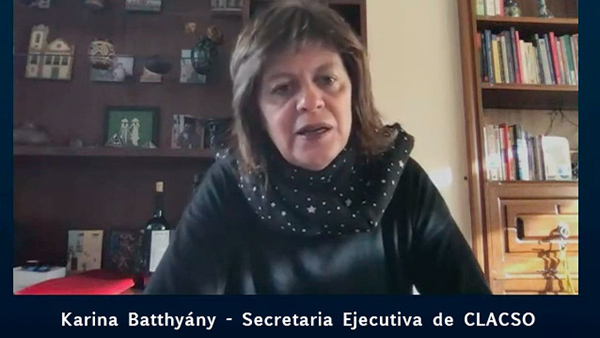
(Transcript of the Column by Karina Batthyány
in InfoCLACSO 15 of July 2020)
I think it's good that in subsequent programs we dedicate ourselves to examining different dimensions of inequality within the context of this health crisis, this pandemic, and its impact on Latin America and the Caribbean. And indeed, one of these dimensions—not the most important, but a relevant one—has to do with what is happening in the world of paid, productive work; not in the world of other types of work, such as unpaid work and care work, which we will also address in future programs.
What do we know so far? Of course, we know that before the pandemic, Latin America and the Caribbean was the most unequal region on the planet. And we also know some characteristics of our labor market in the region, such as the fact that more than half of the workers in our Latin American and Caribbean region are informal. To say that a worker is informal means that they have no social protection whatsoever; no protection of any kind regarding their health rights, their economic rights, or their future retirement: 53% were in the informal sector before the pandemic, half of all workers. We also have to consider what happened to all those people who live day to day, relying on "what I do each day" to put food on the table or to feed their families. What happened to them during this pandemic, given that many of their activities, due to the lockdowns and the economic crisis, came to a halt? These people not only lack social protection as they did before the pandemic (which was very serious), but now they also have no income at all. In other words, they lose their source of employment, even if it's informal, and are left without the means to provide for their families.
But for the other half, those of us with formal jobs, the situation isn't much better either. Consider that in our region, 64%—two out of every three—of those with formal employment and job protection work in the service sector. And, as we know, the vast majority of those in that sector are women. The service sector is precisely the one most affected by the pandemic. What does the service sector encompass? Basic necessities like hotels, restaurants, and the food service industry in general—services to individuals—which were among the first economic activities impacted during this health crisis. Consequently, these individuals, who do have formal employment, found themselves unemployed, receiving unemployment benefits, or experiencing some form of disruption to their livelihood.
All of this leads to the conclusion that, for example, both the ILO (International Labour Organization) and ECLAC (Economic Commission for Latin America and the Caribbean) are predicting that unemployment will increase in Latin America as the pandemic subsides. And unemployment will increase, and poverty will increase. They provide truly chilling figures, such as the expectation that more than 45 million people will fall into poverty, and more than half of those will be living in extreme poverty.
That's more or less the situation in our region today: increased informality, increased unemployment, increased poverty, increased extreme poverty. Of course, not all of these situations are a product of the pandemic. They are issues we already had in Latin America, but which are now worsening. And we have to ask ourselves many questions. We have to ask ourselves what our individual roles are in this situation, and also what the role of the State is. What role should states play in all of this, and what role should the main instrument that states have—public policies—play? How are we going to guide them?
Talking about the presence of the State, Must see How much of neoliberal policies were also very conducive, not only with an already complicated situations of the pandemic, but sometimes also use the pandemic all with Reducing staff. So, what would be the importance, for example, of the State's presence? in the current situation?
The role of the State is absolutely key. And what you were saying about the role of neoliberalism—let's say, these figures I'm giving you that predate the pandemic—are the result of a neglectful State, a State that simply isn't fulfilling its basic functions, which is to ensure the enjoyment of people's fundamental rights. And a fundamental right is indeed the right to work, but not just any work, rather the right to decent, quality work, with coverage and social protection. Half of those of us who live in this region have informal jobs; there we're talking about the role of the State, and here, indeed, opportunities arise. We also have to be careful, because there are many voices that position themselves, I would say, between two extremes. On the one hand, those who say that nothing will change, it's just a matter of time before we return to normal. And on the other hand, at the opposite extreme, that this is an absolute catastrophe and no one knows how we're going to get out of it.
I believe we really need to consider the paths between these two extremes, where the role of the State becomes central—not just any State, but a social welfare State. And when I say a social welfare State, I'm referring precisely to a State that guarantees basic human rights, and where concepts like solidarity, empathy, responsibility, and of course democracy, as well as interdependence among individuals and all those who inhabit a given space, will become central. Because otherwise, the alternative to all of this, far from being the solidarity and empathy I just mentioned, will lead to authoritarianism, selfishness, racism, xenophobia, and each country closing itself off—some of the risks we are already seeing in Latin America.
This is an excellent opportunity: let's remember that old idea that every crisis opens up an excellent opportunity to redesign a series of elements in our region. Today we're talking about work. So, it's appropriate to say: redesign the economic model, and of course, address the issue of debt. The level of indebtedness in the world and the Latin American region is absolutely absurd: more than 40% of Latin America's Gross Domestic Product is committed to external debt. And we must also raise the issue of a universal basic income, which goes directly to what we were discussing about the labor market. But it's also an opportunity to strengthen democracies: only with strong democracies can we implement this idea of welfare states. And when I say "strong," I mean from the perspective of citizen participation. And, of course, we mustn't forget to close the gaps (hopefully eliminate them), at least taking advantage of this opportunity to close the gender gaps that are so prevalent in the labor market and in all social spheres. Let us continue to think that, ultimately, we must not forget that the purpose of CLACSO is precisely that: to understand in order to transform. And that is what we work for every day.
If you would like to receive more information about CLACSO's training programs:
[widget id=”custom_html-57″]
to our email lists.

