
The social organization of care
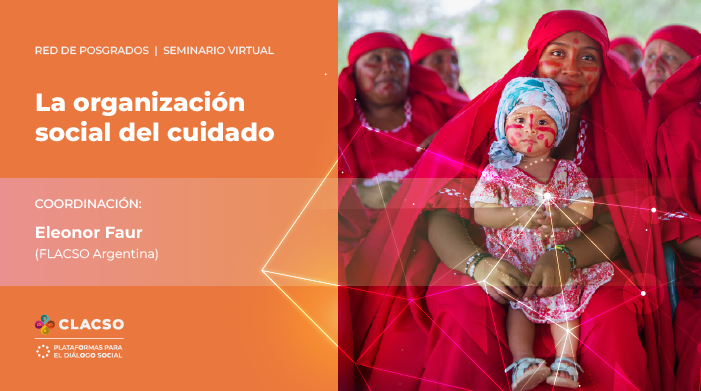
Seminar 2423
ChairCLACSO
Coordination: Eleonor Faur (Flacso, Argentina)
Teaching team: Flávia Biroli (UnB, Brazil), Karina Brovelli (UBA, Argentina), Valeria Esquivel (CONICET, Argentina), Eleonor Faur (Flacso, Argentina), Marisa Fournier (UNGS, Argentina), Elizabeth Jelin (CONICET, Argentina), Francisca Pereyra (UNGS, Argentina), Ariela Micha (IDES, Argentina), Martín Oliva (IDES, Argentina)
Home: 25/09/2024 | Registration: 16/05/2024 to 24/09/2024
Workload: 12 weeks – 90 hours.
Care is a central element of human well-being. However, neither the tasks nor the benefits of care are distributed equitably across the population. While the burden of care falls primarily on the daily work of women—particularly the poorest—Latin American public policies have responded unsystematically to the population's growing care needs. In this context, this seminar aims to discuss how care work is socially organized, paying special attention to public policies, the actors involved in providing care, and how different households and individuals access state and private services, depending on their social and gender status.
Care is established as a central component of social well-being; therefore, the course explores the contributions of the various institutions, actors, and dimensions involved. Working from the concept of the social and political organization of care entails exploring the supply and demand for care, family arrangements and strategies for its provision, the role of care work and care workers, and the analysis of social representations of care.
The category of care confronts us with a classic problem in sociology: the relationship between subjects and structures. On the one hand, the orientation of state policies is based on certain assumptions about the subjects they are intended for, images that, through action or omission, define their rights and responsibilities (for example, those of working mothers or those of poor households). In this process, institutions determine which roles, functions, and responsibilities pertain to different groups (sometimes expanding rights based on universality; other times, exacerbating pre-existing inequalities). Complementarily, it is individuals (according to their needs and possibilities) who ultimately interpret and redefine these structures, so that the order defined by institutions is subject to constant transformation. Thus, the analysis of the social and political organization of care presents significant potential for examining the state of culture, social protection models, and their transformations.
Throughout the sessions, different approaches to understanding the role of care within the social fabric will be discussed, drawing from the sociology of families, the economics of care, social policy analysis, and political science. Research findings on the topic will be presented, which, without attempting to cover an increasingly prolific field of empirical research, will seek to shed light on the various facets involved in studying the social organization of care in democratic contexts.
- The social and political organization of care. Concept map
- Transformations in families. Challenges for care
- The social and political organization of childcare and elderly care
- Social organization for the care of people with disabilities
- Care work
- Care workers
- Care and Social Economy
- Women jugglers. Tensions between employment and daily caregiving.
- Care and masculinities
- Care and democracy
- Rethinking care policies (and systems)
- AAVV (2017) State of fatherhood. Latin America and the Caribbean. MenCare, IPPF, ProMundo, EME and Men Engage Latin America. New York.
- Addati, Laura, Umberto Cattaneo, Valeria Esquivel, and Isabel Valarino. 2018. Care Work and Care Jobs for the Future of Decent Work. Geneva: ILO.
- Brovelli, K. (2019). The irruption of disability: welfare resources, strategies and perceptions regarding the organization of care in the City of Buenos Aires (Master's thesis). University of Buenos Aires, Argentina.
- ECLAC (2010) Care and its disciplinary boundaries, ECLAC Notebooks No. 94 (ECLAC, 2010), Santiago de Chile, Chapter I, pp. 25-32.
- Comas D'Argemir, D. (2014). Long-term care and the fourth pillar of the welfare system. Journal of Social Anthropology.
- Esquivel, Valeria and Pereyra, Francisca (2017) “The working conditions of care workers in Argentina. Reflections based on the analysis of three selected occupations” in Work and Society.
- Faur, Eleonor (2014) Childcare in the 21st Century. Women jugglers in an unequal society. Buenos Aires, Siglo XXI editores. Chapter 1.
- Faur, Eleonor (2014) Childcare in the 21st Century. Women jugglers in an unequal society. Buenos Aires, Siglo XXI editores. Chapter 2 and conclusions.
- Faur, Eleonor (2017) To care or to educate? Towards a pedagogy of care, in Redondo, Patricia and Antelo, Estanislao (ed.) Crossroads between caring and educating. Debates and experiencesBuenos Aires, Homo Sapiens publishing house
- Faur, Eleonor and Ania Tizziani (2017) Women and men. Between the labor market and family care. In Faur, E. (comp.). Women and men in Argentina today. Genders in motion. Buenos Aires: Siglo Veintiuno.
- Faur, Eleonor and Francisca Pereyra (2018) “Grammars of care”, in Piovani, JI and Salvia, A. 2018, Argentina in the 21st century, Buenos Aires, Siglo XXI editores
- Folbre, Nancy (2018) “The Care Penalty and Gender Inequality” in Averett, Susan; Argys, Laura and Hoffman, Saul (eds.) The Oxford Handbook of Women and the Economy, Oxford: Oxford University Press.
- Fournier M, (2017) The work of community childcare workers in the Buenos Aires metropolitan area: A form of "bottom-up" subsidy?. Work and Society Journal. Summer 2017.
- Jelin, Elizabeth. Family. A model to assemble. In Faur, Eleonor (ed.). Women and men in Argentina today. Genders in motion. Buenos Aires: Siglo Veintiuno Editores/Fundación OSDE, 2017.
- Pineda Duque, Javier (2018) Institutionalized care and old age, in Arango Gaviria, LG; Amaya Urquijo, A.; Pérez-Bustos, T. and Pineda Duque, J. (ed.) Gender and care: Theory, scenarios, and policiesBogotá, National University of Colombia, Pontifical Javeriana University and University of Los Andes.
- Vega Solis, C; Martínez Buján, R and Paredes, M (2018) “Experiences, areas and cooperative links in the sustenance of life”. In: Vega, Martínez-Buján and Paredes (eds.) Care, community and common. Cooperative experiences in the sustenance of life. Ed Traficantes de Sueños.
- Zelizer, Viviana (2010) Economic Lives. How Culture Shapes the Economy. Part Four. The Economy of Care. Princeton University Press. Princeton & Oxford.
|
|
Discount for one payment until 18/09 |
In one payment after 18/09 |
|
CM Plenos |
$85 |
$150 |
|
CM Associates |
$85 |
$150 |
|
No link |
$105 |
$190 |
FAQ
The basic requirements for taking a seminar are:
- Availability of at least 4 hours per week to dedicate to the seminar course.
- Internet access.
- Reasonable handling of communication and computer tools.
- Language proficiency in the language in which the course will be taught. The official languages are Spanish and Portuguese.
The seminars last 10 weeks, plus the completion of a final project. A total of 90 hours of dedication will be credited.
A course consists of 10 classes, each accompanied by required reading bibliography, supplementary bibliography, discussion forums and training activities proposed by the teaching team, partial deliveries and a final project.
The course is online and asynchronous. Some instructors may propose synchronous activities. In those cases, the time and date will be agreed upon beforehand between the teaching team and the students to ensure everyone's participation.
To pass the seminar, you must participate in at least 80% of the discussion forums and activities proposed by the teachers, have completed the scheduled partial deliveries, and pass the final work.
|
|
Discount for one payment until 18/09 |
In one payment after 18/09 |
|
CM Plenos |
$85 |
$150 |
|
CM Associates |
$85 |
$150 |
|
No link |
$105 |
$190 |
Inquiries: [email protected]

