
“Popular mobilization prevented the far right from coming to power in France.”
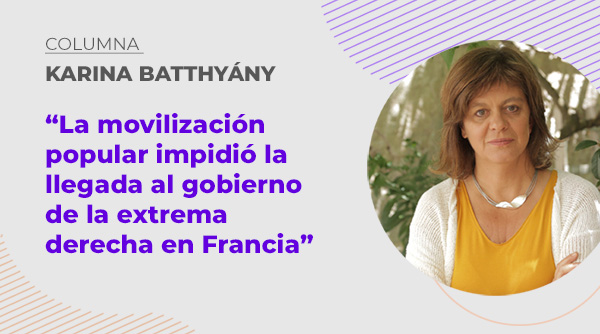
Transcript of Karina Batthyány's column
in InfoCLACSO – July 10, 2024
Today, in this column, we'll be discussing topics related to the latest electoral events in Europe. First, the European Parliament elections held on June 9th, a month ago, which saw gains for the right and far right, especially in countries like Germany, Austria, and France. Then there were the general elections in the United Kingdom and France.
In the United Kingdom, the elections on Thursday, July 4th, saw a crushing defeat for the Conservative Party, which plummeted from 365 seats to 121. This marked the return to power after 14 years for the Labour Party, which secured 412 seats compared to the 203 it held before the election. This result in the UK is clearly very significant, as it reflects a stagnant economy, a crisis in public services such as healthcare and education, and Brexit—that is, the promises made in the Brexit process that have shaped this shift in direction, according to leading analysts of the UK election results.
Immediately afterward, in France, where President Emmanuel Macron had dissolved Parliament on the night of his defeat in the European elections, everything seemed to point to the far-right, led by Marine Le Pen, coming to power. In the first round on Sunday, June 30, Le Pen was the most voted party with a third of the vote, or 33%, and had good prospects of obtaining an absolute majority of 289 seats in the second round on July 7. So much so, in fact, that, anticipating victory, the National Rally had already designated a presumed prime minister, Jordan Bardella, to take office on Monday, July 8.
Today, the results are clear, and while no group (of all those competing in these legislative elections) obtained an absolute majority in the formation of the French Parliament, the New Popular Front, made up of three left-wing forces plus the Green Party, prevailed with 182 seats (the largest minority), 32 more than in the 2022 elections. Together, the party of President Emmanuel Macron, lost more than 80 deputies but still surprised by placing second with 168 seats in the French Parliament.
Finally, the far-right National Rally of Marine Le Pen—joined by right-wing allies—came in third with 143 elected representatives. It's worth remembering that Jean-Marie Le Pen, Marine Le Pen's father and the current leader of the French far right, founded the National Front in 1972, with a platform that emphasized a return to "traditional" French values and hatred of foreigners, as well as openly advocating Nazism. This is the origin of the current National Rally.
Furthermore, it's worth noting that of the 577 elected members of Parliament, 369 are men and 208 are women. There we see, once again, that gender gap in political representation.
As a first conclusion, within the framework of current analyses, it is important to highlight the social and political mobilization that occurred in France as soon as the results of the European elections were known, and especially after the first round on June 30, when society glimpsed the real threat of a potential far-right government in the country. Political parties of the so-called republican spectrum, trade unions, social movements, artists, and athletes mobilized and warned against the risk of a xenophobic and racist government that would restrict freedoms and erode social gains and acquired rights. This massive social mobilization, the unity of the left, and the decision by progressive, centrist, and center-right forces to join forces in more than 200 constituencies acted as a bulwark against the candidates of the National Rally. Furthermore, the record turnout of two-thirds of the eligible voting population (67% of the electorate) must be considered, in a country where voting is not compulsory. These elements may explain the “relative” failure of the far right and the rejection of the presence of numerous nostalgics of the Nazi and fascist eras in its ranks.
We say “relative failure” because they occupy almost a third of the French Parliament, and despite the disappointment expressed last Sunday night by their leaders, the far right improved its position within Parliament with 50 additional seats compared to 2022 (it had only 7 in 2017). So much so that they are already working towards the 2027 presidential elections, which Marine Le Pen, after several setbacks, believes will be the year of her electoral victory.
Let us remember that in the United Kingdom, the far-right Reform UK party obtained 14% of the votes, a much lower percentage than in other European countries but which nevertheless allowed it to enter the House of Commons for the first time, occupying four seats.
Therein lies an element that prompts us at CLACSO, in terms of Platforms for Social Dialogue, to question the perception of disillusionment with so-called traditional parties. This disillusionment is leading generations of young people, and even sectors of the working class, to place their trust in the reactionary and nationalist messages of far-right parties (the governments in Italy, the Netherlands, and Hungary), as is also happening in Latin America with recent cases such as Argentina, Ecuador, and El Salvador, among others. This is a point that requires further analysis: what is happening in terms of trust in and perception of traditional party mechanisms for expressing our politics, particularly among younger people and the working class?
As a counterweight, we have expressions of progressivism that are consolidating in the Latin American and Caribbean region, countries like Mexico, the strong leadership that Brazil is representing with the presidency of Lula Da Silva, Colombia with Gustavo Petro, Guatemala, Honduras, and the expectation of victory of the Broad Front in Uruguay in October.
The rise of the far right in various parts of the world challenges progressive forces not only to build a bulwark against its advance, but also to construct genuine alternatives to the dominant neoliberalism that produces inequalities of all kinds. We must work with the tools of democracy to advance these popular and progressive movements, which propose alternatives based on democracy and respect for human rights, as well as the creation of policies that allow for greater equality for everyone.
Ultimately, that is the commitment we also make at CLACSO, articulating, from academia, knowledge with social movements and organizations, as well as those involved in public policy decisions, to try to generate those transformative policies that are increasingly necessary in our region and in Europe, but also everywhere worldwide.
-We see a rise in brutal inequalities under some of these far-right governments, as well as a rollback of rights. I'm thinking about the many women's movements and the struggles of feminism, which have been very powerful and transformative in the context of new legislation on crucial issues that were previously being ignored, such as care work, sexual and reproductive health, and abortion. How do you see these issues in the context of the rise of far-right sectors?
We already know what happens when these far-right sectors advance… The result is the erosion of rights, the setback of those agendas that took so long to build; that is, these are not theoretical agendas but practical agendas that have consequences for people's daily lives. Regarding the gender agenda, these are concrete consequences for the lives and bodies of women in our region. We see it in some countries, in Argentina with what happened with the Ministry of Equality, with the programs for addressing and combating gender-based violence. We also saw it in El Salvador. We observe how these things always happen when these conservative and far-right forces triumph. Because, ultimately, what is at stake here are two models of society and two models of understanding how we should function as a society, what priorities we should place at the center of our analysis. And clearly, the gender agenda and the feminist agenda also have the distinction of being the main and common enemy of all these right-wing forces.
If you would like to receive more information about CLACSO's training programs:
[widget id=”custom_html-57″]
to our email lists.

