
Memory in times of pandemic
Valeria Vegh Weis1
The March 24th marches in Plaza de Mayo have been a constant in the recent history of Argentine democracy. Neither the state of siege, nor repression, nor stigmatization or accusations of being "crazy" or "guerrillas" managed to stop the Mothers, the Grandmothers, and their families. They continued demanding memory, truth, and justice, every day, and especially every March 24th. They did so when the military dictatorship was in power, and they continued to do so in democracy, even when they were accompanied by only a few thousand people. It was only in 1996, twenty years after the coup, that the organizations formed the Meeting for Memory, Truth, and Justice, and the marches acquired the massive character that defines them today.
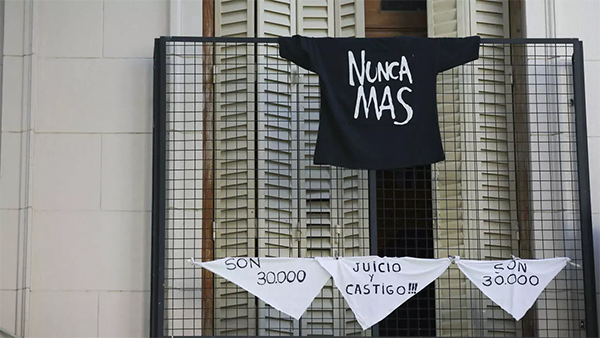
This history of intransigence found its first break on March 24, 2020, when, for the first time in 44 years and in the context of the coronavirus pandemic, the Plaza de Mayo remained silent. It wasn't fear—that has never stopped human rights organizations—but solidarity. In its statement, the MVJ Meeting expressed:
LThe decision not to mobilize on March 24th, as we have done for so many years, is truly shocking, but we understand that Caring for the population requires solidarity-based responses to contribute to the prevention and health of our people".[1]
The Mothers, Grandmothers, and their families took caregiving duties, so deeply marked by gender roles, to the extreme: they not only washed, cooked, and raised their children, but also extended their caregiving responsibilities into the public sphere, where they went out to try to continue protecting them through a collective cry. Today, caregiving duties call us to stay home, and the Mothers and Grandmothers of all care for us as an extension of those 30.000 disappeared detainees.
Such is the historical and emotional importance of this care that, to justify the impossibility of marching, state representatives sought to rely on the declarations of the MVJ Gathering. These organizations then acted as a moral authority even superior to the prohibition decreed by the public administration. Thus, the Ministry of Justice insisted that we should all remember from our homes under the rallying cry: “Let’s do it because they say so.” Horacio Pietragalla, current Secretary of Human Rights and a grandson recovered by the Grandmothers, expressed it with these words: Mothers, grandmothers, and relatives say we have to stay in our homes and remember the 30.000 like this.".[2]
Thus, on March 24, 2020, even in the midst of a surreal pandemic, there were no confrontations, nor did it imply forgetting. On the contrary, it demonstrated the creativity and vitality of organizations in multiplying ways to remember and continue doing justice. In the words of the MVJ Encounter:We can't go to the PWe have a way to avoid contagion, but we want the firm hope in the [unclear] to spread. Nham Mace".
It was then that the paradox arose that the same word that made the struggle possible within the framework of the most dramatic state terrorism, is the one that today allowed the message of 'Never again' to remain present even in the midst of a pandemic: the networks. The NETWORK Since the 70s, it has made it possible for the individual and futile struggle to become a collective struggle that would sweep the world. They are not Estela or Hebe or Tati or Norita; they are not just a mother or a grandmother; they have not been, nor are they now, isolated individuals. They are Mothers, Grandmothers, and Family Members with a capital M; they have been successful in forming “organisms,” and this implies that they are a group, possessing a necessarily collective nature that takes shape from the network, from a union that expands and sustains those who constitute it and all others. Today, another type of NETWORKThe internet allowed them to maintain a constant presence despite the universal and mandatory isolation. networks (and the balconies) were filled with handkerchiefs through the “Pañuelazo” (Handkerchief Protest) in response to the invitation from organizations to share relevant images with the hashtags #PañuelosConMemoria, #24M, #44AñosDelGolpe, #Son30000 and #MemoriaVerdadYJusticia. networks Tears filled the air as those on the other side of the monitors watched the premiere of the film "All My Sons," produced by the Mothers of Plaza de Mayo Association (2020), for free. networks They were filled with previously forbidden information when the Grandmothers, CELS and Memoria Abierta launched the website Desclasificados.org.arwhere you can access secret files on state terrorism declassified by the United States. networks They were filled with images and videos following the call from Espacio Memoria to hold a "projector-a-thon" with projections on windows, terraces, and balconies, later shared online. networks The internet was filled with voices in response to the Museum of Memory's call for a massive virtual "shout" using the hashtag #ConLaMemoriaDespierta (With Memory Awaken). While the web is undoubtedly a tool for remembrance, it can also be isolating. Its effective use on March 24th is possible because it builds upon more than four decades of occupying public space, constructing international solidarity networks, accessing international and local courts in pursuit of justice, and many other structural changes.
At 7:30 p.m. on March 24, a webcast was held in which the organizations of the MVJ Meeting read their now-traditional joint statement. After four years of confrontation with the government in power, this time they find an administration sympathetic to their demands. However, the organizations continued to raise their demands with the Judiciary to give "greater speed"to the trials and "end privilege” of the soldiers detained in “the VIP prison of Campo de Mayo”; to the Legislative Branch to discuss “the legal tools that allow for that acceleration"and to the State as a whole to investigate corporate responsibility during the dictatorship."
But perhaps the most interesting thing is to observe how the manifesto and the networks They make it clear that the historical struggle is not stagnating, but rather becoming even more vibrant with the incorporation of new demands. The scarves that flooded social mediaThey say Never Again but they also demand rights, they say Not One Less, they say shelter, land, work".[3] The manifesto of the organizations feeds off that force and warns about “political prisoners or prisoners for fighting for their rights, such as Milagro Sala and Luis D'Elía.”, asks “that the anti-terrorism laws be repealed… and the repressive apparatus be dismantled"and repudiates the external debt because of"illegitimate, fraudulent, unpayable and odiousTheir demands even extend to the current pandemic situation from a social justice perspective, demanding “mass testing for early detection of the virus"and repudiating"militaristic pressure and any attempt to declare a state of siege".
Caregiving tasks inside and outside the home, networks as a strategy –always– and an atypical March 24th in which the pandemic was not an obstacle to continue sustaining the persistence of the struggle.
1- Argentine-German criminologist, criminal lawyer and university professor. Member of the CLACSO Working Group on Collective Memories and Practices of Resistance.
[1] https://www.pagina12.com.ar/252796-suspendieron-la-marcha-del-24-de-marzo-por-el-coronavirus
[2] https://www.lanacion.com.ar/politica/el-coronavirus-obligo-primera-vez-historia-se-nid2346496
[3] https://www.pagina12.com.ar/255106-la-vida-en-el-centro
If you would like to receive more information about CLACSO's training programs:
[widget id=”custom_html-57″]
to our email lists.

