
Educational localization from the commons: a response from the Global South to the pandemic
Henry Renna[1]
In various locations, organized communities demonstrated actions and commitments to ensure educational continuity during the COVID-19 school closures. Many of these communities, drawing on their own resources, technologies, and local culture, fostered socio-educational interactions that shaped an alternative education and school model. Alongside the debate focused on the 'digital divide' and the role of the private sector, a different practical and theoretical approach is proposed: educational localization from the commons as a response from the Global South to the pandemic. The following section offers a brief overview of systematized experiences in Venezuela and reflections from Latin American teachers who discussed their development.
Mapping one's own learning
Similar to the post-World War II scenario, humanity faces an epochal dilemma regarding its educational future: on one hand, utilitarian and instrumental views that reduce education to a means for post-war economic recovery—in this case, post-pandemic—and on the other hand, a humanist approach to education as a public and common good to rebuild humanity on a battered and divided planet. In this second option, far from the public eye, local actors in Latin America and the Caribbean are implementing, here and now, from their own unique perspectives and time, an alternative form of education.
The first rays of the sun appear and in Nueva Esparta The sound of bicycles and motorcycles can be heard as teachers travel across the territory to reach areas without internet access. At the same time, in SucreThe people's power supports the teachers and they begin delivering, like a territorial mail service, the assignments to the homes furthest from the school. Amazon Indigenous leaders and teachers are seen traveling through communities with their catumare (traditional carts) carrying notebooks and school supplies. Anzoátegui Educators from the village can be seen walking door to door with their community mapires, delivering books, and in Delta amacuro They come and go, even in canoes, notebooks and books that are lent, checked and returned.
Starting the day in Yaracuy The doors of a self-managed room with internet and computers open for students who do not have access, simultaneously in carabobo y Lara Productive backyards are activated, and the "All Hands to Home and Gardening" program is launched. Zulia The scientific workshops are inaugurated, where teachers and students create solutions using everyday materials to prevent the pandemic. At the same time in Miranda Teachers and families open community libraries alongside the Community Councils; in the distance, a voice can be heard—it's the educational public address system announcing daily activities and assignments, and it's also heard loudly in Monagas the sound of the educational megaphone.
Lunchtime arrives and Aragua the school newspaper is received and in carabobo The bicentennial collection. Lunch is finished and messages arrive; it's the socio-emotional chat forum. Yaracuy and the school paella in the guayra, WhatsApp groups where families communicate and organize themselves, and then a text message in Mérida with key information from the Every Family a School Plan.
Suddenly there is a knock at the door; it's the Cooks of the Homeland with the food.
Again, the door; it's the house-to-house visits by teachers in Apure y SucreThe radio is turned on and the school radio programs are listened to. TáchiraThe signal changes and the programs are created by teachers and families in TrujilloAnd then programs created by students come out in Barinas.
Outside the house on the corner, the educational flip charts can be seen. Capital District, the weekly in Aragua, the communal flip chart in Falcón, the billboards of Trujillo, that report on learning projects. In another corner, a mailbox, but not for letters, rather a pedagogical mailbox that receives student work in Bolívar or the plains mailbox that receives them in Barinas And, in the park in the background, a group of boys and girls participating in the outdoor reading program. GuáricoNoises are being heard at a school; they say it's a portfolio festival. Cojedes where knowledge and experiences are exchanged, and in another room in Zulia Teachers develop their logs to investigate their experiences.
It's late, teachers turn on their Canaima laptops, which were locally improved in Mérida, They enter to complete some training sessions in the Mochima Virtual Classroom created with free software in Bolívar y Guarico. At night in Capital District They receive a letter, called the pedagogical letter, which communicates reflections and key themes for intergenerational learning…
Mapping of localized experiences
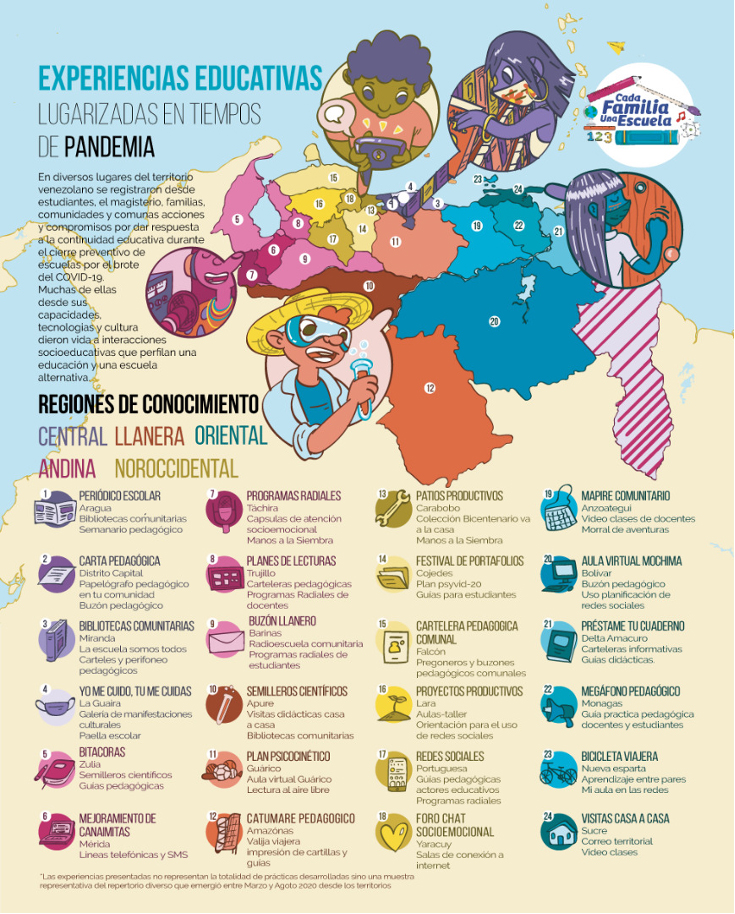
Source: Orinoco-Magdalena Popular Knowledge Node and Utopix
What lies beyond—or within—technological access?
Experiences in Venezuelan territory reveal a practical and theoretical shift away from the debate and policies focused on the lack of connectivity and the gaps in access to technological devices. In the words of Jiovanni Samanamud, Bolivian epistemologist and educator “these experiences, despite the quarantine, give rise to a regionalized and diversified curriculum construction and new ways of speaking, reading and thinking about reality, which They recover everyday experience as a source of knowledge and social production of knowledge".
Indeed, while the dominant thinking established the idea that the only tool available to ensure the continuity of the teaching and learning process and maintain connections in the face of school closures due to COVID-19 is the internet and a technological device, the thinker states that “The creation of teaching methods from its own temporality has found learning modalities relevant to each territory"unprecedented spaces for experimentation based on the same resources and cultural foundations of the teachers."
Apparently, the key lies not only in the exchange value of the platforms, but in their use value. The cases demonstrated this, according to a report that systematizes them (Place-based education from the commons, 2020), "that The decisive factor in the process of distance learning lies not so much in the tool but in the craftsman./to the one who handles it: in the teachers"In the creative and innovative capacities of teachers and territorial subjects to use the various existing technologies in an innovative way to share what is common in solidarity."
It is undoubtedly imperative that governments guarantee the democratization of learning, information, and communication technologies, and a fundamental principle of the 21st century is that all students, without discrimination, especially those from low-income communities and rural areas, have the opportunities and conditions to access and enjoy them free of charge, openly, and safely. But something else is happening. Alongside this, collective and cooperative approaches to self-directed education are emerging from community networks and the ways of being and existing in/from these territories: Educational localization from the commons as a response from the South to the pandemic.
Pedagogical experimentation in/from the territory
Thus we find traces of an emerging culture and subject under construction, which is prefiguring other ways of learning and educating in space, from practical knowledge, from its own language, historically and socially situated.
The educators, I would say Lenin Romero, The director of research and teacher training for the teaching profession, “who promoted the experiences, have decided to value the learning process experienced, and are proposing new alternatives to reinvent themselves, giving the pedagogical experience a diversity of epistemic meanings.” In his words,From ordinary people, from the real world, an alternative anchored in the community was drawn"An education in motion based on a school-territory."
This effort continues the work proposed by the Venezuelan educator Carlos Lanz in his various publications: the idea of a free, open, borderless classroom, the perspective of Educators who remove the fence from the school and have integrated it into community practiceThey have made it a center of communal activity, the base and articulating node of an open-air workshop-community.
The different cases, when we intertwine and weave them into a common project, give life to a geography of freely accessible educational and cultural resources, outlining the body of a pedagogical neighborhood as an ecology of knowledge, an educational commune, in short, in the words of the Latin American teacher Simón Rodríguez, give birth to a true educational “toparchy”.
The emergence of the public-communal
The debate focused exclusively on the digital divide, whether intended or not, can lead to individualistic and privatizing responses from institutions that weaken the public sector, reduce the sovereignty of states, and increase the dependence of peoples.
The Argentine educator points out Maria Rosa Goldar From the Council of Popular Education for Latin America and the Caribbean, “the narratives reveal a plurality and versatility of formats whose central aim is to reposition the school at the center of everyday life.” It is from there, from popular education, continues the professor from the National University of Cuyo, that we canTo refute the neoliberal attacks that use isolation and virtuality as an excuse to fracture the social fabric and the link between schools, families, and community".
These practices and many others undertaken by territorial actors provide an educational alternative that involves an expansion of the public sphere in a communal key, from a cross between schools with community centers, between official knowledge and local knowledge, between teachers, students and popular power, between education and life.
The rector of the Samuel Robinson Experimental University of Teacher Training would say Belkis Bigott “A social movement to protect the right to education has emerged, and a shared responsibility for education has been understood, which has strengthened public education.” The Venezuelan doctor points out, “The pandemic made it clear that One of the ways to ensure educational continuity in times of pandemic is by deepening the communalization of education".
Along these lines, he states Juan GonzálezAn academic from the University of Chile stated that “the pandemic is putting pressure on the education system, opening the door to educational privatization and commodification at a global level.” However, despite all these maneuvers, there are communities like those in Venezuela, the OPECH researcher points out, thatThey have found in community an alternative to strengthen the public sector., from a non-state, but social, inventiveness, driven by popular protagonism that connects the school with the needs and capabilities of the community.”
I would also point out Hernán OuviñaA professor at the University of Buenos Aires, Argentina, says, “These cases demonstrate a pedagogical reinvention aimed at building shared will, a creativity that breaks with the imitative culture of the modern school.” They are formal and grassroots educators who have taken on the task of “thinking for themselves, with their feet firmly planted and their hearts beating, and building solutions from the ground up.” The author of Zapatismo for Beginners believes that “the inventing or making mistakes observed in the actions of these emerging individuals shows an effort to make popular education more public, and public education more popular".
Although the risks of the pandemic to the future of public education systems and schools are clear and evident, We dare to think and act from our own place, from the common ground, in order to open those windows of opportunity to build something different, a viable, unprecedented idea, as Paulo Freire would say, that transforms what we know to date.
[1] Researcher, CLACSO Working Group on States in Dispute.
If you would like to receive more information about CLACSO's training programs:
[widget id=”custom_html-57″]
to our email lists.

