
Insurgency is what leads women to transcendence
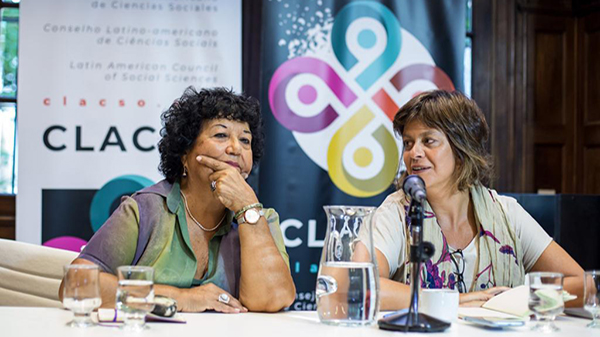

Within the framework of “Women’s Month”, on Wednesday, March 4, the Latin American Council of Social Sciences organized a Training Day on “Gender, Feminisms and Diversities” for workers of the Executive Secretariat in Buenos Aires.

Opening the meeting, CLACSO Executive Secretary Karina Batthyány stated that “during Women's Month, we want to conceptually address gender issues in our daily work at CLACSO.” She then introduced the Argentine sociologist, historian, researcher, and feminist Dora Barrancos.
Starting from the concept that “going to the past is also committing ourselves to a historical transition so that democratic states defend women's rights,” Dora Barrancos, who currently serves as a presidential advisor in her country, reviewed the history of patriarchy from the dawn of the human species to the present day and concluded: “Insurgency is what leads women to transcendence.”

Then, in her presentation that closed the first morning session, Karina Batthyány delved deeper into the topic of care work and the sexual division of labor, which “is a mechanism that generates inequality.” She illustrated this point: “In time-use surveys across all countries, women dedicate approximately two-thirds of their time to unpaid work, while men dedicate the opposite, one-third.”
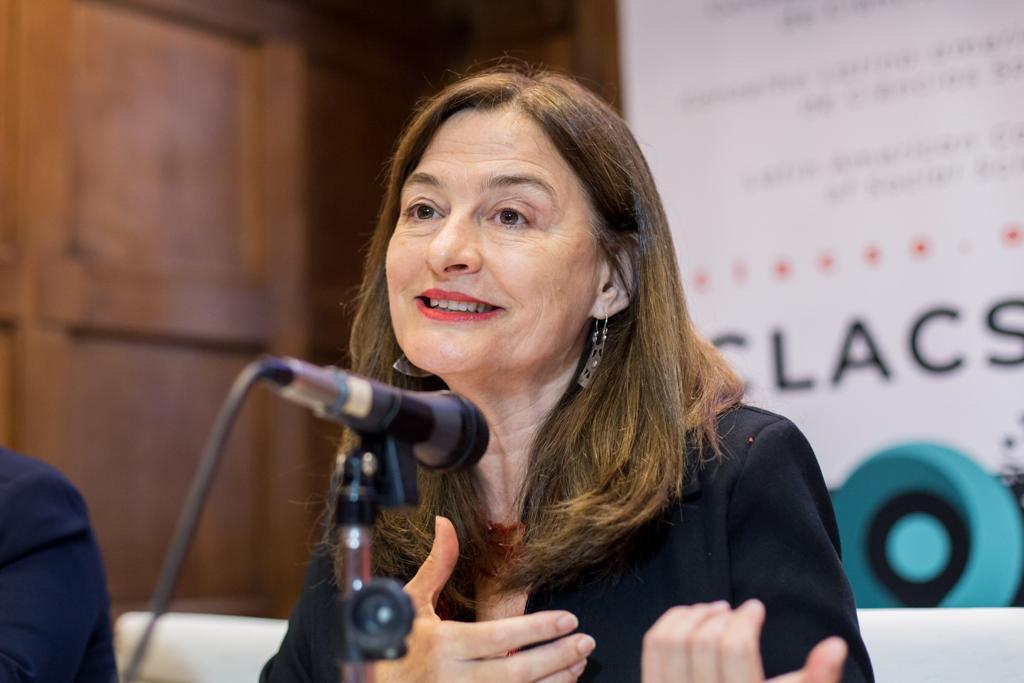
Estela Díaz, Minister of Women, Gender Policies, and Sexual Diversity of the Province of Buenos Aires, focused her remarks on "the issue of work as the central core of gender inequality." She asserted that "as an administration, we think in terms of technical expertise... Together with social and feminist movements, we need to dismantle the patriarchal structures of the State."

In turn, Cecilia Merchan, Argentina's Secretary of Equality and Diversity Policies, stated that "a feminist state must also be driven by a transformative desire." "From our ministry, we want to build state policy and power in a different way," she affirmed at the close of the first part of the day.

In the afternoon, journalist Mariana Carbajal spoke about the presence of women in the media, both as workers and in news and advertising. In the former, they hold far fewer leadership positions than men; in the latter, they tend to be objectified and/or associated with caregiving roles. She argued that “the presence of women in the media must be linked to democratic representation. We need to reconfigure our agenda by incorporating female voices.” She added, “In advertising, you can no longer produce just anything: there is a sector of society that, through social media, sets the media agenda.”

The training concluded with presentations from representatives of the CLACSO Working Groups on Feminisms and Gender Policies: Natalia Quiroga Díaz from the Working Group on Emancipatory Feminist Economics; and Andrea Daverio and Nora Goren from the Working Group on Gender, (In)equalities, and Rights in Tension. They proposed working in committees and a general debate based on two starting points: proposals for addressing the sexual division of labor; and aspects to consider when developing feminist public institutions. The contributions of the participants rounded out a fruitful day of training on gender, which is expected to continue with this and other topics.

Photos by Lucía Prieto
DOWNLOAD CLACSO'S "WOMEN'S MONTH" WALLPAPER:
If you would like to receive more information about CLACSO's training programs:
[widget id=”custom_html-57″]
to our email lists.

