
“Gender equality is a matter of power, a matter that challenges the established powers.”
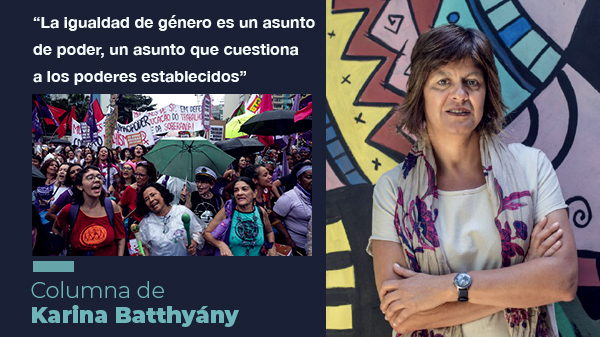
(Transcription of Karina Batthyány's Column)
in InfoCLACSO – 7 de April 2021)
This March, Women's History Month, we at CLACSO have systematically addressed various issues related to gender inequality. Last Wednesday, we dedicated our time to this discussion with our colleagues on the Steering Committee, highlighting the powerful feminist slogan "The personal is political" and how each of us experiences and puts this slogan into practice.
But there remains one dimension I want to address regarding gender inequalities—and although it's already April, of course, since March isn't just Women's Month for CLACSO, but we work on these issues all year round—I want to raise this final dimension, which has to do with autonomy in decision-making. Following the path we've been exploring regarding economic autonomy, physical autonomy in terms of sexual and reproductive rights and violence, we were missing autonomy in decision-making, which basically refers to women's presence in the various spaces where decisions are made in countries and societies; of course, in the branches of government, but also in the other spheres of power present in all societies: business chambers, unions, the media, universities, and a long list of other areas where women and men participate.
Autonomy in decision-making refers to this, as well as the additional measures that can be taken to promote fuller participation and greater equality. We bring up this topic because this Thursday, a report on this issue will be presented in Argentina, as has been done throughout March in other Latin American countries. The Argentine report is titled, look at this section: “Sex and Power: Who’s in Charge in Argentina?” And just to give you a little tidbit from that study before we move on to our regular column, the data tells us that only 2 out of every 10 decision-making positions in Argentina are held by women. This report was prepared by the Latin American Team for Justice and Gender, with whom CLACSO works, collaborates, and has various activities; for example, Laura Pautassi is part of our specializations.
But let's look at what's happening, first of all, globally. If we examine all the states and governments worldwide, we find only 22 female heads of state and government, and nearly 120 countries where there has never been a woman in the presidency or any equivalent high office. Furthermore, women consistently hold only 25% of the seats in national parliaments and only 36% of elected positions at the local (not national, but subnational) levels.
So, you might ask why this is important. Because we believe that when women are underrepresented in public decision-making, policies don't reflect the needs and priorities of the roughly half the world's population that women make up. And we therefore believe it's necessary to move forward with measures that will accelerate progress on a significant issue: if no decisions are made, if no steps are taken to advance women's participation in decision-making, it will take us another 130 years to achieve anything resembling parity. That's on a global scale.
Now, what's happening in Latin America and the Caribbean? Undoubtedly, our region has implemented some measures to advance this trend toward parity, or to try to achieve it. These are known as quota measures, or more recently, parity measures. And this has allowed women's participation in formal decision-making positions to double, and in some cases, even triple, in some countries over the last two decades, the last 20 years of this century. Today, we have a regional average that doesn't reach a third: for example, 31% of parliamentarians in Latin America and the Caribbean are women; slightly lower at 28% for ministers; and even lower at 15% for mayors. These numbers change because, obviously, there are replacements in all countries, both in ministries and other positions. While there are no replacements in elected offices, this is the reality we have right now in Latin America and the Caribbean. Despite the progress that has been made, despite the affirmative action measures taken in many of our countries, the gaps between men and women in political representation remain very large. To reiterate the figures: in no case do we exceed one-third; that is, barely one in three is a woman. This continues to pose significant challenges for women's participation, and if we consider the broader Women's Collective, we also encounter additional challenges when we think about Afro-descendant women, Indigenous women, and young women.
This reality I'm presenting to you, Gustavo, and which I'm sharing with everyone listening—as I was saying—has to do with the Executive branch, where there has been an increase, but we're still far from parity. It also has its counterpart in the Legislative branch, where perhaps the impact of what are called quota measures or affirmative action has been most noticeable. These measures aim to accelerate the very slow pace of growth in women's representation.
We can say, then, that today in our region we still have an outstanding debt, given that women make up 50% of the population, yet we don't even reach 30% of those in various decision-making positions. I didn't refer to universities and other important social spaces because we've addressed them in other columns. But I wanted to bring this issue up again, because we often forget that gender equality is also a matter of power; it's an issue that challenges established power structures.
Karina was reflecting on the implications of this staggering statistic—more than 100 years of progress toward gender parity at this rate—and how the underrepresentation of women in parliaments and executive positions is clearly exemplified . The Voluntary Interruption of Pregnancy and the difficulty in achieving its legalization in much of Latin America seems a prime example of this problem of underrepresentation…
Absolutely. That's why I was saying why this issue concerns us. It's not simply a matter of numbers, but because when women aren't represented in the places where decisions are made, the issues and priorities that concern us, as women, aren't even raised, or when they are (not necessarily with the example you gave), they're approved. And that's why it's important to bring back to the table the necessary affirmative action measures to advance the 130 years that separate the world from parity. We can take steps in each of our countries to shorten that gap. These affirmative action measures, which we can discuss in another program if you'd like, have been widely debated, and I always like to call them "meanwhile measures." That is, perhaps it would be better if they didn't exist, but while we effectively achieve equality, equity, and the participation of men and women in all areas of society, let's promote these kinds of measures that will help accelerate progress.
If you would like to receive more information about CLACSO's training programs:
[widget id=”custom_html-57″]
to our email lists.

