
“The ideology of the Israeli state allows it to colonize, occupy, and plunder Palestine.”
By Leandro Albani for La tinta
Martín Martinelli is the author of Palestine (and Israel), between intifadas, revolutions and resistance, an in-depth investigation into a conflict that has lasted for decades and in which everything from original identities to geopolitical decisions that mark the international agenda converge.
Palestine (and Israel), Between Intifadas, Revolutions, and Resistance is a book that offers a profound understanding of a global issue that, in just over 20 years, will be a century old. Its author, Martín Martinelli, conducted comprehensive, detailed, and precise research into the histories, characteristics, and developments of the Palestinian and Jewish peoples. But the book doesn't simply present "the facts"; it analyzes primary sources, the ideologies behind the actions, and, above all, places him among the long list of historians, intellectuals, and writers who have documented how, since 1948—with the creation of the State of Israel—a planned and systematic policy has been in place to expel Palestinians from their ancestral lands. To this end, and as is evident daily, the ruling establishment in Tel Aviv—sustained and driven by Zionist ideology—and its formidable military and security forces spare no effort in their methods to achieve the total conquest of historic Palestine.
A Doctor of Social Sciences and Humanities from the National University of Luján (UNLu), and a professor of Contemporary History at the same institution, Martinelli has been quietly but persistently researching and working on the Israeli-Palestinian conflict for years. His book, recently published by UNLu Press, is the result of an effort to explain, disseminate, and contextualize a problem that is far from being resolved.
A particularly noteworthy aspect of the book is its prologue, written by the renowned Israeli intellectual, Ilan Pappe, which emphasizes the urgent need for decolonization in Palestine, but through an initiative "from below" and in the hands of the Palestinians themselves, something that has never happened since the illegal Israeli occupation.
Palestine (and Israel), between intifadas, revolutions and resistance will be presented this Tuesday at 16pm at the University Bookstore of UNLa, in which the author, Alan Rebottaro and Omar Gejo, both geographers and members of the Geohistorical Observatory of the University of Luján, will participate.
In an interview with La tinta , Martinelli reflected on how to approach the Palestinian question from Latin America, and particularly from Argentina. According to the author, one approach "is the development in recent years of international studies, in this case, viewed from the perspective of contemporary history," something that, according to the researcher, "has improved, or rather, led to a proliferation of studies on Palestine in general from Latin America, although it is still not a very extensive field."
From Argentina, Martinelli explained, this situation coincides with “countering the image portrayed by mainstream media of Palestinians and the Arab world in general as terrorists. It's a field that still has a lot of room to grow, since it's not very well known, especially the Palestinian case, because it's a people whose state is not fully consolidated internationally. Living under Israeli oppression makes it much harder for them to spread their ideas.”
The professor also pointed out that “regarding universities, particularly in Argentina, there are indeed groups developing that address the topic, but it is not one of the most extensive fields. There is greater dissemination of information about Palestine in general terms, but it still hasn't reached the general public because a biased view persists.”
Martinelli also analyzed that, when addressing the Palestinian issue, it is necessary to reverse "the Israeli voice, interpretation, and narrative of all events related to the Palestinians. This is often influenced by ideological positions."
Nationalism and resistance
Palestinian nationalism was the spearhead of resistance to the Israeli occupation. Over time, this ideology encountered its own limitations and, politically, devolved into a movement led by figures whose credibility is questionable even within the Palestinian community. According to Martinelli, Palestinian nationalism must be "defined" while simultaneously being "differentiated from the Palestinian National Liberation Movement."
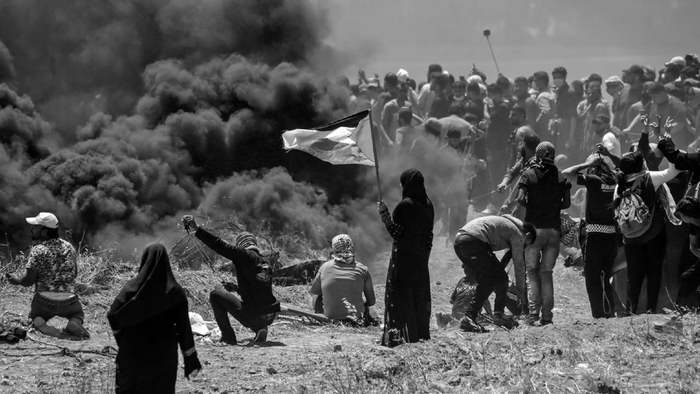
The author explained that “in recent years, political differences have persisted, but there is unity among the people, as seen in 2018 with the Great March of Return, or in 2021 with the strikes and protests that took place simultaneously when Israel advanced on the Jerusalem neighborhood of Sheikh Jarrah, carrying out evictions.” “In one interpretation, Palestinian nationalism offers the people a certain hope of being able to resist the occupation,” he stated.
Accordingly, the author argues that in recent years there have been shifts in the acceptance and understanding of the Palestinian people's struggle for their rights. As an example, he cited organizations such as Human Rights Watch and B'Tselem—the Israeli human rights group—which publicly labeled the Israeli system as apartheid. At the same time, Martinelli noted that, in recent decades, the situation of Palestinians in the territories has also worsened, with the plan to Judaize Jerusalem and the encirclement of the West Bank by the wall since 2002.
“The situation has worsened, but the Palestinian struggle and resistance maintain different forms. That doesn't change the fact that the situation, in that sense, has worsened; that's why one form of resistance is Palestinian nationalism, to try to oppose Israeli oppression,” he summarized.
Zionism and occupation
One of the most interesting chapters of Palestine (and Israel), amidst intifadas, revolutions, and resistance, is the one that addresses Zionism , its origins, its ideological concepts, and how it is instrumentalized to this day not only to justify the occupation of Palestine, but also to silence any critical voice against the Israeli state.
“Like Palestinian nationalism, Zionist ideology has changed over time. What must be emphasized is that it is an ideology that allows for the colonization, occupation, and plundering of Palestinian lands through various legal means,” the author asserted. “This does not imply an inherent attack on the Jewish people,” Martinelli clarified. “What changed between the 19th and 20th centuries is that the concept of the Jewish people became associated with a nationalist or Jewish nationalism.”
Since 2018, the Israeli state has been legally characterized as Jewish, something that entails, according to the UNLa professor, "a structural racism that manifests itself at different levels, such as in education and in the press."
Martinelli, in turn, pointed out how the Israeli government uses historical events to justify its policies. The professor from UNLa indicated that the Jewish people have been persecuted, “suffering in the Shoah during World War II, where 27 million Soviets, some 20 million Chinese, and between 60 and 70 million people in total also died. It was a terrible time for humanity, when atomic bombs were dropped on Hiroshima and Nagasaki. Shifting the focus away from that issue, which still has repercussions and persists in Israel, this follows a different path than what has been happening with respect to the Palestinians for at least 100 years, and which has become more pronounced since the creation of the State of Israel in 1948.”
An identity that endures
“Palestinian identity is not at risk of disappearing,” Martinelli stated. “Their struggle may be persecuted, as it has been throughout these years, but international recognition has grown regarding apartheid and how they are a people who resist incursions and imprisonments every day.”
The identity of the Palestinian people has never ceased to be subjugated, but neither has it been eradicated, even though life in the West Bank and the Gaza Strip worsens with each passing day. To this must be added the "normalization" plan being promoted by the United States and Israel with Arab countries, aimed at gaining their acceptance of the Jewish state and abandoning the defense of the Palestinian cause. Although this military, political, and diplomatic machine is in full swing against the Palestinians, it has so far failed to stop their historic resistance.
Finally, the author addressed the relationship between the Palestinian people and Latin America, where comparing the different conquests by foreign powers is inevitable. “Spatial distance doesn't negate the fact that these processes have been similar, albeit at different times,” Martinelli emphasized. “We have much more in common with peoples like the Palestinians, Iraqis, or Afghans than one might think. The difference may lie in the number of invasions and subjugations suffered by the peoples of the Middle East during the 20th and 21st centuries. In our America, we too experienced the oppressive boot of the United States imposing dictatorships or governments aligned with its policies. We are peoples who should be inclined to understand one another. With the emerging multipolarity of the world, there may be more opportunities for closer ties between these populations.”
Access the full article at: https://latinta.com.ar/2022/11/ideologia-israeli/

