
The great transition
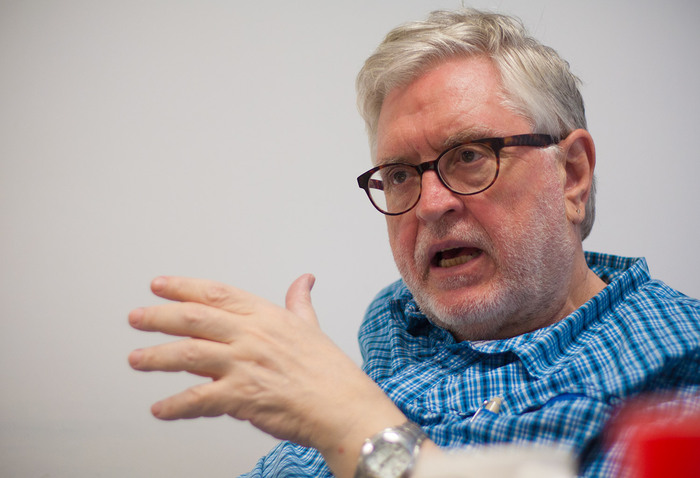
Manolo Monereo's talk and debate
Manolo Monereo's talk, "The Great Transition," was held as part of the Ukraine Dialogues series organized by the Latin American Council of Social Sciences (CLACSO) and the National University of Luján on August 22, 2022. Moderated by Omar Gejo, Martín Martinelli, Gustavo Keegan, Alan Rebottaro, and Luciano Chanique. Transcription by Martín Martinelli (UNLu/Al-Mustafa/CLACSO) and Valentina Taberna (UNLu/OGH).
This discussion took place as part of a virtual broadcast sponsored and hosted by the Geohistorical Observatory of the National University of Luján and the Palestine and Latin America Group of CLACSO (Latin American Council of Social Sciences). During the discussion, Manuel Monereo, a Spanish political analyst and former member of the Spanish Congress of Deputies, commented on the current conflict in Ukraine, placing it within a broader, global process he termed a 'great transition'.
The difficulty we humans face today lies in not having a comprehensive view of what is happening and the underlying trends that explain it. Geopolitics always has two sides: one descriptive and analytical, with pretensions of scientific rigor, and the other more complex and strategic, encompassing knowledge or sets of knowledge related to the political, military, and geopolitical strategies of states. This will always haunt those of us who dedicate ourselves to this strange and somewhat satanic field of knowledge that is geopolitics.
From that critical perspective that one must always maintain in this world, I try to argue that we are living through a period of great geopolitical transition, and within that framework, we must understand what is happening in Ukraine, bearing in mind that it is merely part of a global conflict whose objective is the South China Sea. This is a war that initiates a more serious and profound conflict between the United States and NATO with China.
Similarly, the conflict in Ukraine is a proxy war because the real conflict is between NATO and Russia. That's why I speak of the conflict in Ukraine and not the war between Russia and Ukraine. It's the arena where a political, military, ideological, and cultural battle is being waged between the United States, leading NATO, and Russia. What Ukraine is doing is using the deaths as a political tool for the benefit of a particular Ukrainian political class centered around Zelensky.
The great transition has four fundamental points. The first is the relative decline of US power, which has already been discussed extensively, but it's important to emphasize that this doesn't signify the end or collapse of a power; rather, from a relative perspective, it has less power or no longer has the power it once did. This isn't necessarily good news because the power in question is much more aggressive, and where the United States' power remains intact is in the political-military sphere. There is no other power in the world comparable to the United States: its 800 military bases worldwide, its control over NATO with more than 60% of global spending, and, above all, its capacity and readiness to mount an expedition of one hundred or two hundred thousand troops and deploy them anywhere in the world—only the United States can do that. To this must be added its maritime strategy and its aircraft carrier strength, which guarantees control of the seas. Therefore, that would be the first point.
A second piece of information that helps us understand what's happening is the emergence of China as a major power. It's important to note here—because we tend to have an overly Eurocentric view of the world—that we should speak of a reemergence, a rebirth, because China was the world's leading power at the beginning of the 19th century. To put it plainly, in 1820, China was the world's leading economic power and, as Giovanni Arrighi stated, the world's first market economy. Why it didn't go further remains to be seen, but that's another story. What can be said is that, in two centuries, they have overcome what the Chinese call "the Great Humiliation" (1849-1949), and around 2030 they will be the world's leading economic power in terms of Gross Domestic Product (GDP), although they already are in terms of purchasing power parity. However, this is accompanied by the rebuilding of Russia's power, economically, technologically, and militarily.
There is a third element that tends to be forgotten, but which Latin Americans remember well. We are witnessing the decline of the West, not just the rise of China. Aníbal Quijano said that the day the Spanish arrived in America, they discovered three things: capitalism, modernity, and racism. This decolonial thought, what the Peruvian thinker called the coloniality of power, has shaped Latin American social science and also the relationship between Europeans and Latin America. From this perspective, what is happening is that this power, after 500 years, is returning to Asia, shifting from West to East.
Not only is China emerging, but India is too, and it will soon become the world's leading demographic power with enormous economic growth. I also include Indonesia, with its approximately 170 million inhabitants, the world's largest Muslim-majority country. The former countries on the Indochinese Peninsula must also be considered: Vietnam, Cambodia, and Laos, as well as two countries that, along with Europe, are US military protectorates: Japan, home to nearly 100 US bases with 50.000 personnel, and South Korea, the world's eleventh largest economy.
To this world we must add AUKUS, the agreement between Australia, the United Kingdom, and the United States. The Europeans were not included in this group, and this did not sit well with the French, who have long-standing strategic interests in the region now called the Indo-Pacific. This is where forces preparing to contain China, in George Kennan's terms, will intervene. These forces are united around AUKUS and include New Zealand, Japan, and South Korea, but countries like India and Indonesia are also emerging that will quickly become non-aligned because they will seek to gain their own advantage.
In this context, the decline of the West is taking place, and for the first time, a world not controlled by its culture and tradition is emerging. Latin America must question its Western identity: what kind of West are they?
There is a fourth point, which is the worsening of the socio-ecological crisis. This is real, and if we incorporate it into geopolitical analyses, it means that the entire issue of resources becomes a strategic military objective and poses a very serious problem for these countries, especially for NATO, in terms of migration, due to the fear surrounding this phenomenon, particularly when it involves African migrants. This underscores the importance of understanding, for example, that in 30 or 40 years, a single country like Nigeria will have around 400 million inhabitants, the same population as Europe today. We must grasp the magnitude of the problems we are facing.
In conclusion, if we are in the midst of a major geopolitical transition, moving from a unipolar to a multipolar world, it signifies a global redistribution of power. This is where what Allison calls the "Thucydides Trap" comes into play, and the crucial question arises: Will the United States peacefully accept the loss of global power that this transition will entail, or will it use all its power to prevent it? We are facing an epistemic divide between nuclear winter and climate hell, which, in some ways, intersect, reinforce each other, and exacerbate all the problems that ultimately end up being resolved in political-military terms—through war.
Understanding this scenario, one can observe that Ukraine reflects the fundamental contradictions of European and global geopolitics. In this regard, a careful reading of Brzezinski's "The Grand Chessboard" reveals that its author, writing in 1997, presents a map showing that the axis of European power security comprises France, Germany, Poland, and Ukraine, but that the latter was grappling, for better or for worse, with a conflict with Russia. His foresight was remarkable; those of us who read his work closely realized that Ukraine was going to be the major problem.
Martín Martinelli: How do you view Argentina and Iran's intention to join BRICS, as well as China's approval? How would these additions influence this major transition?
Monereo: The key isn't so much Argentina's entry, although that's magnificent, but rather Lula winning the next elections. In any case, Bolsonaro's role in relation to Russia and China needs to be qualified, but since the left's departure through the coup against Dilma Rousseff, the BRICS have lost influence because Brazil always held the balance. Today, with talk of a second left-wing election in Latin America, Argentina's economic problems and its relationship with the IMF, Boric's presence in Chile, and the entire scenario reveal a world that needs a turning point, and that point is Brazil.
There is no doubt that the moment Lula wins, a strategic alliance with China and Russia will form at his core. This is of such great interest to Brazil that even Bolsonaro has not clearly addressed it. There is an almost inevitable tendency for Brazil to emerge as a leading international political force, which will strengthen the BRICS and, on the other hand, help clarify matters in Latin America.
Brzezinski said that the real danger facing the United States was an alliance between China, Russia, and Iran. I believe that's what's coming. Iran has done a remarkable job containing Israel, surviving for 20 years, and it has achieved this with economic and financial support from Russia and China. This world is changing rapidly, and it's so powerful that it can be seen in the role of Turkey, which is key and is active in all areas simultaneously: it's critical of the United States, it approves the entry of Finland and Sweden but imposes very onerous conditions, and on the other hand, it's re-establishing relations with Israel. It's everywhere, trying to gain leverage to increase its influence. This is happening because a new global power center is crystallizing around the Shanghai Cooperation Organisation and the strategic alliance that was fostered by Pelosi.
Luciano Chanique: This policy change that the United States is making, waging proxy wars without directly intervening, is it due to something they are reserving for direct confrontation in a specific place, or is it a new trend within this transition?
Monereo: I've always emphasized the difference between Trump and Biden, but they're not the same. I think there's a connection between the crisis in the United States as a country and its foreign policy. What's happening now, the persecution of a former president like Donald Trump, who never really won anyone over, is about preventing him from returning to power. A division has emerged among the ruling classes through these two politicians who represent conflicting interests, which are related to both foreign and domestic policy. What many Americans are saying, and I agree, is that the United States is experiencing a crisis of armed civil war and that it's their political system that's in crisis. That explains things like what we saw at the Capitol, but it goes deeper because when they say that one-third of Americans are willing to take up arms against their government, if a Spaniard or an Argentinian said that, it wouldn't be serious, but when they say it, they're all armed. In other words, the possibility of a civil-military conflict is more than just a warning from the ruling classes or the American press.
On the other hand, there's the relationship with international politics. I'm referring to Biden's null victory and, above all, to the group associated with Hillary Clinton and the very powerful Israeli lobby. Bearing this in mind, we observe this idea that they perceive the world situation as dramatic, and there's something that isn't always properly examined: the "time" factor. The CIA produces dozens of reports, and behind these reports are academics, not just intelligence agents. Reading CIA reports, you see how this situation we're discussing has been predicted for years. Americans always, sooner or later, say what they think and argue that they are in a situation where, if they continue down this path, they will lose global hegemony, and this implies losing their way of life, their approach to international relations, the economic system based on the dollar, and the financial system. Without these, the United States is a weak power that can no longer be the sole global superpower.
The manifest destiny of an indispensable power rests on these elements of power. How does a member of the elite see it? With concern. Then the aforementioned "time" factor emerges: if the situation isn't reversed within seven or eight years, hegemony will be lost. They know they must get ahead of the curve and go on the offensive, so they've relaunched a campaign to regain hegemony, to crush and eliminate the countries that could overshadow them, especially China and, consequently, Russia.
Russia is like Noah's Ark: everything they have in abundance, including biodiversity, is lacking in the rest of the world. This is clearly seen in the conflict with Ukraine: the West's dependence on Russia is greater than Russia's dependence on the West. The world is showing Biden that things are no longer as they were before because the strategy and alliance between Russia, China, and Iran is very powerful, as the world is fundamentally changing. A world is emerging in which many countries, while potentially non-aligned, will be decisive.
In this context, what we are witnessing is the fierce response of a great power that feels challenged and threatened, and that is willing to play a dangerous game under a very risky assumption: that others will not have the courage to use nuclear weapons while they can use their military dominance without fear of a nuclear response from others. It is a very difficult game.
Gustavo Keegan: When the war in Ukraine is discussed, China is either relegated to a secondary role or not mentioned at all. You mention that this is a much more organized US strategy to oppose China, with Ukraine serving as a buffer.
Monereo: On February 4th of this year, there was a very important meeting between China and Russia, from which a document emerged that clearly outlined the kind of future world that unites these two countries. I don't know if what would happen 20 days later in Ukraine was discussed, but it's obvious that something must have been said. The forces preparing a new international order are doing so knowing who the enemy will be and who they have to defeat.
I believe the United States, as we can see from its own documents, bases its entire strategy for defeating China on a two-pronged approach: provoking regime change while simultaneously containing and provoking. It's no coincidence that the same tactics are being followed in Taiwan as in Ukraine: cornering, drawing others into the Taiwan issue, and forcing a response.
We must distinguish between a strategic aggressor and an operational aggressor; I believe the United States is the former, and it already succeeded with Japan at Pearl Harbor: it's about provoking your enemy in such a way as to force a response, but if a provocation occurs, it's because the balance of power favors the US. The United States has sufficient power to lay siege and then transform the conflict into a defensive war in pursuit of supposed world peace against the enemy aggressor. This strategy was decisive in the 40s and is still so today, but much more powerful now because the media has such a strong hold on public opinion.
The strategy is to prevent China from becoming a decisive player in the Pacific, because that's where American power is defined. In this sense, the wars Biden is orchestrating aim to bring about regime change in Russia and China. This is written in a document called "The Long Telegram," which contains an analysis similar to ours and warns that now is the time to rein in, contain, and harass China.
Luciano Chanique: How do you see the European situation in this scenario?
Monereo: The major problem this crisis has brought is that the European Union has become NATO's political arm, losing its decision-making capacity independent of NATO and the United States. In fact, its alignment with the United States is contributing to an economic crisis. The big problem for European elites is their inability to develop an analysis and policy independent of the United States: Europe's security will always be linked to Russia, and thinking that annihilating Russia will solve the problem demonstrates a complete lack of understanding of the situation. This will pose a problem for the European Union and its governments when winter arrives and inflation, recession, and unemployment set in.
What happens in Italy will be key because Germany's weakness, Macron's weakness, is evident. For now, what Europe has done is foster a crisis that will end in a debt crisis and, consequently, in a political crisis that will call into question Europe itself and its future because the Franco-German axis is no longer the leading force of the United States, and political leadership now lies in Eastern Europe. The old new Europe, the true one, the reactionary one, the anti-communist one. The other periphery of Europe is the one that will emerge victorious.
The problem is easy to explain. For the left, for Latin America, a multipolar world is better. The only real imperialism is the collective triad that Samir Amin spoke of: the one that dictates the world's destiny, against which the others rebel. Each does so for different reasons, but this world gives the left the opportunity to regroup, something that wouldn't happen in a unipolar world.
What remains of the European left? What remains of national liberation movements? The only place in the world where the fight against neoliberalism continues is in Latin America. There are no prospects for a genuine left-wing struggle outside of there. The left needs a world that allows it to breathe and reorganize, and that will only happen in a multipolar world, but it will come at the cost of wars, as has always been the case. What the left must do is take note, bet on the end of the unipolar world, and gain state and political positions, bringing to the forefront something that was once important: internationalism. That is what this stage requires. Valuing popular sovereignty, national independence, self-reliant economies, and mechanisms for regional integration. All of this is in the document between Putin and Xi Jinping.
If we are able to generate a pacifist and anti-imperialist movement that unites nations and peoples, we can ensure that the end of American hegemony is not the end of humanity as we knew it.
Omar Gejo: We know what creative destruction means for capitalism. In its almost positive version, it's the idealist one, but in the realistic one, wars are the creative destruction of capitalism. The postwar order is nothing other than the order that emerged after the creative destruction of that imperialist war. Marxists, or the left, also have their own creative destruction, which isn't wars but revolutions, and Lenin was a thinker who synthesized this to define the imperialist era: an era of wars and revolutions. For many decades, the Western left abandoned the possibility or perspective of revolution as creative destruction. Can this change?
Monereo: In Marxist theory, crisis inevitably signifies two things: the devaluation of capital and the restructuring of the working class. The former is nothing more than the destruction of factories, of constant capital, of accumulated labor. But from this perspective, every economic crisis is a creative destruction.
Another thing entirely is the creative destruction organized by those in power. It's being orchestrated from within the government: the reset that Davos so aptly represents with its disruptive new technologies that destroy the existing productive landscape and create a new one. Capitalism is planning this destruction because it understands that society must be changed by altering the technologies and the economic and social organization of power. This means that the only revolutionaries left in the world are the neoliberals, because we have ceased to be revolutionaries, and they are the only ones who talk about revolution: they give it more appealing names, but ultimately they speak of a revolution yet to come, paradoxically carried out by them from the power of the State and against the working classes.
This reignites an old conflict between society and technology, suggesting that technological change can be used to improve people's living conditions or against them and the labor movement. A technological system is being planned that will negatively impact people's living conditions and wages, ushering in a new world. Within this framework of general restructuring, why not consider war a beneficial instrument that could resolve systemic problems? Some believe, for example, that the ecological crisis can be resolved by reducing the population and leaving open spaces for 'wild' nature to govern itself, thus restoring the planet's global balance.
I am particularly interested in the situation and future of Africa, which is closely linked to the European world. Seeing thousands of people who, for perfectly understandable reasons, want to leave their countries for Europe and then find themselves at the mercy of criminal gangs, enduring mistreatment, makes it clear that this is a very serious problem. A few days ago, Bill Gates said something very serious in Davos: Africa will be the world's primary engine of population growth, and within 30 years, most of the world's poverty will be concentrated in Nigeria and the Congo. For Europe, this represents demographic pressure, and for NATO, it is a key political and military objective.
The biggest problem we have in Europe is that we've lost our leftist identity; we don't have a serious project for social transformation, and we've also lost our analytical bearings. If the relations of economic and political dependence with Africa don't change, things will go badly for the European way of life. It's suicidal to ignore Africa and think that establishing a police state like Morocco will solve the problem.
A few days ago, the State of Mali denounced France before the United Nations for rearming jihadist forces. This speaks volumes about what is happening and the power of imperialist countries that go around the world portraying themselves as benevolent, sanctifying Human Rights, and then not only raise counter-revolutionary forces but also attack entire populations for geopolitical dominance. They are angry with China, and it's understandable because China forgave the debt of 17 African countries with billions of dollars in reductions. The stage is set for conflict, and African countries, fed up with colonial powers, are turning to China for obvious economic, not internationalist, reasons.
There is a world to win that lies before us, and that is positive. For the first time in a long time, we are going to see a global victory in a transition toward a multipolar world that faces serious problems and still needs to be defined, but which offers possibilities, more room for maneuver, and greater capacity for intervention to the people, to those who fight against neoliberalism, against imperial domination. That is what is coming now, and what we must do is what the workers' movement has historically done: a pacifist struggle, a serious practice of internationalism, liberation, whether through democratic means or armed struggle, and leading an anti-imperialist fight. The people must intervene to create a multipolar, diverse, and inclusive world because we white people are not the world.
Full article available at: https://contrahegemoniaweb.com.ar/2022/08/28/la-gran-transicion/
Discussion available at: https://www.youtube.com/watch?v=j_Gaq-iC2eI

