
"Feminist management implies a profound change in the structures and practices of knowledge."
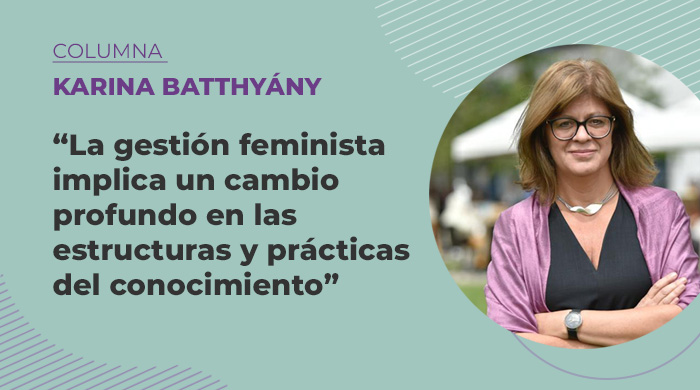
Transcript of Karina Batthyány's column
in InfoCLACSO – March 5, 2025
For the past six years, CLACSO has used March as Women's Month to raise awareness and highlight the challenges, opportunities, and obstacles surrounding gender equality.
The current administration of CLACSO has declared it a feminist institution. To speak of feminist management, particularly in academic and political networks, implies, first and foremost, a profound change in the structures, dynamics, and practices of knowledge and action within the framework of public policy.
At CLACSO, we apply the main concepts of feminist theory, gender systems and the sexual division of labor within the framework of institutional management, in order to try to build collaborative, horizontal, inclusive spaces within our institutions and networks of action and work, where gender equity is not just another or peripheral issue but a central axis of the production and circulation of knowledge and of political advocacy actions.
Within the context of an academic and political network, feminist management at CLACSO translates into strategies to democratize access and participation, promote co-responsibility in intellectual and administrative work, and above all, challenge the mechanisms of exclusion that persist at the level of society, our institutions, academic spaces, and political action.
Furthermore, it's not simply a matter of parity—saying how many men and women we have, for example, on work teams or as authors of CLACSO publications—but rather a structural transformation that allows the knowledge, experiences, and trajectories of women and diverse groups to be valued and made visible on equal terms. In other words, it's about applying what we once discussed regarding equipotency, equivalence, and equiphony within our institutions as substantive dimensions of equity.
The key dimensions of feminist management in academic spaces are:
– The democratization of knowledge production and circulation: not reproducing the elitist logics that have historically conditioned male subjects in terms of who produces knowledge and from what perspective. A very useful tool in recent decades for CLACSO in this regard is promoting open access, the recognition of non-hegemonic knowledge, and the decentralization of academic production, thereby fostering collaboration among different networks, territories, and countries, as well as the inclusion, as a fundamental principle, of voices that have been historically marginalized (such as women's voices).
– The equitable distribution of work and resources within our institutions and the resources available to them. Let us recall certain somewhat stereotypical images of women performing organizational tasks typical of secretaries rather than substantive work within institutions. At CLACSO, the aim is to distribute work equitably, both administratively and intellectually, in positions of greater visibility and recognition. Feminist management promotes a fair distribution of these responsibilities, avoiding the invisibility of the contributions that women make in various spheres.
– It is necessary to have horizontal structures or structures without rigid hierarchies, where everyone feels called upon to build collective leadership and where decision-making includes significant levels of participation in the collective process, rather than an individual position of power. Mechanisms must be created so that different voices are heard and respected.
– Gender issues must be placed at the forefront of research, meaning they shouldn't be merely peripheral topics to be addressed "on a formality," but rather permeate the various research, training, and academic activities promoted by institutions in terms of mainstreaming a gender perspective. This also implies taking on new challenges in developing research agendas for areas not currently recognized as central to the social sciences, and embracing methodological challenges in approaches that involve epistemological breaks with mainstream social science thought in order to challenge Eurocentric biases.
– In turn, we must work on preventing and addressing specific instances of gender-based violence within our institutions. Feminist management must prioritize prevention to avoid these situations, but it must also address them if prevention has not been sufficient, with clear protocols for situations of harassment, violence, and discrimination to guarantee safe spaces and ensure that people feel secure in their institutional and work environments.
Working within academic institutions and networks with a feminist perspective and management approach leads to greater equity in the distribution of opportunities for everyone. Furthermore, it strengthens the spirit of collaborative work, transforming organizational cultures and impacting both the organization itself and daily well-being, which then extends to other areas of interaction within these gender systems.
An institution like CLACSO has always included gender and women's rights (from a long time ago), and gender and feminism (more recently), within its founding principles and institutional history. What is new about the current administration is how we implement this feminist approach; that is, the idea of addressing and raising concrete issues through academic and knowledge production.
Looking back at these six years of management, everything related to knowledge production at CLACSO concerning feminism and gender inequalities has grown exponentially. Today, many of our research projects and findings are among the top reference materials in our Latin American and Caribbean social science library.
Furthermore, new topics have been added to CLACSO's main research agenda, not secondary agendas, such as new issues related to the evolving dimensions of gender inequalities or persistent structural challenges in Latin America. These include care work, topics associated with the environmental agenda and ecofeminism, and those related to political participation and participation in the labor market, among others.
We also promote specific publishing collections on feminist topics to showcase all Latin American and Caribbean scholarship and give space to the vast critical mass of scholars who are concerned with and dedicate their research to these issues. Since 2022, we have achieved parity in CLACSO's publishing catalog, especially in flagship collections such as the Essential Anthologies of Latin American and Caribbean Critical Thought Collection. There, we can say that we have a collection with gender parity; that is, the leading women social scientists of the region are now represented in that catalog.
Regarding funding and the principle of resource allocation, both for research opportunities and the resources available to carry out research, several actions can be observed during these last six years of management at CLACSO. Furthermore, scholarships and research programs in various fields were promoted with gender equity criteria, ensuring that women researchers (particularly younger ones) and gender-diverse individuals have more opportunities to develop their projects within our institution. This includes scholarships and research programs with gender equity and specific funding for feminist and gender studies research.
I want to highlight the CLACSO training programs, because they have grown significantly and offer courses on emerging topics in care, gender, and public policy, which are among the most in-demand in our curriculum. Whenever possible, and if resources allow, scholarships are prioritized for women from feminist and LGBTQ+ backgrounds.
Care policies within academia include various initiatives to incorporate the right to care into the academic agenda, funding policies, and the flexibility of scholarship and program criteria for women with care responsibilities.
This perspective, which we have identified from a theoretical standpoint, must be translated into concrete mechanisms within the framework of CLACSO's feminist management. Furthermore, we have promoted, within the Working Groups, the practice of issuing calls for proposals to strengthen the academic networks comprised of various exchange spaces within CLACSO's own feminist network. We are also undertaking an initiative to identify ways to further strengthen the feminist and cross-cutting perspective within the feminist Working Groups of our institutional structure.
Today, CLACSO has specific protocols for the prevention and management of all forms of gender-based violence for those of us who work in the Executive Secretariat and for the various activities and events organized by the CLACSO network. In addition, we are very active in various awareness campaigns on gender-based violence within academia. It is now impossible for a social scientist in training to not have gender studies included in their curriculum.
In terms of communication, we have developed various initiatives, such as the "March, Women's Month" proposal, which focused on ensuring that the voices of women and gender-diverse individuals were present in different dissemination spaces: at InfoCLACSO, in discussions, seminars, meetings, and academic debates. We have also developed initiatives to further amplify women's voices, such as the "Thinking and Acting from Feminist Perspectives" Observatory, which we developed during the height of the COVID-19 pandemic. Furthermore, we have given central importance to the topics of feminism and gender in our conferences, as seen in the opening dialogue "Feminisms in Latin America" at the Mexico Conference #CLACSO2022.
And finally, I just want to say that the effective participation of women in all academic activities at CLACSO has also been very visible in recent years. Today, in the 21st century, in 2025 and on March 8th, the principle of gender parity is applied in discussions, seminars, book presentations, and any other activity in which CLACSO participates in the field of social sciences.
– Many of the feminist and gender initiatives or research projects ended up in concrete public policies in the countries of the region, right?
– Yes, absolutely. The issue of care work has become central to CLACSO because it has also become central in the field of social sciences, and today it is an unavoidable topic on the academic research agenda.
CLACSO began working very actively on the topic of care, promoting training and research opportunities, but above all, collaborative work with social movements and organizations, and with those involved in public policy. We can say that many of the issues we have raised throughout Latin America and the Caribbean are beginning to translate into concrete policies.
I still vividly remember the forum we held within the framework of our Platforms for Social Dialogue (PDS) on the topic of care in Cuba, during the height of discussions on Cuban policy. We worked for days with people from the public sector. And today, we can say that the Caribbean nation has its National Care Policy. CLACSO has always worked to connect knowledge, public policy, social movements, and organizations.
If you would like to receive more information about CLACSO's training programs:
[widget id=”custom_html-57″]
to our email lists.

