
“The Guatemalan prosecutor’s office remains captured by political-criminal networks.”
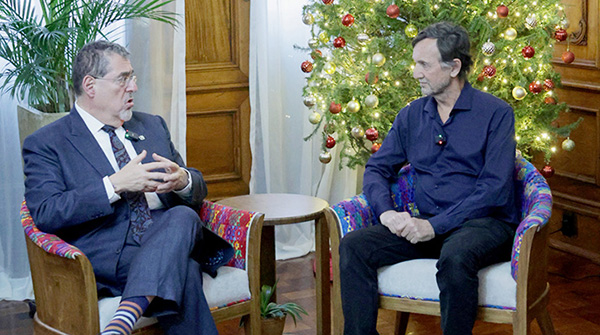
Exclusive interview with Bernardo Arévalo de León, President of Guatemala , within the framework of the International Colloquium “ Social Sciences and Violence in Central America: Between Sieges and Resistances ” , organized from December 4 to 6 in Guatemala City, a joint initiative of the Latin American Council of Social Sciences, the CLACSO Member Centers in Central America and the CLACSO Working Groups “Violence in Central America”, “Feminisms, Resistances and Emancipation” and “Ruralities and Political Transitions in Central America and Colombia”.

Mr. President, thank you for receiving us at your home and in your office, which you have occupied for less than 11 months. In short: How did you find this country 11 months ago, and what are the first signs of your new government?
We found the country on the brink of a profound political crisis, facing the possibility of electing a government that would simply confirm and deepen the capture of the state, a process that had been developing over several administrations through criminal political networks. These networks used the political system and the party system as a springboard to access public office, from the local to the national level, with the aim of engaging in illicit personal enrichment and the management of corrupt interests. We were a political option that was elected in an improbable way, given the prevailing forecasts. We came in second place in the first round, which allowed us to advance to the second round, where we gained ground and achieved a resounding victory. This victory became a mandate to undertake precisely the rescue of democratic institutions, the fight against corruption, and the fight for transparency. This was fundamental to our government program, an essential condition for bringing development to a people who have been waiting for it for centuries and whose interests have always been marginalized by various groups, and in this case, by these criminal political elites. So we knew what we were going to find, unfortunately, we also knew what we were going to find: a state that, in fundamental ways, such as the Attorney General's Office, remained captured by these political-criminal networks, with a comparatively strong bloc in the Congress of the Republic—because we are the third largest party, but extremely fragmented and, in any case, a minority bloc—which placed us in a complicated position in the Congress of the Republic and with the task of fighting two battles simultaneously. On the one hand, the battle that corresponds precisely to fulfilling the vision of ensuring that institutions begin to generate development in various sectors such as education, health, and agriculture; and on the other hand, defending ourselves against the attacks that began from day one, with attempts to prevent us from taking office, and which have continued to this day. So it has been an intense and complicated year, but a year in which we have made significant progress: when one begins to look at the raw, hard data, comparing the performance of the Ministry of Health, the Ministry of Education, or in areas such as housing policy compared to previous administrations.
-And what is the importance of regional and even continental integration for governments like yours, and for being able to rely on other like-minded, progressive, and democratic governments?
First, it's important to recognize that most of the problems governments and peoples face in this world have dimensions that transcend regional or international borders. And often, they are regional problems in themselves. Migration isn't just a problem for Guatemala, nor is it just a problem for the United States; it's a regional phenomenon that we must understand insofar as this movement of people can generate problems and challenges for governments to address: such as organized crime, drug trafficking, environmental issues, and development and its connection to trade. These are all issues that no country can tackle in isolation, least of all a relatively small country like Guatemala. In this sense, the ability to establish a framework of relations with countries in the region, especially those with shared interests and a common political vision, becomes fundamental to facilitating governance.
-You mentioned migration, and it's obviously a problem for the region and for Guatemala. I understand that in Guatemala there are three distinct issues: Guatemalans emigrate, it's a transit country, and it receives regional migrants. How are you addressing this reality?
Yes, we are a country of origin, a transit country, and a receiving country. This is precisely one of the issues where, from the outset, we have made it clear that the approach must be regional. We have established working groups with Mexico, for example, to address trilateral issues, and we have a working group on migration with the United States and Mexico. We are also part of the working group on migration created within the framework of the Summit of the Americas, where we organized a meeting with the ministers responsible for these issues from the various countries of the hemisphere. We believe that the scale of the problem can only be addressed reasonably if we understand the role that each of us, as states, plays within this regional phenomenon and do so collaboratively, based on fundamental principles. For us, for example, a fundamental principle was a commitment we made to treat migrants passing through our country in the same way we demand that our nationals be treated when passing through other countries or upon arrival in other countries: with full adherence to human rights, respecting their dignity, and seeking solutions that ultimately make migrations orderly, regular, and above all, safe for migrants.
-From January 20, 2025, with the arrival of Donald Trump to the White House, do you foresee any complications or changes?
"Changes are clearly going to happen. An administration is coming in that has placed migration at the heart of its electoral campaign and its governance. We have been monitoring these positions, and we have already established contacts with officials from the incoming Trump administration. Regardless of any changes to this adopted discourse, we must be able to find ways to work with the U.S. administration and other countries in a way that upholds the principles of respect for migrants' rights that we have mentioned."
-And to conclude, Mr. President, let's talk a little about the social sciences… What importance and impact do they have within this Latin American and Caribbean reality that is so changeable and conflictive at times?
I'm a sociologist; I trained in the social sciences. The social sciences allow us to understand the phenomena occurring in our countries with a deeper and more granular perspective than the typical viewpoints found in journalism. The challenge lies in connecting this more profound understanding with the development of political practices and policy strategies that truly acknowledge and respond to this more serious, granular, and profound knowledge offered by the social sciences, rather than simply reacting to the superficial reactions that often arise in the context of everyday political practice.
Eric Domergue interviewed
Directed by Guido Fontán
Photo: Daniel Hernández Salazar
If you would like to receive more information about CLACSO's training programs:
[widget id=”custom_html-57″]
to our email lists.

