
"Public higher education has been under severe attack in our region."
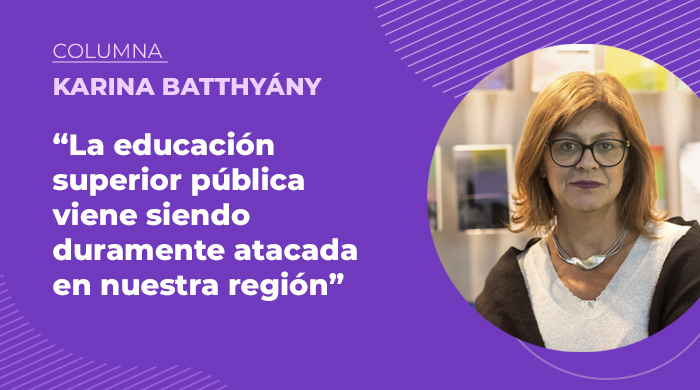
Transcript of Karina Batthyány's column
in InfoCLACSO – July 24, 2024
Within the framework of the #CLACSO2025 Conference, next year we will meet in Bogotá, Colombia, under the broad thematic umbrella of Horizons and Transformations for Equality, which responds to the issues that CLACSO has been working on in recent years.
This theme encompasses diverse and broad topics, each with its own emphasis. Firstly, it relates to our Platforms for Social Dialogue (PDS) project. In addition, we will be addressing a range of issues that reflect the main concerns of the social sciences, humanities, and arts. We will also review the work we are currently promoting at CLACSO, including our Working Groups program, as well as our training, publication, knowledge dissemination, and general communication efforts.
As always, we hope that the #CLACSO2025 Conference will bring together interested parties from across Latin America and the Caribbean, as well as from other regions of the world. Today, our Latin American Council of Social Sciences is a platform of, by, and for Latin America and the Caribbean, but with a global reach. We work in conjunction with CLACSO's Member Centers in different regions of the world, although, of course, our primary focus is on our Latin American and Caribbean region.
At the CLACSO2022 Conference in Mexico, we had over 15.000 in-person participants. We believe that in Bogotá, Colombia, we can reach that number as well. What we've found in the various working meetings is a significant and growing interest from diverse audiences, primarily from the academic sector that gathers around CLACSO, but also from those involved in public policy at the national, regional, and local levels—that is, from the various cities and departments of Colombia. And, particularly in Colombia, a wide range of social movements and organizations will be participating in our CLACSO2025 Conference.
Last Monday, in Medellín, Antioquia region, where a meeting was held on the topic of Care Systems and Policies, the importance of the upcoming CLACSO Conference was raised in order to bring together academics, public policy, movements and social organizations around the topic of care.
We are truly looking forward to a great #CLACSO2025 Conference, preceded by our Assembly, the most important moment for CLACSO from a political and institutional standpoint, held every three years. It is there, on the one hand, that we evaluate what has been accomplished in the last three years, but above all, and most importantly, that we design the guidelines, emphases, and thematic forces for the years to come.
And in the current context of a region like Latin America and the Caribbean, these meetings are becoming increasingly relevant and allow our network to strengthen.
– We know there will be tributes and gatherings of many dimensions, with award recipients, within the framework of #CLACSO2025, just as we experienced the impressive and impactful Mexico Conference #CLACSO2022…
– We're not going to reveal anything yet, but we do invite everyone to closely follow our communication channels, social media, and website. https://www.clacso.org/And our weekly meetings at InfoCLACSO, because we will be sharing the latest news regarding participation, recognitions, activities and agreements that we are finalizing week by week towards our #CLACSO2025 Conference.
– In today's program, we're also focusing on public universities, which in some parts of Latin America are or have been under siege. We saw this in the context of what happened in Brazil during Bolsonaro's time, but also in Argentina with Milei. What's your analysis of this, and what are the challenges facing public universities in the region?
– Public universities are an absolutely central issue. Public universities play a very important role throughout the world, but especially today in Latin America and the Caribbean, a region characterized by public, autonomous, and co-governed universities, and further marked by the University Reform of Córdoba, Argentina, in 1918. Their role is crucial in the generation of knowledge and the advancement of knowledge as a public good, a good for everyone.
The knowledge generated in these public higher education institutions is under serious attack, not in all countries, but certainly in several in our region. This occurs primarily in two major dimensions: the first being budgetary. We see this today in Argentina, which is one of the most dramatic cases at the moment, though not in history.
We must also remember what happens in each of the countries when the neoliberal model advances, and particularly the mercantilist model, which conceptualizes higher education, and therefore the universities that provide this type of training, as a commodity and not as a public good, not as a good to which we all have a right and should therefore have access.
So, the first dimension has to do with resources, with cutting budgets so that universities can fulfill the role they are called to as members of Latin American states and as institutions that guarantee the right to education for all throughout life.
Another dimension that greatly concerns us is academic freedom, a fundamental principle that governs university activity and life, and which is currently under attack in several countries in the Latin American and Caribbean region, as well as in other parts of the world. There, the practice of higher education, university teaching, and the production of knowledge and research are being called into question.
These academic freedoms are being curtailed, besieged, and persecuted. Moreover, these are not theoretical persecutions, but rather direct, personal persecutions of many colleagues for their ideas in various countries. This phenomenon, which permeates the entire spectrum of higher education, is particularly worrying in the social sciences and humanities, undoubtedly due to the topics and objects of study we work with. It is in this field that the majority of these cases of persecution, curtailment, and harassment of academic freedom occur.
Budget cuts and academic freedom are two elements that we must continue to pay attention to, seeking alternatives and ways to prevent these types of practices that stifle public universities in our region.
The underlying motive behind all of this is the desire to turn higher education into a commodity. Of course, at CLACSO we strongly disagree with this market-driven approach, because we reaffirm our commitment to education at all levels, particularly higher education, as a public good and a right for everyone.
– We saw cases of some universities that, in an effort to secure funding, even began generating it through other means, such as renting space or working almost exclusively for certain industries or companies, marginalizing certain topics that are not economically viable. How important is it to talk about open science, open access, and science evaluation in the context of these crisis situations, right?
Absolutely. And that's also one of the ways to limit the freedom of expression of public universities: the imposition of agendas or the prioritization of certain topics at the expense of others, solely based on market criteria. Furthermore, there's the privatization of knowledge generated with public funds—that is, knowledge generated within the realm of public higher education. That's why we also work to defend open access and open science, the principle of knowledge without any barriers for everyone, with the idea of knowledge as a public good and a right.
If you would like to receive more information about CLACSO's training programs:
[widget id=”custom_html-57″]
to our email lists.

