
"Comprehensive Sexuality Education aims for all people to live a dignified, full and free life."
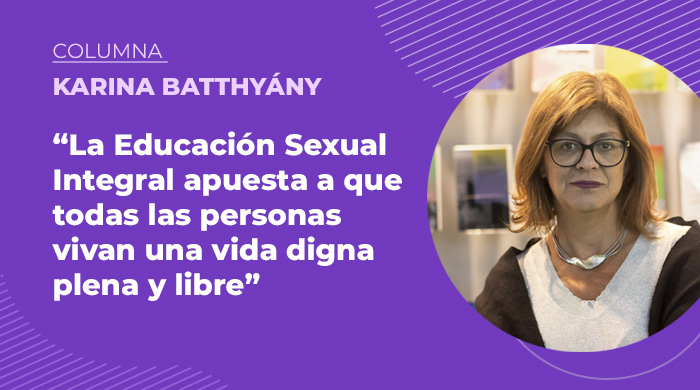
Transcript of Karina Batthyány's column
in InfoCLACSO – March 26, 2025
Today it is very timely to talk about Comprehensive Sexuality Education (CSE) as a necessary component to strengthen democratic systems and deepen progress in gender equality policies.
CLACSO is privileged to house in our Virtual Library all the materials produced over many years in Argentina regarding Comprehensive Sexuality Education (CSE), which the current government decided to remove from its website. These materials are now safeguarded and compiled in the CSE Library, offering open access and contributing to the future of sex education through government archives in Argentina from 2006 to 2023.
I want to especially thank the technical teams who worked on the proposal to provide us with the Comprehensive Sexuality Education materials so that we can have them on our CLACSO website today. A very special thank you also to my dear colleague and friend, Eleonor Faur.
In these times when human rights are being challenged and anti-rights rhetoric is gaining ground in many Latin American countries, defending Comprehensive Sexuality Education (CSE) means defending a societal project based on equality, justice, and freedom. CSE is not merely a pedagogical tool, but a political commitment to the democratization of knowledge, the development of free subjectivities, and the unrestricted respect for the rights of all, but especially those of children, adolescents, and young people.
When we talk about Comprehensive Sexuality Education (CSE), we are referring to an educational approach that addresses sexuality from a holistic perspective, considering not only biological or reproductive aspects but also affective, ethical, psychological, social, and cultural aspects. Furthermore, CSE is a secular education based on science and with a human rights approach that recognizes the diversity of identities, orientations, bodies, and forms of relationships. It is not about "indoctrinating" or "invading" the privacy of families, as some conservative campaigns in many countries suggest, but rather about guaranteeing the right to knowledge, self-care, autonomy, and protection against all forms of violence.
Comprehensive Sexuality Education (CSE) empowers children and adolescents to understand their bodies, recognize their emotions, develop respectful relationships, and learn to identify situations of abuse, discrimination, or violence. It is a key tool for preventing unintended teenage pregnancy and sexually transmitted infections, as well as for combating gender-based violence and abuse.
In Latin America and the Caribbean, progress in Comprehensive Sexuality Education has been diverse and heterogeneous, in many cases the result of sustained struggles by feminist movements, student movements (at the national and regional levels), teachers' movements, and human rights defenders.
A little bit of history
Argentina is one of the countries with the most developed institutional and regulatory framework for Comprehensive Sexuality Education (CSE). The National CSE Program was created following the enactment of Law 26.150 in October 2006, which establishes that all students have the right to receive comprehensive sexuality education in public and private educational institutions at the national, provincial, City of Buenos Aires, and municipal levels. The law also mandates that all schools in the country must include comprehensive sexuality education in their curricula to foster responsible attitudes and prevent problems related to sexual health. CSE encompasses biological, psychological, social, emotional, and ethical aspects of sexuality and aims to achieve equal treatment between men and women.
Last November, the Milei administration decided to remove a series of educational materials, alleging that they disseminated “a high level of gender ideology” and “contained elements that promote indoctrination in classrooms,” among other justifications. It criticized, for example, that “many of the materials use inclusive language (the use of the letter 'e'), which is not included in the official teaching guidelines.” The government targeted approximately one hundred audiovisual products for different age groups and across all three educational levels, in a list that included everything from a story by María Elena Walsh to videos addressing topics such as diverse families, the history of the painter Antonio Berni, the problem of online grooming, HIV/AIDS prevention, and various contraceptive methods.
Previously, the City of Buenos Aires, governed by Jorge Macri, had “temporarily” removed all ESI content available on its website, claiming that “all documents, images, videos, courses, activities and bibliography on this subject will be subject to a neutral study.”
Likewise, today at CLACSO we are working on the presentation of our ESI Library in open access, materials that were produced from 2006 to December 2023. We find different pedagogical resources that were produced to support the work of teachers in guaranteeing the right to comprehensive sexuality education.
Other countries in the region have also made progress in Comprehensive Sexuality Education (CSE), such as Uruguay, which incorporated a sexual and reproductive rights approach into its educational curriculum in 2008. This approach became a cornerstone of a national policy for civic education with a gender and human rights perspective. Uruguay formulated and implemented the National Gender in Education Plan for over a decade, mainstreaming these approaches across all levels of the education system, along with systematic teacher training and the production of educational materials. In 2020, with the arrival of Luis Lacalle Pou's right-wing government, the gender agenda faced significant obstacles. Institutional spaces for working on these issues were reduced, resources were cut, and training programs and educational content development were dismantled. This resulted in a setback, not an elimination, of CSE policies, which are now being revived under the new progressive government in Uruguay.
In Mexico, the federal framework has mandated sex education since the 90s, but state autonomy has led to significant disparities among the different Mexican states. Robust programs were developed in Mexico City, Oaxaca, and Jalisco, while in other states, conservative resistance limited their reach.
In Brazil, the context is more challenging because, since 2008, with the rise of ultraconservative sectors, campaigns such as "schools without gender ideology" have been promoted, seeking to censor content related to sexuality and the rights of the LGBTQ+ community. However, teachers' collectives, various universities, and feminist organizations have resisted and are working from this perspective of a critical and emancipatory Comprehensive Sexuality Education (CSE).
We must also mention Cuba, which has developed sexual education policies since the 70s, led by one of our CLACSO-CENESEX Member Centers, which link health, education and culture.
At CLACSO, we strive to support and promote a regional agenda that integrates research, training, and advocacy around Comprehensive Sexuality Education and sexual and reproductive rights. We have various CLACSO Working Groups addressing these issues, fostering spaces for critical reflection, knowledge production, and the strengthening of civil society networks and institutions.
Comprehensive Sexuality Education is a new territory and a new field of political, cultural, and epistemological debate. It is a topic that has advanced significantly because educating about sexuality is educating about rights, responsible relationships, equality, and democracy. It is a commitment to building more just societies where all people, regardless of their gender, orientation, identity, or history, can live a dignified, fulfilling, and free life. Comprehensive Sexuality Education is now more than ever an urgent cause, a victory to defend, a territory to work on, and a horizon for continuing to build equality.
– How difficult it is when the logic of not implementing these plans is considered, which would mean not educating children…
– Absolutely. We're reverting to the old notion that these topics should only be discussed behind closed doors, within homes and families, but that can't be the only source of information and education. Nor can we say that the only information and education regarding sex education comes from within the home and that the State has no role to play. It's a return to those conservative discourses that have done so much harm to minorities in their ability to freely exercise their rights.
– Finally, various CLACSO Working Groups developed, by consensus, a protocol against gender-based violence from an intersectional perspective for the Council's activities. What is your opinion regarding the importance of a gender protocol?
– We didn't want to end this InfoCLACSO cycle, within the framework of March, Women's Month, without mentioning the importance of having approved and now having in effect a protocol for addressing and intervening in situations of gender-based violence from an intersectional perspective within the scope of activities organized by CLACSO. The protocol was created through the efforts of a Commission formed by various CLACSO Working Groups, which discussed and exchanged ideas until arriving at a final proposal that was approved by our Steering Committee. Furthermore, it complements the protocol that CLACSO already had and approved in recent years regarding gender-based violence and workplace harassment in terms of prevention and institutional intervention. The CLACSO Working Groups involved in developing this protocol truly made a proposal that was taken very seriously by our Steering Committee, and I would like to mention them: the Working Group on Gender, Feminisms, and Memories; the Working Group on Critical Legal Thought and Sociopolitical Conflicts; and the Working Group on Emancipatory Praxis, Common Goods, and Decolonial Methodologies of Alter Globals. and the GT Feminisms, resistances and emancipation.
If you would like to receive more information about CLACSO's training programs:
[widget id=”custom_html-57″]
to our email lists.

