
"Education in the Caribbean faces tensions between a globalized world and its cultural identities."
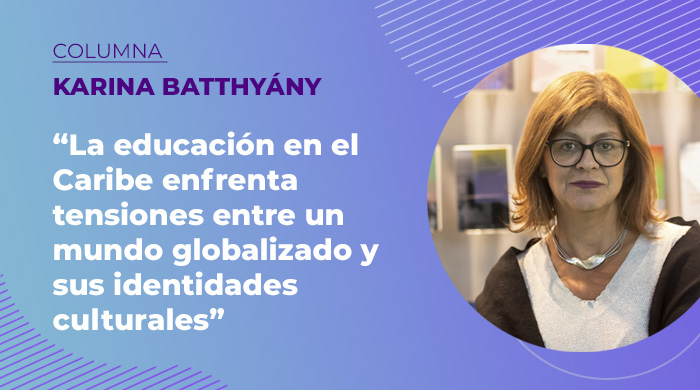
Transcript of Karina Batthyány's column
in InfoCLACSO – December 18, 2024
Today we will talk about the international meeting “Ancestral knowledge and plurilingualism of the Caribbean in higher education: Learnings and perspectives” which took place from December 12 to 14 in San Andrés, capital of the Colombian archipelago of Providencia and Santa Catalina.
The meeting became a stage of absolute prominence for this intercultural dialogue, where, once again, academic leaders, Raizal communities and government representatives met, which not only allowed reflection on the educational challenges of the region but also raised the urgent need to integrate ancestral knowledge and linguistic diversity as central axes of educational models.
The Caribbean, renowned for its linguistic, cultural, and ethnic diversity, is the product of a complex historical tapestry of colonization, resistance, migration, and transculturation. These processes have shaped a mosaic of ancestral knowledge and cultural practices that have resisted hegemonic impositions and continue to be marginalized by global dynamics and dominant educational policies. This presents tensions and challenges for higher education, as it does throughout the rest of Latin America and the Caribbean.
In particular, higher education in the Caribbean region faces tensions between the demands of a globalized world and the need to preserve and strengthen its cultural identities. On a daily basis, Indigenous, Afro-descendant, and Raizal communities grapple with the imposition of dominant languages, curricula disconnected from local contexts, and the erasure of their knowledge and epistemologies.
This process has had worrying consequences, such as the loss of Indigenous and Creole languages, the marginalization of local knowledge in universities, and a growing disconnect between academia and the social and cultural realities of the people. San Andrés, Providencia, and Santa Catalina are proof of this tension, where the Raizal communities that historically inhabited these islands continue to fight for the recognition of their language, their history, and their rights. In this sense, the meeting represented a horizon of hope and transformation. The multicultural dialogues highlighted not only the challenges but also concrete proposals for integrating ancestral knowledge, multilingualism into educational processes, developing relevant public policies, and promoting a critical, inclusive, and intercultural educational model.
Furthermore, one theme that emerged during the meeting was the relationship between higher education and academic freedom, a crucial debate in our region. Today, higher education in Latin America faces deliberate threats of commodification and defunding. There is an effort to promote privatization, jeopardizing a fundamental right and a pillar for building and strengthening democratic societies: the right to free, secular, inclusive, and quality higher education.
At CLACSO, we have always supported the struggle of public universities throughout the region that are currently facing market-driven and privatizing policies. We also work to guarantee academic freedom, because we consider it an essential commitment. Without academic freedom, we cannot aspire to more just, democratic, and equitable societies.
The principles of the right to education and the defense of academic freedom are directly linked to CLACSO's Platforms for Social Dialogue throughout the Latin American and Caribbean region. In this specific case, these dialogues are connected to the need to build educational models that respect ancestral and local knowledge in order to promote intercultural dialogue. This international meeting highlighted that the Caribbean has a responsibility to build an educational model that not only responds to global demands but also recognizes its cultural and linguistic diversity.
It is necessary to question power structures and transform educational practices to include historically excluded communities. These discussions must take place with a broad audience that brings together academia, social movements, and public policy. The challenge, then, lies in building a university where ancestral knowledge, Creole languages, and local cultures are integral to the educational process: only in this way will we be able to advance transformative education, capable of responding to the needs of Latin American and Caribbean peoples to build more just and sustainable societies.
The current dynamics of higher education in our region present three major tensions. The first is the tension between expansion, democratization, and inclusion, framing it as a public good and fundamental to social well-being. The second is linked to universalism, particularism, and differentiation: how to construct differentiated strategies aimed at educational inclusion in different contexts. The third is the challenge of the necessary or internal differentiation between this greater educational inclusion and current educational systems. Despite progress in access to education, we observe how structural inequalities persist for Indigenous and Afro-descendant peoples in terms of retention, graduation, and relevance within educational models.
– Within the framework of this International Meeting, there is the importance of all the debates that CLACSO has been promoting regarding diverse knowledge and languages for academic publications, right?
– Absolutely. At CLACSO, we advocate for multilingualism, which establishes some very strong starting points that should be expanded in the future to include multilingualism in all its local expressions. Ultimately, Latin America and the Caribbean, within the framework of their educational systems, must respond to global demands and strengthen their cultural, linguistic, and epistemological roots, rather than suppressing or rendering them invisible as is currently happening.
– What is the importance of outreach and expansion policies in enabling more people to access public universities in different parts of the region?
– We must start from the premise that higher education is a right for everyone. To guarantee this right, we must promote unrestricted, that is, broad and universal access to higher education systems, without allowing for mechanization, commodification, or private provision.
If you would like to receive more information about CLACSO's training programs:
[widget id=”custom_html-57″]
to our email lists.

