
The long-term care economy in Europe, Latin America and the Caribbean
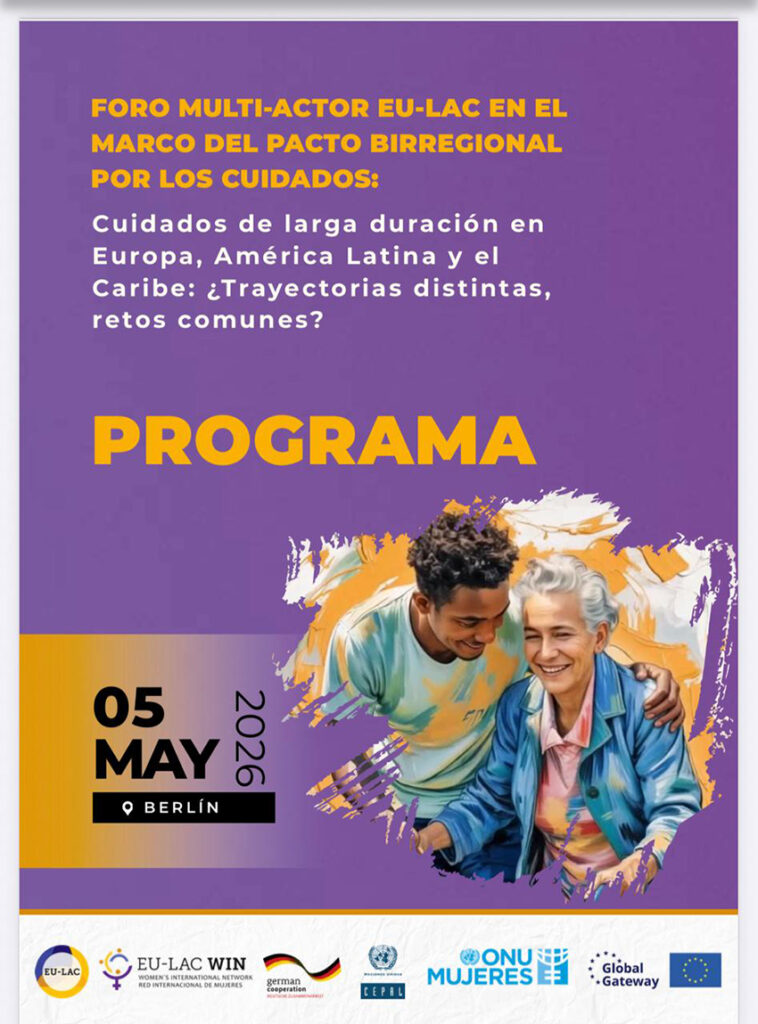
Following the historic launch of the EU-LAC Bi-regional Care Pact at the CELAC-EU Summit in Santa Marta, Colombia (2025), the Multi-stakeholder Forum held on May 5th, entitled " The Long-Term Care Economy in Europe, Latin America and the Caribbean: Different Trajectories, Common Challenges ?", sought to translate political commitments into concrete solutions. Nora Goren , Coordinator of the Articulation and Strengthening Area, participated on behalf of CLACSO .

The dialogue included diverse voices from academia, public agencies, development banks, the private sector, and civil society who wished to share best practices and proposals for:
-formalizing employment, professionalizing, promoting skills and improving working conditions for caregivers in the long-term care sector;
-the financing strategies for sustainable social protection systems investments in the “silver economy”;
-Multi-actor and innovative cooperation in the provision of long-term care and assistance at the local level (family / community / public sector / private sector).
Europe and Latin America and the Caribbean are undergoing significant demographic transformations, characterized by an aging population, increased life expectancy, and declining birth rates. These trends are generating a growing demand for long-term care services, in a context marked by structural challenges such as informal employment in the sector, gender inequalities, and limited access to quality services.
In both regions, care systems combine formal services with a heavy reliance on informal care, which falls disproportionately on women. At the same time, strengthening care systems is recognized as a key element for social protection, inclusion, and economic development.
On November 9, 2025, at the CELAC-EU Summit in Santa Marta, Colombia, the Bi-regional Pact for Care was formally launched. Designed as an informal, values-based cooperation mechanism with voluntary participation, it is open to all countries in Latin America and the Caribbean, as well as EU Member States. The Pact aims to serve as a permanent forum for bi-regional dialogue and cooperation on the legal, social, and economic dimensions of care systems.

