
“The environmental dimension, one of the dimensions of inequality”
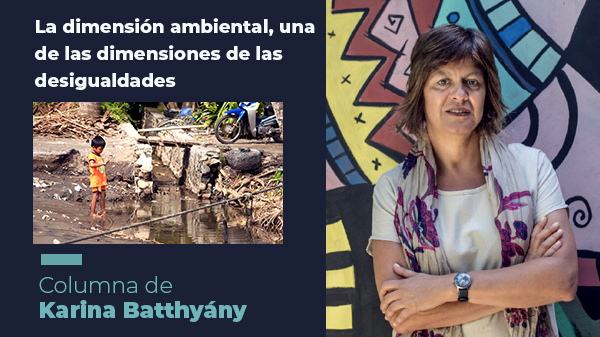
(Transcript of the Column by Karina Batthyány
in InfoCLACSO – August 26, 2020)
We're going to talk about a dimension related to the issues we've been discussing regarding inequalities. And also one of the strategic axes that CLACSO has been working on in recent years, which is the environmental dimension. Something like elements for thinking about other ways of inhabiting and caring for the planet and ourselves. This is one of the points that the pandemic also shows us: that the way we are inhabiting the planet today seems to be somewhat detrimental to its nature. This element you mentioned—the emergence of zoonotic diseases, those transmitted from animals to humans—is not a new phenomenon, but it has been increasing. Viruses, of course, are not new either; the viruses that have plagued and continue to plague humanity. But perhaps there is a close relationship with the destruction of ecosystems, with the planting of monocultures on an industrial scale, with CO2 emissions.2The dumping of polluting waste into rivers, seas, and oceans, indiscriminate fishing, deforestation, burning, and forest fires, the construction of mining camps, and a long list of other things I could add, all show us that we need to question the relationship between those of us who inhabit the planet and nature.
And it is fundamental to think about the future development of societies from a perspective that replaces the somewhat extractive and anthropocentric vision we have had until now. Once again, I believe we must reaffirm and insist on the idea we discussed in a few columns ago: care, which also includes, of course, caring for the environment. And once again, we must care for life, not only human life, but all forms of life, above the interests dominated by capital. We need, therefore, to question the ways in which production has been organized globally since at least the mid-70s, with those global value chains that have had such a profound impact on the commodification of nature and the destruction of natural ecosystems. We also need to rethink these economic models based on forms of production, consumption, organization, and technological development that finally ration the use of natural resources and minimize environmental pollution. It is urgent to build social dynamics capable of responding to the dynamics of capitalist restructuring and the dynamics of wealth concentration that entail the destruction of ecosystems. Once again, I insist: we must move toward this new idea, this new pact, this new social contract that is not only social, but also economic and environmental, and that is capable of guaranteeing social, economic, and environmental justice. We urgently need this eco-social pact at a global level that incorporates these elements, that incorporates the terms we have raised in previous columns: solidarity, democracy, and co-responsibility, also in relation to the environment. Ultimately, it is about expanding the paradigm of care, about valuing reciprocity and interdependence among people, but also with the environment, with nature, with the earth. We have an opportunity to build this new relationship with the environment. This crisis also shows us that it is urgent, that it is time to rethink our relationship with nature, and above all, our anthropocentric relationship and our notion of autonomy that neglects the environmental dimension. Let us not forget that our lives, the lives of human beings, represent only 0,01 percent of life on the planet. So, please, let us show greater humility and begin to consider these dimensions in an integrated way, because if we don't, other pandemics await us, along with a proliferation of phenomena linked to pollution and the climate problems that are affecting, and will continue to affect, our living conditions.
Thinking about several very specific situations where environmental problems generate social problems: the displacement of people due to floods, who have to leave their homes because of environmental issues, due to climate effects related to climate change. This is what we're talking about happening in many places: the fires in Brazil that have caused catastrophes in the Amazon, also with the displacement of many populations. But I was also thinking about people who live in industrial areas like Dock Sud, in the province of Buenos Aires, where pollution raises the blood lead levels of children born in those towns; there, the social problem is very concrete.
Absolutely. That's why we want to position the environmental dimension as one of the dimensions of inequality, which, of course—as in all cases—we shouldn't analyze separately, but rather with this idea of intersectionality, and how the environmental dimension influences the social, economic, political, gender, generational, and other dimensions in an interconnected way. That's why I emphasized the importance of working on this new pact or social contract that includes these dimensions: the social, the economic, the political, and the environmental. The problem, I think, is that we often forget about it or don't place it in the right context, and that's why I wanted to bring up this environmental dimension in this column today.
If you would like to receive more information about CLACSO's training programs:
[widget id=”custom_html-57″]
to our email lists.

