
Debt, that leaden life preserver
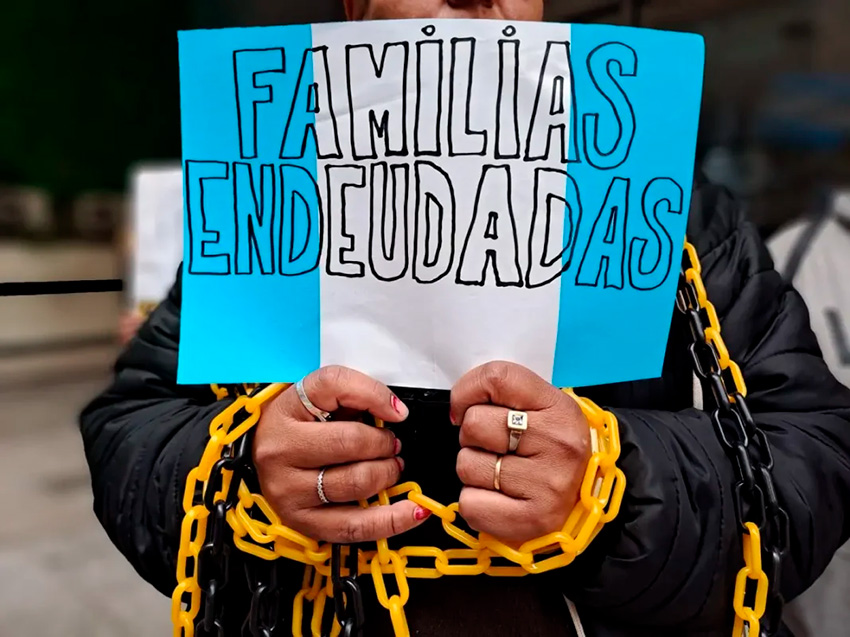
Approaching its third year in office, the austerity measures imposed by Javier Milei in Argentina “are being financed by household debt,” estimates Verónica Gago . “Spilling down from the top, from the IMF to households with insufficient wages, now just a click away, debt is the new normal for precarious lives. But what happens when these debts can no longer be repaid? How does this predatory machine operate?” she asks.
Mariana Gené , Gabriel Kessler, and Gabriel Vommaro, in turn, understand that “ delinquency among Argentine households has grown rapidly and has become a public issue. The Central Bank reported that delinquency rates on family loans rose from 2,94% in February 2025 to 12,8% in June 2026. Bills on refinancing, credit regulation, and debt relief accumulated in Congress. The government refused to intervene: 'Did they put a gun to your head?' asked Javier Milei. For the libertarian president, debts are agreements between private parties, and assisting those who cannot pay would mean shifting the cost onto others.”
Maximiliano Alonso, in turn, analyzes that “Argentine families take out little credit and even then they can't pay it back. The explanation lies not in the interest rate but in what is charged afterward, and in a legal limit that was eliminated by decree in December 2023. Underlying all of that is a circuit that no statistics record.”
Finally, for Ariel Wilkis, “the increase in delinquency has already set its own agenda. It occupies public attention and is emerging as a legislative concern: refinancing projects, interest rate caps, and temporary relief for debtors. The question I'm interested in asking is not how much delinquency there is today, but how to view that data in the long term: what categories do we use to interpret it, what profound transformations does it reflect, and what future—or lack thereof—is it presenting us with.”
The adjustment is financed by family debt.
Debt, that leaden life preserver
The austerity measures implemented during Milei's nearly two and a half years in government have been financed by… household debt. Spread from the top down, from the IMF to households with insufficient wages, debt is now just a click away, the new normal for precarious lives. But what happens when these debts can no longer be repaid? How does this predatory machine operate?
Fintech came to change the ways of dealing with precarious and urgent situations.
The burden of debt in the so-called mental health crisis is central.
By Verónica Gago*
The young woman, "tired" from the transportation strike, speaks of her personal debt. Her testimony goes viral on social media because of the exhaustive account she manages to give in minutes of what it means to be a worker in Argentina today: precarious, working multiple jobs, with caregiving responsibilities, dealing with deplorable housing and transportation conditions, and... heavily indebted. The high school student who speaks out about the underfunding of education and the mental health of young people on TV programs speaks of family debt. The retiree who drives for Uber speaks of debt. The salaried worker whose entire salary is absorbed by the banks at the beginning of the month speaks of debt. The teacher on the verge of resigning speaks of debt because she does the math and concludes that she's almost paying out of her own pocket and that it's better to diversify her multiple jobs on platforms. The mother who cares for family members with disabilities speaks of debt, forced to take on new expenses as public programs are cut. The street vendor, harassed by neighborhood loan sharks, speaks of debt; she can't seem to boost sales and confirms the drop in consumption. The laid-off small business worker speaks of debt; he can't find another job and confesses that Didi is already overwhelmed with drivers in his small town. The shop assistant, whose salary is paid in installments, speaks of debt. A dejected patient in the pharmacy line, lamenting the cuts in benefits from his health insurance, speaks of debt. The tenant, who already took out a loan to pay the building fees and is now also going into debt with Mercado Pago to pay the rent, speaks of debt.
In just a few months, debt became the common condition of a threatened livelihood. Debt became the lead weight of agonizing routines as inflation rises and deregulation fuels the plunder of those who live by their labor. And with good reason: 20,5 million people are in debt just to make ends meet, whether with banks, credit cards, digital wallets, platforms, supermarket cards, or other sources (1).
But debt is also a mass concern now because, along with its proliferation, something else is revealed: it has become unpayable. There's a new stage in this game that the far right sold under the slogan of "financial freedom." Record delinquency rates are the indicator of this snowballing debt, which can neither be paid off nor refinanced because interest has inflated it and its growth rate is impossible to match with income. Meanwhile, the harassment, pressure, and anguish have increased, forcing those in debt into endless workdays, borrowing from relatives (even begging them to take out loans), canceling their health insurance, dropping out of the simplified tax system, and selling belongings. The government couldn't remain silent. The president himself reacted to an Al Jazeera report on household debt that had international repercussions. Then Economy Minister Luis Caputo came out and said that it's not wrong for families to go into debt, provoking anger from many. Behind the numbers, the cases are repeating themselves, multiplying, and causing a shift in public sentiment. The strategy of encapsulating the debt in guilt and shame is beginning to collapse, and hatred is being directed at the libertarian administration, which is experiencing its lowest approval ratings since taking office. Could family debt bring down the government?
A new threshold
Household debt has its own flows, its own ways of expanding and intensifying. It's not new, but it's crossing a threshold, and the effects are being felt. If we trace its history briefly, two moments stand out. One is the pandemic, when the alliance between mobile phone technology and debt incurred during the emergency solidified. It was then that digital wallets became widespread. What's technically called fintech isn't just, as its name suggests, a financial technology: it's a marriage between digitalization and finance that has changed how we cope with precarious and urgent situations. It's an alliance between mobile phones and finance that has further decentralized the supply of instant cash and fueled the race to make a few extra dollars through small, everyday speculations. With a click, loans appear in the phone's balance, and interest starts accruing.
The second turning point is the accumulated poverty, inflation, and economic deregulation that characterize this third year of Milei's administration. In recent months, the issue of family, individual, and household debt has become a daily public conversation that the media could not avoid. The fact that money doesn't stretch far enough has been a reality for quite some time. But debt was precisely the solution. Debt financed the adjustment with interest rates hidden in fine print. What income failed to cover, debt covered. Increases in basic services were financed with installments. The fact that consumption didn't fall during the first two years of the administration was because it was sustained by borrowing. But this use of debt, on the one hand, accelerated impoverishment: a true extractivism of wages, pensions, and other income at the hands of the deregulated economy. On the other hand, it multiplied credit options: bank and non-bank debt, informal and personal loans, from loan sharks and credit cards, became a combination. Debt is not ahistorical; on the contrary, it fulfills specific functions within particular timeframes. It is, however, a versatile mechanism for managing the exploitation of precarious labor in favor of its financialization. That is to say, debt leads to the incorporation of finance as an internal element of labor force reproduction, linked to survival, tied to desires, and available as a tool against dispossession.
But today we face a limit: debt is no longer enough. Debt has become unsustainable, amounting to millions of pesos in already struggling households. Taking on debt is no longer the springboard that allows the government's promise of improvement to be fulfilled. Current delinquency rates in fintech, particularly in the now-popular digital wallets, are double those of other financial institutions (3). These numbers increase when considering the situation of young people: 1 in 3 can no longer pay their debts (4), a situation compounded by their already precarious employment situation.
Harassment and despair
According to Luci Cavallero's presentation (5) to the Consumer Protection Committee of the National Congress, chaired by Hugo Yasky, the situation of delinquency is due to the fact that people who were originally able to meet their financial obligations can no longer do so; that successive refinancings to avoid delinquency are no longer sufficient; and that the exponential growth of debt is mainly due to the interest that increases it month after month. According to the report prepared by the organization Movida Ciudad, which has been holding nationwide meetings on debt relief and providing support to indebted individuals, the desperation of those in debt to banks stems from the fact that they "offer refinancing with installments that exceed the actual ability to pay and in some cases induce delinquency as a condition for accessing refinancing plans" [1] . Another problem is the lack of information regarding how automatic debits affect income, and the difficulty in submitting written notices to banks, since such a notice serves as proof of intent to pay, delaying the formal demand for payment. In the case of digital wallets and financial institutions, the situation is even worse because there are no effective customer service channels, only automated responses, and zero transparency regarding rates and interest, leading to rapid referral to collection agencies. This is where the most predatory part of the chain comes in: collection agencies begin harassing not only the debtors but also their families, even contacting their employers. They operate through phone calls and WhatsApp messages, threatening garnishment and other legal action, even when such action is not a concrete possibility at that stage. Meanwhile, there is complete helplessness. The Pre-Trial Conciliation Service for Consumer Relations (COPREC), which was under the Ministry of Economy and was the main tool people had to file claims without resorting to litigation, was eliminated by decree in 2025. This body resolved conflicts between consumers and suppliers on a pre-judicial basis, existed since 2014 and operated at the national level.
That free service no longer exists. According to the report, claims now go to local consumer protection agencies (provincial or municipal) or to mediation and the courts. Meanwhile, people in debt are falling into despair. Who has time to handle all those inquiries amidst a hectic work schedule?
Debt reduction, the new collective bargaining agreement
Connecting public debt and household debt has been a key feminist approach that anticipated the trickle-down effect from the IMF: external debt translates into austerity from the top down, from the state to households. The IMF has just come to the country's rescue by ratifying the agreement. But this technology of endurance is reaching its limit. First-person accounts are varied. However, for those with caregiving responsibilities, mostly women, the debt weighs even more heavily. Single-mother households experience the greatest hardship, where indebtedness generates emotional stress that has nowhere to be released, especially since it intersects with so-called "food debt." Debt thus becomes a major intensifier of pre-existing inequalities related to housing, care work, and dependence on state aid programs. The debt mechanism, which is no longer exceptional but rather a daily occurrence and escalating, is a key component of an emotional economy of exhaustion. Furthermore, due to the pressure of self-adjusting expenses, many people admit to cutting back on therapy sessions, outings with friends, and other social activities. Debt becomes a mechanism of isolation, weakens social bonds, and reinforces humiliation in daily life (“I’m worthless,” “I can’t get out of this,” “I made the wrong decisions,” etc.). The burden of debt is central to the so-called mental health crisis.
Pedro Bussetti, head of DEUCO (Defense of Users and Consumers), publicizes the extreme situations of retirees in the greater Buenos Aires area whenever possible. Faced with the inability to cover basic expenses, debt arises, but when payments fall into arrears, a different, more 21st-century technology emerges: illegally tapping into the electrical grid, bartering food, and relying on the exchange of services and assistance. And, of course, there's what arose from that crisis and is now operating at near capacity: community kitchens.
Meanwhile, several unions have placed the issue on their urgent agenda. In the survey we are conducting between ATE (Association of State Workers) and its Gender and Diversity Secretariat, the Labor Relations Union Observatory, and the GIIF (Feminist Research and Intervention Group) of the University of Buenos Aires, we are analyzing the intersection of wage decline, debt, and multiple job-holding. In one of the meetings, a union leader recounted that workers have such high levels of debt that they go to ATMs in the early hours of the morning, on the very night their salaries are deposited, to avoid being swallowed up by pre-existing debts the next morning. Many of these banks are "public" banks, which are also currently under scrutiny for government corruption.
The widespread practice of requesting salary advances to pay debts and rent has also emerged. Unions in various provinces are already demanding a debt relief plan for municipal, provincial, and state workers in general. It's clear that there can be no collective bargaining agreement without a discussion about debt relief. This is precisely because debt leads to an unlimited drain on wages, as salary increases barely keep pace with inflation and fall far short of the percentage of wages used to pay off debts.
We have been investigating household debt for some time. In fact, its effects are crucial for understanding what we call the authoritarianism of “financial freedom,” a key tactic used by the far-right in the Argentine government to appeal to precarious and indebted populations. A significant portion of the vote for Milei was based on the promise of stability in the face of a daily economy plagued by inflation. This debt, at the level of everyday life, fostered a culture of precarity and a way of managing daily hardship that manifests as the devaluation of frozen incomes. It lasted quite a while: two years of rhetoric about sacrifice, self-imposed effort, and blaming collective social rights for the disastrous economy.
Through the over-indebtedness of the population, the capital-labor relationship is reconfigured by means of financial and algorithmic super-exploitation. This is where the political project of anarcho-libertarian capitalism takes root, while it sells off glaciers and land and engages in punitive demagoguery. But we are also witnessing its limits—physical, emotional, and political. Something is rotten.
NOTES:
- Economic Studies Department of Banco Provincia, February 2026. https://www.bancoprovincia.com.ar/gateway/cdn/Semana%20Económica%20920%20(20-feb-26)
- “In Argentina, locals are taking loans to buy food”, Al Jazeera, https://www.aljazeera.com/economy/2026/2/16/in-argentina-locals-are-taking-loans-to-buy-food
- Central Bank of Argentina's Debtors Registry https://www.bcra.gob.ar/conocer-que-es-la-central-de-deudores/
- The Banking Association: report “Free or imprisoned by debt: young people in the crosshairs of the financial crisis”. https://www.instagram.com/p/DXXNKi8kVYq/?igsh=MWt1c3E0YzVpdXFkYg==
- City Scene
*Researcher and feminist activist. Co-coordinator of the CLACSO Working Group “Popular Economies: Theoretical and Practical Mapping.” Her latest book, co-authored with Luci Cavallero, is Against the Authoritarianism of Financial Freedom , Tinta Limón editions, August 2025. Article published in EL DIPLO No. 323, May 2026 – © Le Monde diplomatique , Southern Cone edition
[1] https://www.youtube.com/live/B-0sFanc6bY?si=pLr0UMi21w5vrHzB&t=588z
Politicizing debt without appealing to the State: indebtedness and political identification in Milei's electorate
By Mariana Gené, Gabriel Kessler and Gabriel Vommaro [1]
Delinquency rates among Argentine households have risen rapidly and become a major public concern. The Central Bank reported that delinquency on household loans jumped from 2,94% in February 2025 to 12,8% in June 2026. Bills for debt refinancing, credit regulation, and debt relief have accumulated in Congress. The government has refused to intervene: “Did they put a gun to your head?” asked Javier Milei. According to the libertarian president, debts are agreements between private parties, and assisting those who cannot pay would simply shift the burden onto others.
Since July 2024, we have been following five groups of Milei's "hardcore" voters through regular contact via WhatsApp groups. [2] Debt affects them, sometimes dramatically, and many acknowledge that it is no longer an exceptional resource for paying for food, utilities, and daily expenses. But this acknowledgment does not necessarily lead to calls for state regulation or a reassessment of their political allegiance. The novelty lies not in the suffering itself, but in how it is interpreted: the same participant might describe an economy that forces families into debt and, minutes later, argue that each debtor must bear the burden without public assistance.
Classical social theory taught that values, viewpoints, and beliefs intervene between experience and attitudes, acting as a framework for interpreting people's lived experiences. Marx called this ideology, but the misinterpretations of it as false consciousness led to the search for alternative analyses, ranging from phenomenology to habitus theory. Political studies have also shown that collective identities and adherence to a leader function as cognitive shortcuts: they allow individuals to take a position on distant issues and make sense of everyday experience. In polarized contexts, negative partisanship—which solidifies the group in its aversion to the adversary—shapes much of how people perceive events: if a spokesperson for the group considered the adversary adopts a position, members of the in-group tend to assume that the opposing position is the correct one.
Milei's core voters are going through this kind of alignment. Many have crossed a bridge: they've abandoned the expectation that the state will take care of public affairs and have reached the shore of radical criticism of its intervention. When the debt situation becomes dire, that urgency isn't enough to reverse that shift.
Debt does not politicize itself
Argentina has experienced other periods in which debt entered the public sphere, with different outcomes. During the consumption boom of 2003–2015, credit was seen as a means of accessing goods and well-being; as long as the installments were integrated into the household budget, debt was portrayed as a means of inclusion and social mobility, and did not give rise to a movement of consumer debtors (Luzzi, 2021; Wilkis, 2024). Those with UVA mortgages followed a different trajectory: even with low delinquency rates, the indexation of the principal and the feeling of paying while still owing money fostered a national organization, supported by a morally legitimate figure—the debtor who continued to pay—a valuable asset—their only home—and an identifiable responsibility in the state policy that had enabled it. Feminist politicization carried out another operation: the slogan “We want to be alive, free and debt-free” brought together heterogeneous obligations to show their common effects on autonomy and care, seeking to “bring debt out of the closet” (Cavallero and Gago, 2020).
Indebtedness does not, in itself, lead to politicization. It is necessary for the experience to be deprivatized, for a shared interpretation of its causes to emerge, for responsible actors to be identified, and for some organization to translate the experience into demands. The current situation combines a potentially greater scope with a more difficult articulation: there is no single contract or visible asset to defend, but rather credit cards, personal loans, digital wallets, unpaid bills, and informal debts increasingly used to cover current expenses. This fragmentation hinders the construction of a common identity, but also makes it less plausible to explain all debt as entirely free choices.
The government and the opposition draw opposing conclusions. The ruling party believes the debt is an individual matter that doesn't erode its support; part of the opposition imagines that the missed payments signal the beginning of disillusionment. Our study paints a less straightforward picture. The government underestimates the concern: most people consider the debt a problem, whether they are personally affected by it or not. But the opposition jumps to conclusions: recognizing a shared problem doesn't necessarily mean agreeing on its solutions.
Diagnoses that do not anticipate solutions
When these Milei voters were asked about their own and others' experiences with debt, three ways of experiencing and judging debt emerged, shaped by their material circumstances, their environment, and certain ideas about responsibility and justice. Ten of the twenty-nine people who responded about their personal or close experiences described a critical situation: credit no longer finances improvements but food or services, and debt appears not as a freely chosen contract but as a consequence of insufficient income. A second group (eight out of twenty-nine) does not experience critical debt but views the problem as serious, and some interpret it in structural terms. A third group (eleven out of twenty-nine) interprets debt from a moral perspective of individual responsibility: without their own or others' critical debt, they distinguish between the good debtor who adjusts and fulfills their obligations and the bad debtor who overspends, and they use their own stability as a parameter for judging very different situations, relegating informality, interest rates, or income loss to a secondary role.
Experience matters – those who are suffocated more easily recognize the collective dimension of the problem – but it does not by itself determine the political position: even among those who read it in structural terms, the value of effort and distrust towards the State persist.
When asked about solutions, the most widespread position is non-intervention. Nineteen of the thirty participants who expressed their views on what should be done rejected the idea of the State regulating rates or refinancing debts; seven advocated some form of regulation, mediation, or public prevention; four described the problem without being able to formulate a solution. For the anti-interventionist majority, debt is a free agreement between private parties: bailing it out would be unfair to those who pay with effort and could reduce the supply of credit. The government's task is to stabilize the economy, lower taxes, and recover wages, not to intervene in individual contracts. The solution is general and future-oriented; debts are individual and present-day issues.
The vacillations of the group demanding some form of state action are revealing. They don't form a homogeneous bloc: several responses begin by accepting the official principle—the state shouldn't "take charge"—and then add exceptions, such as limiting interest rates deemed abusive or incorporating financial education. They don't abandon the language of individual responsibility; they try to complement it with some form of protection. And the four without a defined position also illuminate this trend: between experiencing a crisis and demanding a collective solution, there's a process of interpretation that isn't always completed.
Debt and political loyalty
What happens when debt directly affects Milei's supporters? Six of the ten participants in critical situations reject state intervention. They don't deny their financial hardship; they process it through three often combined strategies: personal responsibility, confidence that the government's plan will yield results, and retrospectively attributing the crisis to Kirchnerism.
The negative identity, which activates a sharp opposition to everything associated with Kirchnerism, also shapes the allocation of responsibilities. In a previous study, we showed that many Milei voters aligned their interpretations with those of the government when an issue became a rallying cry for the opposition (Kessler and Vommaro, 2026). This occurred with pensions, when voters who supported improving pensions backed the presidential veto of the increase, interpreting it as a destabilizing maneuver. Something similar happens with the debt. State intervention is associated with welfare programs, social programs, and "giving away money"; rejecting it confirms the distance from Kirchnerism. The image of "a gun to the head" offers a concise formula for articulating these dispositions: the value of compliance, the memory of past crises, and anger toward those receiving aid. It allows for acknowledging the problem without shifting responsibility to the government and maintaining the promise that macroeconomic order will ultimately improve daily life.
The alignment, however, is neither total nor irreversible: some seek a middle ground (reasonably affordable loans, a viable relationship between wages and prices) that upholds individual responsibility without resigning themselves to exorbitant interest rates or insufficient wages. Individual responsibility, they argue, can only be exercised if work allows one to live. Debt thus creates tensions within Milei's electorate, but does not, in itself, produce a rupture.
Ultimately, material conditions matter, but they don't speak for themselves. Between an unpayable bill and a political demand, political affiliations, associated frameworks, notions of justice, and ways of assigning responsibility all come into play. Hence the twofold lesson. The government cannot ignore the problem: the majority recognizes it, whether they suffer from it or not. But its critics cannot assume that the solution they envision will emerge from this problem in the eyes of voters, as if it were the result of a straightforward, logical argument. For now, part of the reason for the continued support of libertarians hinges on this gap between shared experience and the imagined solution.
Highlighted
Cavallero, L. and Gago, V. (2020). A feminist reading of debt: We want to be alive, free and debt-free! Tinta Limón.
Kessler, G. and Vommaro, G. (2026). «The construction of the radical right-wing electorate in Argentina». Sociological Studies , 44, 1–25.
Luzzi, M. (2021). “Consumption, debt and inequality: the expansion of financial services for households in Argentina, 2003–2015.” In S. Feldman (Ed.), Inequalities in Argentina: actors, territories and conflicts . UNGS Editions.
Wilkis, A. (2024). A history of how we got into debt: loans, installments, interest and other ghosts of the Argentine experience . Siglo XXI Editores.
[1] Mariana Gené (National University of San Martín – National Scientific and Technical Research Council – [email protected] ). Member of the CLACSO Working Group “Elites, Inequality and Democracy”; Gabriel Kessler (National University of San Martín – National University of La Plata – National Scientific and Technical Research Council – [email protected] ). Member of the CLACSO Working Group “Violence, Authoritarianism and Democratic Security Policies”; Gabriel Vommaro (National University of San Martín – National Scientific and Technical Research Council – [email protected] ). Member of the CLACSO Working Group “Elites, Inequality and Democracy”.
[2] Since July 2024, we have conducted a longitudinal study using five WhatsApp groups with voters who supported Milei in both rounds of the 2023 elections. For this text, we analyzed the responses of 29 participants to a question about debt and of 30 to another about possible state intervention. The counts are descriptive and do not seek to statistically represent the Milei electorate.
The price of not being able to pay
Maximiliano Alonso*
Argentine families take out little credit and even then they can't repay it. The explanation lies not in the interest rate but in the fees charged afterward, and in a legal limit that was eliminated by decree in December 2023. Underlying all of this is a system that no statistics record.
There's a figure that's been appearing in Argentine newspapers for months, and through sheer repetition, it's lost its meaning. Delinquency rates among households in the banking system reached 12,8% in May, the highest level in two decades, and in the world of digital wallets, they climbed to nearly a third of the total portfolio. Headlines alternate between two equally convenient interpretations. For some, it's proof that the economic adjustment has reached households. For others, it's a transitional phenomenon inherent in a credit market that's resurfacing after a decade of financial repression. Both have a point, but neither explains the essential question: why does a debt of one hundred thousand pesos originating from a supermarket purchase end up, eight months later, as a sum that its owner can no longer pay under any circumstances?
It's worth starting with the fact that almost never accompanies the others. Argentine families are among those that take out the least credit in the world. Household debt, measured against GDP or disposable income, is a fraction of that of Chile and considerably lower than that of Brazil. A country that owes little and cannot pay does not have an over-indebtedness problem in the way textbooks define it. It has something else.
Part of that other issue has already been addressed, and rightly so: credit has stopped financing durable goods and has begun financing current expenses. Food, utilities, medicine, the month that doesn't end. When a loan covers basic necessities, no restructuring will generate solvency, because there is no future repayment capacity to rebuild; there is insufficient income in the present. This is well known and frequently reported.
What is not published is what happens after the breach, and that, in my opinion, is the crux of the matter.
When someone stops making payments, the interest rate promised when the loan was granted ceases to apply, and a different rate takes over: the penalty interest, which is added to the compensatory interest and which, in Argentina today, has no legal cap. This wasn't always the case. Law 25.065, on credit cards, stipulated that penalty interest could not exceed fifty percent of the applied financing rate. This limit was eliminated by Emergency Decree 70 of December 2023, as part of the same deregulation package that liberalized access to credit history databases. The measure received little discussion then and is not being discussed at all now, even though its effects are reflected monthly in the Central Bank's statistics.
It's worth emphasizing this distinction, because all subsequent public policy depends on it. The compensatory interest rate is the price of credit and is agreed upon before taking it out; capping it, as Japan attempted in 2006 and Chile in 2013, makes funding more expensive for informal lenders and excludes those who cannot prove income from the formal system—and in a country with 44% informal employment, there are many. The penalty interest rate, on the other hand, is applied after default. Limiting it doesn't restrict anyone's access to credit, for the simple reason that no one decides to take out a loan based on how much they'll be charged if they can't repay it. It's a regulation without exclusionary costs, something quite rare in the instruments of financial policy.
So far, everything is based on statistics. It's important, then, to address what the statistics don't show, because the problem is much worse than what can be measured.
When someone runs out of bank credit, they turn to a digital wallet, and when that wallet rejects them due to late payments, they're left with the neighborhood lender. It's a downward spiral where each step is more expensive and offers less protection than the one before it, and the bottom step isn't recorded anywhere. The Central Bank sees what happens in banks and with non-financial credit providers. What happens on someone's doorstep on a Friday afternoon goes unseen.
The available evidence is fragmented, but all points in the same direction. A survey by the CIAS University Institute among young people in low-income neighborhoods found that 57% of these households had to borrow money to cover daily expenses, and that the predominant method was informal: 68% turned to family or friends, 39% to local moneylenders, and 19% to local businesses, while the formal lending system was reduced to a minimal presence. Within the regulated system itself, the residual category of “other loans,” which includes small-value transactions and greater informality, jumped from 10,7% to 31,9% of irregularities. And nearly six million households, 59% of the total, have obligations outside the banking system, in a heterogeneous category ranging from loans from relatives to unpaid school fees.
The cost of that final step isn't measured in interest rate points. These days, the Buenos Aires Province Security Minister publicly described what social organizations in the Greater Buenos Aires area have been denouncing for months: families taking out loans, unable to repay them, and ending up losing their homes. There are kidnapping cases stemming from debts of just a few hundred thousand pesos. Where the creditor is a criminal organization, the default isn't resolved through an enforcement proceeding.
And this didn't only happen in Argentina. It is, in fact, the best-documented side effect of consumer credit regulation. When Japan set a 20 percent annual interest rate cap in 2006 and limited total debt to one-third of income, the formal sector contracted at a rate that surprised even the regulators, and a portion of the excluded borrowers reappeared on the other side, in the hands of the illegal lenders known there as yamikin.
Latin America has its own version, and it's worse because it originated within organized crime. The "gota a gota" (loan sharking), established in Medellín during the 1990s as a mechanism for laundering drug money, has expanded, according to research by El País and Connectas, to at least sixteen countries in the region, with rates that InSight Crime places at around 20 percent daily. In Peru, the Peruvian Institute of Economics estimated an average of 500 percent annually, with one-tenth of the loans exceeding 10,000 percent. The first warnings began to appear in Spain this year. Mexico, Chile, Costa Rica, Uruguay, Bolivia: the map practically filled itself in, and wherever it arrived, it arrived with extortion.
The conclusion is uncomfortable for those of us who propose regulation, and we must face it head-on: every restriction on formal credit has consequences for those left out, and that consequences are not prudence. Therefore, no serious reform can be limited to simply setting caps. South Korea, after its 2003 crisis, did not limit itself to regulation: it created low-interest public microcredit programs specifically aimed at the excluded population, to compete with informal lenders for customers. The United Kingdom established specialized teams for the criminal prosecution of usurious lending, with their own budgets and investigative capacity. These are the two elements that are lacking in Argentina and that no discussion about interest rates can replace.
That said, there are readily available measures that don't cost a penny. If a significant portion of the outstanding balance currently listed as unpaid consists of penalties calculated without limit on a comparatively smaller principal, applying the cap that the law stipulated until December 2023 and recalculating the debt does not constitute a write-off: it constitutes a recalculation. The difference is far from semantic, because no one has to defend debt forgiveness in Congress or explain to a taxpayer why they are funding someone else's party. It is about restoring a limit that existed and was removed by decree.
There are more dormant tools at play. Article 771 of the Civil and Commercial Code empowers judges to reduce interest rates when the rate, or the result of its capitalization, disproportionately exceeds the average cost of money, and mandates that any excess charges be applied to the principal. The remedy is already in place. The problem is that it operates on a case-by-case basis, before a judge, with legal representation, and over timeframes measured in years, which is simply inapplicable to the nearly six million people currently in arrears. Transforming this judicial remedy into an automatic administrative rule, applied during the debt settlement process itself rather than in a court ruling, is likely the most impactful and least fiscally costly reform available on Argentina's financial agenda.
There is also an asset that the country underestimates. The Central Bank's Debtors Registry consolidates information from banks and non-financial credit providers: it shows, in one place, what a person owes in the banking system and what they owe in digital wallets. Chile only launched an equivalent registry in April of this year, after years of legislative process. Norway did the same in 2019. We have had this infrastructure for some time and only partially use it, because consulting it is neither mandatory nor binding for those who grant credit outside the banking sector, which is precisely where irregularity is three times higher than in the regulated system. It's worth clarifying that this registry only illuminates the surface. What lies beneath remains invisible, and no public policy can be designed blindly regarding a phenomenon whose magnitude is unknown.
None of this fixes the wage problem, and it would be dishonest to suggest otherwise. No debt policy solves an income problem; at best, it prevents it from worsening. But there's a statistic that should be far more troubling than it is: among debtors aged twenty to twenty-four, default rates on digital wallets exceed forty percent. This is a generation being shut out of the formal financial system before they've even fully entered it, due to arrears of often paltry amounts that have ballooned thanks to unlimited interest. We already know what the next step on that ladder is. It took Korea a decade to repair damage of this nature. We still have time to avoid causing it altogether.
Maximiliano Alonso holds a PhD in Economics, studied at ULB in Brussels, and finance at Oxford. He works as a senior advisor at a multilateral development bank and is the honorary president of the SurLab Foundation.
Debts, rights and the future
Ariel Wilkis [1]
The rise in delinquency has already set its own agenda. It occupies public attention and is emerging as a legislative concern: refinancing projects, interest rate caps, and temporary relief for debtors. The question I'm interested in asking isn't how much delinquency there is today, but how to view that data in the long term: what categories do we use to interpret it, what profound transformations does it reflect, and what future—or lack thereof—is it presenting us with? If we look at it only as a problem of the current financial situation, the answer is limited to interest rates and extending payment schedules. If we look at it for what it truly is—the visible manifestation of a social transformation that has been developing for almost a decade and that affects the very link between households and democracy—the question shifts in scale, and with it, the possible answers. The five theses that follow attempt to organize this long-term perspective.
1. Household debt, a missing link in the promises and failures of democracy
When I began writing *A History of How We Became Debted*, I started from a conviction that isn't always obvious: household debt—the kind that doesn't appear in headlines about the IMF or in negotiations with foreign creditors—is a territory where the link between society and politics is silently played out. The book's objective was to examine, through household debt, the convergence and divergence between the expectations that Argentine democracy generated since 1983 and the failures and disillusionments that those same expectations ultimately produced. In this sense, debt is not a residual aspect of the domestic economy: it is a link that connects the daily lives of families with the collective project of democracy. That is why I maintain that one cannot write a history of Argentine democracy without, in parallel, writing a history of its household debt. Both stories run parallel, explaining each other, and where politics fails to keep its promises, debt emerges to fill the void, however precariously and at a tremendous cost to those who bear it. It is through this long-term perspective on the role of debt as a link between society and politics—and not as an isolated chapter of the economic situation—that I interpret the present: how we got here and what paths we might take to get out.
2. Household debt is the source of a new social issue
Household debt has become a new social issue, a source of inequality, exploitation, and, in certain contexts, domination. The old social question of the 20th century was organized around the wage relationship: access to basic rights—housing, health, education—depended on formal employment and the protection the State guaranteed for that relationship. Today, that access is increasingly mediated by households' ability to obtain financing in a heterogeneous and unequal credit market. Credit and debt have ceased to be one option among others and have become a structural necessity: households manage them as a safety net against risks they can no longer address with their labor income or state protection. This transformation is not exclusive to Argentina—regional studies show a similar dynamic of financialization among lower-income households in various Latin American countries—but it acquires a particular intensity in Argentina due to the combination of chronic inflation, structural informality, and a more limited formal credit market than that of neighboring countries. This new social issue also conditions all political projects: it encourages far-right versions that promise to break with the existing order, and it requires progressive versions to rethink their social protection strategies by incorporating the centrality of debt in the daily lives of households.
3. Debt grows where rights and social protection fail.
Empirical evidence allows us to precisely identify who bears the brunt of this transformation: renter households, households with children and female heads of household, and, a recent development, workers affected by precarious employment. These three profiles are not random: each points to a right that remains unguaranteed—access to regulated housing, childcare protection, job security. Where this right fails, what emerges is not simply an unmet need, but a debt. This reversal of the usual relationship between need and debt has significant analytical consequences. It means that the problem cannot be solved solely in the financial sphere, by discussing interest rates or refinancing schemes, even though such discussions are necessary in the immediate term. The underlying problem is that a growing proportion of households can only sustain their daily lives by sacrificing savings, selling belongings, and accumulating debts with no end in sight. As long as the State fails to effectively restore these rights—housing, care, work—debt will continue to fill this void, with a cost measured not only in pesos but also in the expectations that households place, or fail to place, in the democratic promise. Understanding this relationship between rights and debts is not merely an analytical exercise: it is the prerequisite for developing any public policy that aims to reduce the structural inequality that pervades Argentine society today.
4. Debts "cushion" the unrest but redirect political discontent
Why doesn't the sustained decline in household well-being automatically lead to a visible social explosion? Part of the answer lies in the very nature of debt as a lived experience. In Argentina, much of popular debt is informal—with family, neighbors, local businesses—and this informality, while generating enormous emotional strain, doesn't place the debtor under the constant threat of the financial and banking system that operates in other countries in the region. This relative buffer allows discontent to be managed internally for an extended period, before a political solution is found. But this delay doesn't equate to resignation: it accumulates. The working class has been managing its finances for decades with a combination of social programs, informal work, and debt; the middle class, on the other hand, began increasingly using credit cards to make ends meet since 2018, and especially during the pandemic.
What defines this debt regime is not just its magnitude. It's its cumulative meaning . Aspirational debt—the kind that allows you to buy a refrigerator, pay your car loan, plan a vacation—creates a link between present effort and a promise of the future. Sacrificial debt is the exact opposite: it gets you nowhere. It's the price of staying put. And when that experience is repeated layer upon layer, government after government, something breaks in the relationship between households and politics.
When this daily sacrifice found no recognition from the political establishment, it transformed into discontent with the state, and this discontent became ripe for the appeal of an outsider promising to reverse the terms of sacrifice. It is no coincidence that a large segment of society, which saw in its own financial struggles proof that it "could manage on its own," found plausible the promise that the state, and not households, would be the one to sacrifice. In this sense, debt not only cushions the blow but also, sooner or later, determines where discontent is channeled.
5. Sacrificial debts are the challenge for a future proposal
The sacrificial debt regime that describes the financial experience of millions of Argentine households was built up over years – the pandemic, chronic inflation, insufficient wages, structural informality – and is deepened by Milei's adjustment policies.
If the problem is late payments, we discuss interest rates and refinancing; but if the problem is sacrificial debt, we discuss rights. Where a right—labor, social—fails, a need doesn't arise. A sacrificial debt arises.
Credit is money not yet lent; debt is money already lent. The former relates to the future, the latter to the past. A scarcity of credit and an overflow of debt are not merely an accounting imbalance, a negative cash flow problem; they represent the dominance of the past over the future. A society burdened by debt erodes the expectations for the future offered by democracies, devouring these expectations from their very foundations and undermining the illusion of a better tomorrow—its most essential and indispensable fiction.
[1] Researcher at CONICET and Dean of the Interdisciplinary School of Advanced Social Studies (EIDAES) at UNSAM. Article originally published at https://movimientoderechoalfuturo.com.ar/

