
"The disappointment regarding the agreements and conclusions of COP29 is great."
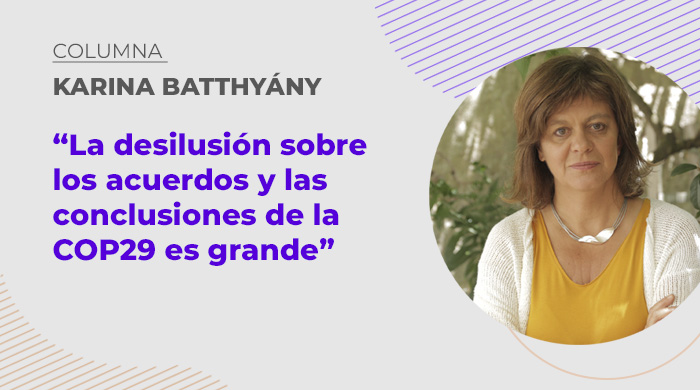
Transcript of Karina Batthyány's column
in InfoCLACSO – November 27, 2024
On Monday, November 11, the annual UN climate change conference, COP29, took place in Baku, the capital of Azerbaijan. Frankly, there is great disappointment regarding the agreements and conclusions reached, with ambivalent feelings about certain tensions and confrontations.
Industrialized nations undoubtedly celebrated the conclusions included in the final document, while the countries most affected by climate change were left with a sense of little progress and feeling they had gained nothing. 2024 has provided ample evidence of the implications of climate change in terms of recorded temperatures and is projected to be the hottest year on record. It also set records for floods, droughts, and other extreme weather events.
It was two weeks of tense, polarized negotiations, where the final agreement sets a generic goal for the fight against climate change: to mobilize $1.3 trillion in public and private resources by 2035. But it does not clearly specify where the money will come from or how much developed countries should contribute to help less developed nations, which are often the most affected by the consequences of climate change.
The wealthiest nations should contribute $300.000 billion annually by 2035, tripling the current target of $100.000 billion. Despite this increase, the new pledge falls far short of the actual needs of the countries most affected by climate change, which have criticized the stinginess of Western governments, led by the United States and the European Union.
Several countries slated to receive funds to mitigate the effects of climate change, such as Cuba, Bolivia, and India, have criticized wealthy nations for their lack of commitment. The Nigerian delegate described the amount offered by developed countries as an insult and a joke. Meanwhile, the Indian delegation's representative opposed the document, expressing deep displeasure with the final text and asserting that it is nothing more than an optical illusion because it fails to address the enormity of the challenge humanity faces regarding the environment and climate change.
Although the central debate at COP29 was financing, it also failed to send a clear and forceful message about the urgent need to rapidly reduce emissions and abandon fossil fuels. At COP28 in Dubai in 2023, for the first time in over 30 years, a direct mention was made of the need to move away from fossil fuels to prevent global warming from reaching increasingly dangerous levels. However, pressure from oil-producing countries resulted in the removal of any direct reference to fossil fuels, and greenhouse gases were discussed only in terms of the consequence, not the cause, of the problem.
At COP29, there was considerable pressure, spearheaded by Saudi Arabia. This pressure prevented a consensus from being reached on including direct references to fossil fuels, as the text supporting the Dubai summit's outcomes was not approved. No mention was made of the need to move away from these fossil fuels, which are the root cause of many of the problems being discussed.
Spokespeople for the most powerful and environmentally damaging countries nevertheless sought to project optimism, asserting that the agreement would enable the clean energy boom to continue growing and that countries could share the benefits of bold climate action, resulting in more jobs, stronger growth, and cheaper, cleaner energy for everyone.
The most critical analysts emphasize that the final document ignores the link between the effects of climate change and other multiple crises. Especially in countries already severely affected by environmental degradation and poverty, the climate crisis increases the risk of hunger, malnutrition, poverty, disease, and population displacement. This is why access to climate change mitigation and adaptation funds is so urgent in these fragile and conflict-affected states where there is a high level of food insecurity. However, the countries most exposed to climate-related shocks are not currently receiving the resources they need to prepare for and mitigate them.
As the Humanitarian Assistance Report 2023 has shown, multilateral climate finance per capita in climate-vulnerable countries with long-lasting crises is only one-fifth of the funds provided in climate-vulnerable countries without long-term crises.
The increasing number of climate-related extreme weather events, such as droughts, floods, and heat waves, threaten the food security of millions of people, disproportionately affecting women and children. Despite this, COP29 failed to secure any new binding commitments in the area of food and agriculture for a socially just and sustainable transformation of food systems that places small-scale farmers and the right to adequate food at the center.
At COP29, the Baku Climate Harmony Initiative was launched, led by the COP presidency and supported by the Food and Agriculture Organization of the United Nations (FAO). Its aim is to catalyze and accelerate the transformation of agriculture and food systems by 2030 for the benefit of people, the climate, and nature. This initiative focuses on farmers' contributions to climate change mitigation and adaptation but lacks concrete steps or commitments on how to achieve this. Therefore, beyond documents and words, it is crucial to understand that unless the voices of the most affected communities are truly heard and considered in climate negotiations, the much-needed transformation in this area will not occur.
Climate change is not a future problem; it is an urgent issue that must be addressed now, because it affects the most vulnerable regions of all five continents with droughts, devastating fires, increasingly frequent floods, increasingly destructive hurricanes, melting polar ice caps and glaciers, the resulting rise in sea levels, epidemics and pandemics, but above all, with consequences for food security, including cruel and brutal famines like the ones we are witnessing right now. And this concerns not only the least developed countries but every country on Earth.
Let's consider the images of Spain devastated by mudslides and floods in recent weeks, or California ablaze. No one is safe, no one can look the other way, and once again, states and countries alone cannot find the solutions.
The populations of the most industrialized countries also have the power and the urgency to demand concrete measures from their rulers to stop and reverse damage that could become irreversible for the environment and for the inhabitants of planet Earth.
So, COP29 missed a great opportunity to start taking serious action with real transformations on this issue as urgent as climate change.
If you would like to receive more information about CLACSO's training programs:
[widget id=”custom_html-57″]
to our email lists.

