
"Inequality and poverty particularly affect girls, boys, young people and women."
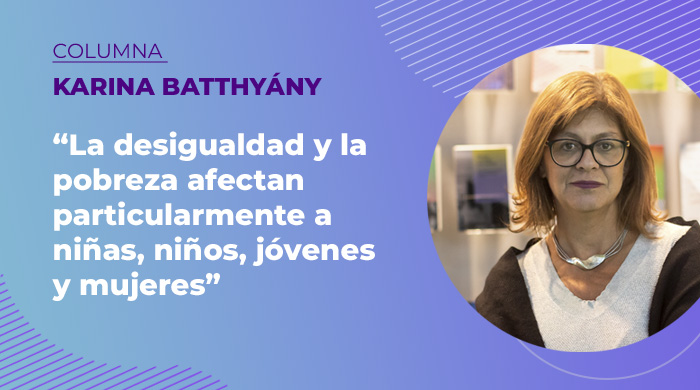
Transcript of Karina Batthyány's column
in InfoCLACSO – May 8, 2024
At the FLACSO Argentina headquarters, the International School of Postgraduate Studies of the Network on Childhoods and Youth (RedINJU) is being developed, which represents quite well the work we do at CLACSO.
All the activities carried out, such as the eleven schools that preceded the one mentioned, as well as the postdoctoral training programs and other research and knowledge dissemination initiatives, are cooperative and collaborative. Furthermore, it engages with the three audiences that CLACSO always likes to work with: social movements and organizations, the academic sector, and the public policy sector.
FLACSO has always been part of our CLACSO Network, with activities that reflect the Social Dialogue Platforms (PDS) framework. This commitment extends throughout Latin America and the Caribbean, based on the conviction that it is through social dialogue that we can build transformative alternatives for our region.
– At a very particular moment in Argentina in relation to children and young people, and in general with a very complicated socio-political map and with concrete difficulties within the framework of a new government, to the point of the removal of rights, what is your analysis regarding these political changes in Argentina?
The issue of childhood and youth is central in Latin America and the Caribbean, where it is linked to regressive policies and the erosion of rights for these groups, and indeed for the population in general. I am referring to rights policies that profoundly disrupt daily life, those elements that were painstakingly built up over years to improve and transform the daily lives of children, adolescents, and young people.
Today, all those rights policies are being cut back from regressive perspectives in terms of very basic rights such as education, health, and care, calling into question two central elements: democracy in terms of well-being and possible improvements in daily life, and inequalities in terms of how poverty has increased in Argentina since the beginning of 2024. Those of us who dedicate ourselves to studying the issues of democracy, inequality, and poverty know that it particularly affects children, youth, and women within those categories.
– In that context, it is difficult to exclude the issue of care work, as it is a completely related topic within unpaid work…
– First, with the change of government in Argentina, the care initiative, which was making significant progress in terms of legislation, a system, and concrete policies, was cut short. This situation is not unique to Argentina, because unfortunately, it also occurs in other Latin American countries. Even in Uruguay, where progress had been made in establishing care systems, these policies were quickly cut when neoliberal, right-wing, and far-right governments came to power.
Furthermore, in concrete terms of the well-being of these children and adolescents, there are all the cuts associated with the education system, which is being dismantled. In this sense, all that is happening is a return to the home, that is, to families and women, with hours upon hours of caregiving. And on the other hand, these same women, who are burdened and overburdened with this unpaid care work, see their retirement prospects reduced by all the reforms being implemented, and they will lose the possibility of ever accessing retirement benefits, pensions, or a pension.
– We had elections in Panama, with José Raúl Mulino winning the presidency, associated with what appears to be the far right. Do you have any thoughts on this?
The first thought is the extreme concern of seeing how these far-right governments are spreading in various countries of Latin America and the Caribbean. Of course, in this case I'm referring to Central America. What has happened in Panama is just one more point on that map that is shaping the expressions of the far right in our region and in the world.
So, through the work we do at CLACSO, we are trying to find alternatives for this new moment. Once again, we must place democracy at the center, in its fullest sense and with all its content—that is, democracy linked to the exercise of citizenship and its rights in daily life. We will closely follow the situation in Panama, how José Raúl Mulino's victory influences Central America and all of Latin America and the Caribbean, because we are indeed concerned about this new victory of the extreme right in our Latin American and Caribbean territory.
If you would like to receive more information about CLACSO's training programs:
[widget id=”custom_html-57″]
to our email lists.

