
“Inequality in Latin America is linked to the unfair sexual division of labor and care.”
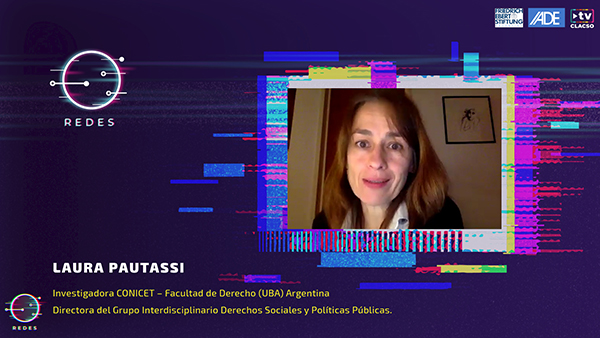
As part of the second meeting of the Virtual Conversations Series on Social Security and the Pension System, organized by CLACSO, the Friedrich Ebert Foundation, IADE, and the CLACSO Working Group on Social Security and Pension Systems, CLACSOTV spoke with Laura Pautassi, CONICET Researcher – Faculty of Law, University of Buenos Aires. Director of the Interdisciplinary Group on Social Rights and Public Policies.
Interviewed by Gustavo Lema
Laura Pautassi argued that “we no longer need to talk only about the pandemic crisis, but about how we are positioning ourselves to think not only about the solutions—because this will probably take some time—but also about how we emerge from it in a better position and how we can build societies that are somewhat less unequal than those we have in Latin America. Latin America is not only the most unequal continent on earth, measured by income inequality, but this inequality is also linked to the unjust sexual division of labor and care, and this has been brought into sharp focus by the pandemic. In fact, the major contributions from gender perspectives, feminist economics studies, and the sociology of care clearly show how the non-monetary economy is currently sustaining monetary economies; the crisis is being sustained thanks to this invisible, unrecognized, unpaid work, which is primarily done by women in the region. Therefore, the proposal for a universal basic income is one that has been debated for many decades, a proposal that began in the 90s, primarily in Europe, by some [unclear/unclear]. From the most prominent contemporary political theorists and philosophers… Citizen's income offers an answer; it's a proposal for how we can establish an income that is at least sufficient to satisfy basic needs—in a broad sense, basic needs—but that is universal, meaning for everyone, and that is unconditional, with nothing in return. This also carries significant weight in Latin America, where it was implemented in the 90s, a time when conditionality and reciprocity were central to social policies. And this very idea of unconditionality also implies a construction of autonomy.”
If you would like to receive more information about CLACSO's training programs:
[widget id=”custom_html-57″]
to our email lists.

