
Democracy (im)possible
By Anahí Durand – Co-coordinator of the CLACSO Working Group on Disputed States
Peru is experiencing the collapse of the political regime imposed by Alberto Fujimori's self-coup in 1992 and renewed during the 2001 transition. Pedro Castillo's victory channeled the expectations of the most excluded sectors and opened a new chapter in this agony. Castillo had to confront the constant obstructionism of powerful groups entrenched in Parliament, in collusion with the Public Prosecutor's Office and the mainstream media. Their objective was always to prevent a pro-people mandate led by one of their own from completing its term and succeeding.
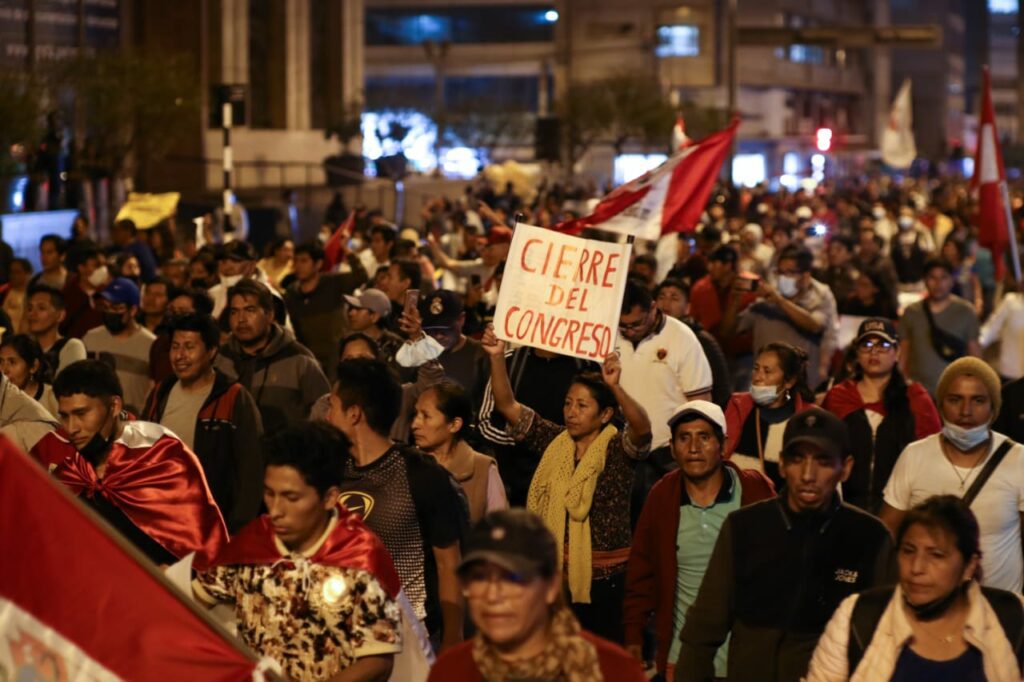
After sixteen months of siege, in a desperate act, Castillo attempted to close Parliament and convene a Constituent Assembly. Barely had he finished his speech when the police arrested him, even though he was still president, and two hours later Congress impeached him and swore in Vice President Dina Boluarte. The public reaction was swift, and demonstrations demanding the closure of Congress, a new Constitution, and Castillo's release multiplied throughout the country. Boluarte's response has been repression and criminalization; a state of emergency has resulted in dozens of deaths, injuries, and arrests. The right-wing majority in Congress has agreed to call new elections for April 2024 and refuses to allow a referendum on a new Constitution.
Today the regime is violently collapsing. Liberal democracy, as a path to transformation for the majority, is shackled by powerful groups accustomed to direct control of the state apparatus. But the popular sectors, until recently depoliticized and fragmented, have burst onto the scene with political demands and a level of prominence unseen in recent decades. It is therefore important to analyze the current situation from two concurrent perspectives: on the one hand, the tension between formal democracy, hamstrung by the elites, and the popular will expressed at the ballot box; and on the other, the possibility of establishing a plebeian democracy that gives way to a new social pact, finally breaking the old pendulum swing of authoritarianism and violence.
Formal democracy; a legality with its hands tied
Gramsci explains an organic crisis, or regime crisis, as the collapse of the entire socio-political and economic system, generating great instability as institutions lose credibility and legitimacy in the eyes of the citizenry. In Peru, the civic-military-business dictatorship of Alberto Fujimori established the neoliberal regime enshrined in the 1993 Constitution. The 2001 transition did not bring about significant changes to the established order. The right-wing groups that seized power ignored demands for change to the model, including the demand for a new Constitution. The economy was booming, and the regime continued on its course while promoting the image of a successful country; any protests were brutally repressed.
With the transition, the State affirmed its role as a promoter of private investment, consolidating an elite connected to transnational businesses that were not always legal, as evidenced by the involvement of high-ranking officials in the Odebrecht case. At the base, as a corollary to this unequal prosperity, lay a country marked by precariousness, with 70% of workers in the informal sector linked to textile SMEs, informal mining, public transportation, and also to organized crime and drug trafficking. Politics was mired in its own crisis, with parties emptied of substance and selling out each election, and a Parliament transformed into a corporate body where local bosses secured their businesses, be they private universities, law firms, or slot machines and casinos. Fed up with the political class, the popular sectors grew increasingly disaffected with democracy, and levels of interpersonal distrust rose [1].
That excluded, informal, and systematically fragmented country voted for proposals for change. It did so in 2006 when 30% voted for Ollanta Humala in the first round, and again in 2011 when 31% elected him. They were betrayed, but in 2016 they persisted with Verónika Mendoza, who garnered 20% in the first round. In practice, a quarter of the electorate clung to the basic premise of liberal democracy that their vote could change things. But for this premise to be real, other variables are at work, such as a party system that guarantees that, upon reaching power, the demands of the voters will be met; a political and institutional design that allows for a balance of power; and, above all, actors who respect the established rules of the game and do not modify them for their own benefit.
In Peru, the party system is mired in a long-standing crisis. The old guard blocks the path for newcomers, and their ties to voters are extremely fragile. This is exacerbated by the political system, designed since 2016, which has increasingly shifted towards parliamentarianism. Unable to win the executive branch, but holding a parliamentary majority, Fujimorism, along with groups like Alliance for Progress, used Congress to manipulate the law to its advantage, employing mechanisms such as "impeachment for moral incapacity." Pedro Pablo Kuczynski was the first victim of impeachment. Martín Vizcarra defended himself by invoking the vote of confidence, which, if denied twice, allows for the dissolution of Parliament. However, the new Congress impeached Vizcarra and passed a law limiting the vote of confidence, thus disrupting the balance of power. Furthermore, to block citizen initiatives, a law was passed restricting the right to call a referendum on constitutional reform. All of this was done with the endorsement of the Constitutional Court, whose members, of course, are appointed by Congress.
In 2021, that quarter of the country—precarious, informal, distrustful, and devastated by the pandemic—voted again for change, and they voted for one of their own. To the surprise of the Lima establishment, rural teacher Pedro Castillo won, raising the banners of that excluded Peru, and adding the anti-Fujimori vote in the second round. For the elites, the objective was clear: this man from Chota couldn't govern, so they fabricated electoral fraud. Once Castillo was president, they maintained their objective, manipulating the law to sabotage his government. From Parliament, they presented three motions for impeachment, prevented him from leaving the country, and censured his ministers. The Attorney General's Office did its part, reinterpreting the Constitution to investigate a sitting president, opening dozens of case files. The mainstream media amplified every accusation with high doses of racism and classism. The two votes of confidence that the president presented to enable the referendum and restore the balance of power were shelved by Congress.
Pedro Castillo's desperate attempt to dissolve Congress and convene a Constituent Assembly was not a bolt from the blue destined to disrupt a healthy democracy. It was a response to a legal system that had been previously shackled and tailored to the needs of the powerful groups that were about to remove him from the Presidential Palace. Castillo's arrest by the police while still president, his removal by a delegitimized Parliament with only 6% public approval, and the swearing-in of Boluarte sparked popular outrage. Democracy appeared to be hamstrung, and the people took to the streets and highways, refusing to accept that their vote—that last vestige of power they seemingly possessed—was worthless. Today, the uprising continues, and mobilizations demanding the closure of Congress, Castillo's release, and a new Constitution are multiplying. The elites, accustomed to seeing scattered and sectoral protests, criminalize them and respond with violence. The outcome remains uncertain; we shall see if a democratic solution is possible.
The democratic way out: Pedro Castillo, the uprising and the constituent path
The elites' contempt ultimately triggered a national explosion unprecedented in the 21st century. While polls predicted widespread discontent if Castillo were impeached and Congress remained in place [2] , no one imagined the magnitude and territorial reach of the protests. It is therefore important to examine this explosion in light of Castillo's administration, considering not only what he failed to do, but above all, what he did to help the informal and excluded segments of Peru recognize that another form of democracy was possible.
For Lima's politicians, intellectuals, and press, Castillo was always an uncomfortable figure, a target of their criticism. They weren't interested in understanding why, despite the brutal counter-campaign, the president maintained a 30% approval rating (an astonishing figure in a country that hates its politicians). And Castillo is not easy to characterize. A peasant and entrepreneur who carved out a place for himself in politics backed by the radical wing of the teachers' union and supported by the peasant patrols. Not very leftist by the standards of the left, distrustful, pragmatic, and a stickler for quotas. The teacher who studied at a teachers' college, who paid for his specialization at La Cantuta by washing sheets in a Lima hotel, who campaigned with a hat and on horseback while all the progressive spotlights were on the cosmopolitan Vero Mendoza, won a presidential election and occupied the Government Palace for sixteen months.
What did Castillo accomplish in government? Very little in terms of policymaking. Beyond the constant obstructionism in Congress, he failed to implement transformative measures, and except for sectoral issues like labor rights, topics such as tax reform and the nationalization of natural resources remained unresolved. He was also unable to assemble a cohesive technical team to carry out his proposed changes. Pressured by the crisis, Castillo pragmatically selected his personnel to avoid impeachment, granting power even to his adversaries. He was never able to unite a left-wing bloc, overwhelmed by the sectarianism of Perú Libre and the hypercritical nature of middle-class progressivism. Naturally suspicious, he prioritized family members and close associates who became involved in corruption scandals. Although there is no evidence directly implicating the president, nor any indication of wealth, the accusations amplified by the press were enough to label him corrupt.
But more important is understanding what Castillo did. First, he strengthened the representative, identity-based component of democracy, that equalizing factor by which all citizens are of equal worth. Second, and more importantly, he strengthened the deliberative component. Both in the Presidential Palace and in the decentralized cabinets, Pedro Castillo and his ministers met with teachers, Indigenous communities, unions, informal miners, coca growers, and all the diverse sectors of that precarious, informal, and excluded Peru. They gave accounts and took notes, promising much but also sealing commitments. It would be easy to categorize this as populism, but it's not enough. This political dynamic redistributed power, taking it out of spaces forbidden to the people and, at the same time, bringing the people into those forbidden spaces. Simultaneously, it affirmed customary practices, which occur in rural communities and now took place in the center of government. This redistribution included the struggle for control of the public apparatus; Professionals from Chota, Chiclayo, and Cusco entered the public sector, displacing the middle classes of Lima. The press and the elite clamored that they were unqualified, but, as one of them stated, “ We are professionals and we have the right to be here.”
This uprising, whose unifying element is the rejection of the political class represented by Congress and Dina Boluarte, has as its fundamental axis the hard core of almost 40% who are also mobilizing for Castillo, the president who was one of their own [3] . This marginalized, informal, rural, and excluded Peru has become politicized under Castillo's government and is moving from subordination to antagonism. It no longer wants to be a spectator or go to the polls every five years; it doesn't want to protest only about economic issues; it has a political horizon to defend and is doing so at the risk of its life. Peasants, miners, community patrol members, teachers, and motorcycle taxi drivers are gathering on highways and in plazas in Ayacucho, Arequipa, Junín, and Lima. I ask one of them why he is there: “ We asked the professor to close Congress, and he did it; now it's our turn to do our part for him.” The Asháninka leaders declared themselves in ancestral rebellion and stated, “ They haven’t let our president work a single day, and he has fulfilled our demands; now we are going to defend him .” There you have Andean reciprocity.
After fifteen days of brutal repression with more than 25 dead, hundreds wounded and arrested, with President Castillo imprisoned on charges of rebellion and his family in exile in Mexico, the situation is far from calm. Congress has yielded by calling new elections for April 2024, but it downplays the protests and refuses to concede on the referendum for a new Constitution, much less on the release of Pedro Castillo. The people remain angry; they want the congressmen gone, they want the traitor Dina gone, they want a new Constitution written by themselves. Undoubtedly, the repression, criminalization, territorial dispersal, and absence of legitimate leadership other than Castillo himself may diminish the uprising. But the outcome of the crisis remains uncertain, and if the mobilized people have achieved anything, it is to open the path to a constituent assembly, the process toward a new Constitution as a new social pact that includes these majorities. It may take more or less time, but the balance of power is in dispute, and there is a core group of believers. It will be fundamental how popular, leftist and progressive forces come together so that this constituent solution becomes a reality and has the leading role of this other Peru that has been humiliated and offended for so many years.
[1] In every year of the survey, Peru has consistently ranked among the countries with the lowest levels of interpersonal trust, along with Brazil and Haiti. Institute of Peruvian Studies (2021)
[2] According to the latest IEP poll, 71% of Peruvians do not agree with Dina Boluarte assuming the presidency www.iep.org.pe
[3] 71% indicated they would mobilize for the closure of Congress; secondly, 40% would do so to show their support for former president Pedro Castillo, and 15% in favor of Congress. www.iep.org.pe
Access the full article

