
The cruel pandemic, a crisis of modernity and a deepening of the global food crisis. Common struggles and solutions
Narciso Barrera Bassols[1]
Manuel Gonzalez de Molina[2]
José Nelson Montoya Toledo[3]
Olga Isela Morales Villeda[4]
Shantal Meseguer[5]
This is the crossroads of history: either death or symbiosis
Michel Serres
The Natural Contract
The cruel pandemic, a small but painful crossroads
The extremely serious situation that both the world and our Latin American region are facing in terms of the rapid expansion and deepening of the COVID-19 pandemic, responds to a complex set of impacts framed within the same project of modernity, installed as a dominant structure that associates manifestations of an unprecedented crisis, which goes even beyond the inequalities generated by the capitalist system itself, and which unfolds in all aspects of life, resulting in a pandemic of planetary characteristics and systemic consequences, still unpredictable (CLACSO, 2020).
The structural violence of modernity has unleashed a civilizational crisis, an interwoven crisis that cannot be understood through fragmented and linear thinking—characteristic of the hegemonic system—but rather from a systemic and complexity perspective. Today, coupled with climate change and the destruction of ecosystems, the hegemonic, inefficient, and polluting industrial agri-food system, which promotes the commodification of food, is severely exacerbating food-related health problems, destroying collective and community ways of life, and consequently generating unprecedented social and economic polarization and inequality. Into this grim panorama, COVID-19 emerged to definitively reveal the resounding failure of the modernity project, its industrial agriculture, and its hegemonic agri-food system (Taibo, 2014).[6]In this sense, the pandemic that is currently afflicting us is nothing more than a reflection of a broader global crisis that is already civilizational in nature; it constitutes a small sample that foreshadows others of greater severity and force (Fernández Durán & González Reyes, 2014; Álvarez Cantalapiedra, 2019).[7].
A historical review is necessary to find clues that will lead us to understand the nature of this emerging situation. Epidemics have arisen in contexts of sedentary and overcrowded populations, where the destruction of ecosystems and habitats of wild species is carried out simultaneously, along with their displacement by monocultures and domesticated animals. In this way, the pathogens inherent to these animals slowly mutated until they became host to humans; the most recent example of this is avian and swine flu, which passed from these animal populations, crowded into food production centers, to the human populations that consume these products (Wallace, 2016).[8]This zoonotic process is magnified in modern cities, home to 70% of the world's population. Industrial agriculture and intensive, confined livestock farming favor the development of mutated pathogens that then spread to human populations, often malnourished due to mineral and nutrient deficiencies, with increasingly less diverse and ultra-processed diets. All of this contributes to weakened immune systems, making them more susceptible to attack by pathogenic microorganisms like the COVID-19 coronavirus. But what can we do about it?
The emergence of agroecologies in the face of the collapse of the corporate agri-food system
…When we are able to imagine
the planet as our common home
nature as our original mother,
to whom we owe love and respect.
It does not belong to us.
We belong to her.
When we get through this quarantine,
We will be freer from the virus.
the quarantines caused
because of the pandemics
Boaventura de Sousa Santos
The cruel pedagogy of the virus
For decades, agroecology has drawn attention to the risks and unfeasibility of maintaining an industrialized agri-food system and has offered - thanks to the work of farmers, researchers, social movements, peasant or indigenous peoples, new urban peasantries and youth returning to the countryside - a series of alternatives to the hegemonic agri-food system, but also to the prevailing political-economic system (Rosset & Altieri, 2018)[9]Food security and sovereignty have been championed through the design of sustainable agroecosystems, the creation of alternative agri-food systems, consumer networks and solidarity markets in short circuits; all this, through the exchange of knowledge, wisdom and experiences with horizontal methods, the protection of biocultural diversity and scientific approaches that challenge or demonstrate the precepts of Western science and its subservience to the same global and hegemonic system (López & López, 2003)[10].
In this sense, the systemic consequences of the COVID-19 pandemic, which, like any crisis or breaking point, also account for processes that bifurcate in the search for possible solutions - in short, medium and long term- (IPES-Food, 2020)[11] and which today are a “cruel pedagogy” that reveals to us the worsening of the already serious situation to which the world population has been subjected, mediated by the inability of the State to respond to such an emergency (Robinson, I. II, III, 2020)[12]It is revealing to recognize that the world has lived for the last 40 years in a state of permanent crisis, as suggested by the Portuguese sociologist Boaventura de Sousa Santos (2020: 19)[13]This situation is further aggravated by the spread of the pandemic, legitimizing the acute and catastrophic concentration of wealth and, if this trend continues, the imminent deepening of the ecological crisis. In this sense, the prolongation of the unjust global or corporate agri-food system, as it adapts to these new post-pandemic conditions, which have been called “the new normal,” offers only one controlled path along which large corporations will attempt to consolidate their power, portraying themselves as guarantors of food security, in order to sustain the global system as a whole. More of the same, but updated, path with its aggravated consequences.
Conversely, the lessons of this “cruel pedagogy” prove fertile ground for strengthening alternative agri-food systems driven by agroecology, as we will see later. In the short term, the consequences of COVID-19 will exacerbate food injustice in multiple ways: shortages, a drastic reduction in access to food due to lack of economic resources, increased poverty, disease, and famine for a growing segment of global society. However, the lessons that emerge and will emerge from this situation enable, in the face of the current circumstances, the strengthening of transitions toward localized food sovereignty, its widespread adoption based on the need to care for life and the territories where it is recreated, and with this, the strengthening and scaling up of other possible food worlds (Altieri & Nichols, 2020; Mier y Terán et al., 2018; Ferguson et al., 2019; Zibechi, 2020).[14]The pandemic and its impacts thus present opportunities to redirect course, either for or against life itself. This will enable the activation of collective imagination and the political capacity held by those who wish to safeguard community life, in the fullest sense of the word (Lianke, 2020; Roy, 2020; CONAIE, 2020).[15]This forked path will either open up or exacerbate tensions and disputes, battles yet to come; however, the spectrum of possible alternatives allows us to glimpse horizons of achievable utopias, whose examples demonstrate that the future is here and now, rooting new ways of living, eating, healing, and loving to resist, confront the crisis, and feed the hunger for life with dignity and justice (Southern Ecosocial Pact, 2020; Svampa, 2020; Holt-Giménez, E. & R. Patel, 2012)[16].
The global crisis affecting us today has compelled us to deepen our reflection and innovative practices in the face of the challenges ahead in overcoming it, with the aim of relearning—through dialogue, debate, and listening—how to rethink ourselves and rebuild shared forms of social life. Health, reproduction, dignity, and hope must be centered on care for personal and collective life (Herrero, Cembranos & Pascual, 2011).[17] and those who care. For this very reason, it is necessary to respond to the current emergency and the post-pandemic one, since we believe that, in the short term, a food, socio-ecological and economic crisis will intensify, as well as the emergence of more authoritarian governmental systems and new forms of population control, and attacks against social movements, given their inability to resolve the increase in demands for well-being and the guarantee of rights. In this context, the pluriverse of movements for food sovereignty and those for the defense of the territory will be threatened even though their perspectives, knowledge and practices that contribute to mitigating and overcoming the crisis are crucial because our lives depend on it (Prats, Herrero & Torrego, 2016).[18].
But what is agroecology, or rather, what are agroecologies?
Historically,
Pandemics have forced
to humans
to break with the past
and imagine their world anew.
This one is no different.
It's a portal.
A door between
one world and the next.
Arundhati Roy
The pandemic on the portal
In front of the portal
The world is immersed in a profound crisis of a global nature, made up of different dimensions including the ecological, the social, the economic, the cultural, the political and the ethical; a complex problem considered as the crisis of modernity (Touraine, 1994)[19]This crisis results from a complex combination of multiple interwoven and inseparable crises at a planetary level. This complexity includes the loss of direction and meaning in science, technology, and production/consumption; all of which are centered on the paradigm of development with growth for progress and the commodification of knowledge, leading humanity to the abyss. This multidimensional combination of the crisis allows us to point out that its global character is the most widespread and tangible evidence of the crisis of the Western or modern civilizational project (Morales, 2011).[20].
The global agri-food system is also, consequently, in a severe crisis caused by the exhaustion of its productive capacity, its environmental, health, and social effects, and its inability to fulfill the tasks for which it was rhetorically designed and positioned as the only possible one. While a very significant portion of the world's population does not obtain the minimum calories necessary for their bodies to function, making hunger and malnutrition a structural phenomenon, large sectors of the population in both rich and poor countries are affected by overeating or malnutrition, suffering serious health problems as a result and placing an extraordinary burden on already strained national health systems, among other welfare and social security systems (Bello, 2012; González de Molina, 2011).[21],[22].
However, as Toledo and Ortiz (2014) mention[23]This civilizational crisis finds its counterpart in the emergence, multiplication and expansion of alternative projects carried out by diverse social conglomerates at the local, municipal, regional, national and international scales (for example, their integration into the Via Campesina), which appear as counter-hegemonic and emancipatory proposals to the global process of ecological, food and social deterioration that predominates in much of the planet (Holt-Giménez, 2011)[24]In general, these projects are a consequence of social resistance and have several shared features, such as being championed under forms of participatory democracy, developed significantly by women, youth and indigenous peoples, with support from politically committed scientists, technicians and environmentalists, carried out through ecologically appropriate practices and under collective modalities of culturally adopted productive and consumption organization, which put into practice short circuit solidarity economies, which manifest themselves in very diverse ways, and which include a complex range of diverse actors in their participation (Toledo, 2019)[25].
These social projects converge in various rural and urban areas of Mexico, Latin America and the world, linked nominally, ideologically or through daily practice with agroecology, considering the most recent and integrative definitions of the concept and approach (Toledo & Barrera-Bassols, 2017)[26]Therefore, it is important to mention that there are various concepts of agroecology as an inter-science based on dialogue or inter-knowledge, as a set of practices that are carried out daily, as well as a social movement with political components strongly rooted in the territories (Wezel et al., 2009; Giraldo and Rosset, 2017, among others)[27].
Agroecology is both a science nourished by a pluriverse of knowledge and a set of practices. As a science, it is based on the application of ecology to the study, design, and management of sustainable agroecosystems (Altieri, 2002).[28]However, it still requires the necessary and complete understanding of the relational ontologies historically sought by the pluriversality of worlds, beyond the modern and western conception based on the argument that the world-is-made-of-a-single-world (Escobar, 2019)[29]24However, a main objective of this agroecology is to go beyond alternative agricultural practices to develop agroecosystems, landscapes and territories centered on pluriactivity, on the expansion of agrobiodiversity with minimal dependence on agrochemicals and energy inputs, and on the design of alternative agri-food systems based on integrated management of their different activities and processes (production, distribution, transformation, exchange and consumption), all of them adapted, improved and situated in order to achieve food, health, energy and shelter sovereignty in the territory, and in various stages of transition (Altieri, 2002)[30].
Altieri and Toledo (2011)[31]They mention that agroecological systems are deeply rooted in the ecological rationality of traditional agriculture. Along the same lines, Toledo and Barrera-Bassols (2008)[32]These examples demonstrate that there are many instances of peasant-based agri-food systems that, throughout history and to this day, have been successful and resilient due to the maintenance and enrichment of seed diversity, crops, domesticated animals, agroforestry practices, and the multiple uses of their landscapes. All of this is achieved through the maintenance and improvement of soil conditions, water management systems, and agrobiodiversity practices. As a result of this complex web of knowledge and practices, a diverse and culturally adapted cuisine has been created, characterized by seasonal cycles and rich in nutrients and flavors.
Thus, agroecology also addresses food needs by promoting self-sufficiency based on a socio-ecological metabolism centered on the organic, promoting food production in communities and sustaining peasant economies through exchange or marketing in short circuits (González de Molina & Toledo, 2011)[33]This is an unfinished approach that greatly prioritizes the local, as it is aimed at supplying local markets, shortening the food production and consumption circuits, thereby avoiding the waste of energy that would be involved in transporting them from distant places (Altieri and Toledo, 2011).[34].
In this way, the areas of study and action of agroecology have expanded considerably, moving from agroecosystems to the agri-food system as a whole, and transitioning from the purely agricultural field to the political-territorial field (González de Molina, et al., 2020)[35]For example, new agroecological projects have the following in common: food production in diverse contexts (rural, urban, peri-urban), food production without toxic residues, creation of solidarity networks of producers and consumers, and the emergence of consumersThat is, groups and individuals who consume what they produce, generating new forms and market niches through the regeneration of synergies that sustain short-circuit food systems not based exclusively on monetary exchanges, but on the exchange of common goods through community reciprocity, as well as on the creation of spaces where the social fabric is built and rebuilt, collectivity and cooperativism are fostered, and where an attempt is made to rebuild a more informed citizenry with political and environmental awareness. For this reason, new, more integrative definitions of the concept of agroecology have emerged, based on people, communities, conviviality, and a political nature (Giraldo, 2016).[36].
An example of this is the definition by Gliessman and colleagues (2007)[37], for whom Agroecology is “the application of ecological concepts and principles to the design and management of sustainable food systems“This means, on the one hand, broadening its object of study to include all the processes involved in food production, an absolutely necessary step for a comprehensive and complex approach to the problem. Certainly, the primary function of agricultural systems is food production, but the comprehensive solution encompasses everything from production to consumption.”from the garden to the table“This perspective on the food problem is essential for the design and scaling up of sustainable agricultural systems (González de Molina, 2013)[38].
Its vocation is the analysis of all types of agricultural processes in their broadest sense, where mineral cycles, energy transformations, biological processes and socio-economic relationships are investigated and analyzed as a whole (Altieri, 1995)[39]This includes a thorough understanding of the hegemonic global agri-food system and its impacts, as well as those offering knowledge and technical resources for its adaptation and innovation toward agroecological systems based on territory, culturally adapted, just, and sovereign. Therefore, we speak of agroecologies in the plural, or of the existence of a pluriverse of agroecologies in progress, shaped and championed by sectors of society that are moving toward the construction of other possible worlds; worlds in transition, worlds in transformation.
Agroecologies are, moreover, as mentioned by (Sevilla, 2018)[40] Strategies for confronting the development of capitalism through the care of what we understand as nature are sustained by forms of collective action that seek to decenter the profit-driven logic of the market. The political dimension of agroecology is essential, since a depoliticized ecological agriculture is easily adapted or co-opted by agribusiness. Agroecologies place life at the center with all that this implies, resulting in cultures of care (for the land, for living beings, and for the planet), with broad and profound participation from women and the community or collective. In this sense, agroecologies are political, or they are not agroecologies (Toledo & Barrera-Bassols, 2017).[41].
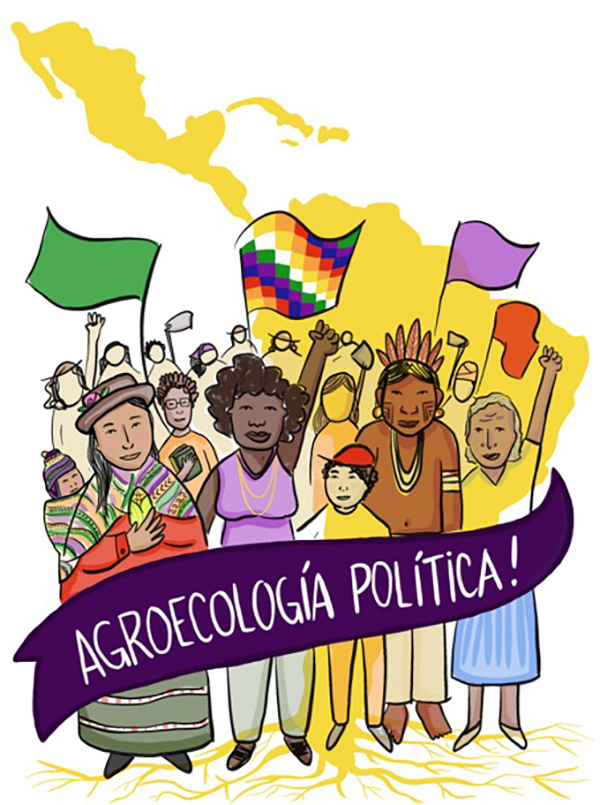
Agroecologies are political, or they are not agroecologies.
We urge everyone not to lose human contact.
But temporarily change the forms to
knowing each other as comrades.
Brothers, sisters, brothers.
Words and hearing with the heart.
They have many paths, many ways.
Many calendars and many geographies
to find you. And this struggle to
Life can be one of them.
EZLN
Voices in times of pandemic
In front of the portal
"Food movements of the world, unite!" reads the title of a book that reports on a growing number of collective actions in defense of healthy food, food sovereignty, and, many of them, especially in Latin America and Mexico, in defense of territorial sovereignty.[42]Faced with the perverse effects caused by the hegemonic and global industrial agri-food system on the health of the planet and the billions of people who currently inhabit it, these movements have acquired enormous political relevance due to the spread of hunger and disease, soil erosion, deforestation, and the loss of ancestral lands and territories. For this reason, agroecologies have put forward a transdisciplinary and intercultural approach that proposes the restoration of local and territorial agri-food systems, centered on relinking the paradigms of agronomy and ecology as a kind of biomimicry—that is, the act of imitating nature as a path toward reconstructing human production systems in order to make them compatible with the biosphere, as philosopher Jorge Riechmann put it.[43]Something that our ancestral peoples know well and that, despite the multiple forms of epistemicide, resists and renews itself in increasingly intimate spheres.
Agroecologies, as inter-knowledge, re-establish these links by assuming two postulates. The first is the recognition that nature, as we conceive it now, is the result of a long and multifaceted process of experimentation for the continuation of life. Its intelligence and adaptability, unfolding in the face of unpredictable events, have managed to sustain themselves for billions of years, fostering the expansion of biodiversity and all that this implies. The second postulate recognizes that, throughout human history, our species has been able to adapt to this complexity and even enrich the diversity of life through its intelligence and skills, creating new species, landscapes, knowledge, and ontologies. This biocultural memory resides fundamentally in agrarian peoples and communities who, having a direct relationship with what we call nature—or what is more than human—have been able to recreate this richness, represented as agrobiodiversity, through complex processes of biomimetic recreation. Thus, although agroecology as a variegated fabric of inter-knowledges is a novel inter-discipline/practice still under construction, its most advanced definition is the one that postulates as its main epistemological foundations, its inescapable link between knowledge, practices or daily life and social movements.
Agroecologies, as territorialized or situated practices, include the reorganization of social structures, the recovery of biocultural memory or its adaptation as a kind of ethnogenesis, and the strengthening of the collective, thus reinforcing community ties in defense of the common good. But fundamentally, they are emblematic activities in the reorganization of our ways of life, which, in the face of the ecological and civilizational crisis—and those we are currently experiencing with this cruel pandemic—strengthen self-restraint against waste as a precautionary measure for the preservation of life. In this sense, food sovereignty as a human right is fundamentally political. This inalienable right leads to new ways of valuing the meaning of living well and with dignity, which, together with the rights to energy, health, and shelter sovereignty, constitute the narratives and practices championed by social movements of a growing number of collectives in resistance and defense of land, food, and territory, both in cities and in the countryside. And it is here that the pluriverse of agroecologies—as inter-knowledges, practices, and situated social movements—are playing a strategic role, becoming new social paradigms that are becoming popular, widespread, and articulated, as indicated by the title of the book mentioned above, exclaiming, "Unite!"
Agroecology and politics are thus revealed as an inextricable communion, given that the act of eating is an immeasurable political and cultural act. Or, put another way, every human—and non-human—act passes through the stomach. This is how the link between agroecology, politics, and the deployment of territorialized policies has required a synthesis that transcends the initial emphasis, directed exclusively at technical investigation, centered on the plot of land and on the human being as producer. Political agroecology comprises a novel, albeit incipient, transdisciplinary approach that not only allows for the necessary critical study of the hegemonic agro-industrial food system with its institutional and financial structures and its multiple impacts on ecosocial health, but also strengthens the connections between academia and social movements by providing tools for analyzing the relationships between different actors involved, their institutional modes of action, and their economic, political, and cultural demands. In short, political agroecology emerges as an interdisciplinary approach that prioritizes analysis for strengthening the agroecological transitions championed by the diverse social movement in defense of a dignified life, especially in Latin America. But what are the theoretical and conceptual foundations of political agroecology?
What is Political Agroecology? The simplest definition is the application of political ecology to the field of agroecology, or the integration of the two. If political ecology studies socio-ecological change in political and institutional terms, we could say that political agroecology is the interdisciplinary field concerned with the design and production of actions, institutions, and norms aimed at achieving agricultural sustainability. But political agroecology is not only a field of research. It is also an ideology that, in competition with others, is dedicated to disseminating and challenging the hegemony of a new way of organizing agroecosystems—or the relationship between humans and non-humans—based on the ecological paradigm, sustainability, and decolonial and anti-patriarchal critique.
The link between politics, policies, and agroecology is inextricable. However, the necessity of politics and policies, and all that this entails, has not been fully internalized by the various actors that make up the Latin American agroecological movement. Meanwhile, purely “technical” perspectives of scientific agroecology are becoming increasingly influential. This is compounded by the emerging process of corporations co-opting its paradigms and practices in pursuit of expanding their perverse accumulation and dispossession, a process that has accelerated with the pandemic to reproduce their own imperial logic (Alonso-Fradejas, A. et al. 2020).[44]Ignoring the political dimension and politics, or relegating them to a secondary role, prevents agroecological experiences—usually confined to the farm level or, at most, the community—from achieving the necessary scope, scale, and strength to become alternatives to the dominant food system. Therefore, it is necessary to establish a common framework for collective agroecological action, to lay the theoretical, conceptual, and methodological groundwork for developing agroecological strategies that take into account the different levels at which collective action is considered and the various instruments with which it can be implemented. Analyzing the significant experience already accumulated in this field throughout Latin America and the Caribbean should be one of the main tasks to be carried out through dialogue. This responds to the growing demand and diversification of the agroecological movement in the region, which is increasingly involved in areas of action that go beyond the farm or the community, including feminist, student, and environmental movements in their attempts to re-politicize different areas of life.
What role do women, Indigenous peoples, Afro-descendants, and peasant farmers play in agroecological transitions and their scaling up? What are the narratives and practices of these political actors? How do they organize and influence food and territorial transformations? What role What are their roles and how could they effectively influence the development of agroecological plans at various scales, and what is their role in the creation of national agroecology programs, for their own benefit? Why do their struggles constitute the vanguard of social movements in both rural and urban areas?, but also the rearguard of practices that have been going on for some time and are now becoming increasingly visible in unexpected placesUndoubtedly, these and other questions require analysis from the perspective of political agroecology and constitute the link in a necessary but growing and urgent political connection between academia, practice, and social movements.
A brief but heartfelt closing…
To project a way out of this crisis that is not
a return to savage capitalist normality,
but a path towards a different society.
This will be possible if we take the best
of us as peoples,
community ties
and of popular territorial unity,
and regional, which we will feed during this battle.
They will be part of the fabric that builds
the horizons of transformation of Abya Ayala.
CONAIE et al.
Appeal from indigenous peoples,
Afro-descendants and organizations
popular in Latin America.
In front of the Portal
Voices in Times of Pandemic 2020
We are living through a time of crossroads, where interwoven paths point to new or renewed directions in an increasingly perilous situation, one that challenges us to broaden the fabric of life in order to continue nurturing it. The paths of this fork are already here and now, for there will be no global justice without cognitive and ontological justice. Reducing the effects of this pandemic means expanding civilizational horizons, and this is essential, simply because life itself is slipping away. In the face of this, new questions arise today due to the COVID-19 pandemic we are experiencing, and others that are being considered as a subsequent consequence of this cruel situation: its effects on social interactions and eco-dependence, as well as the imminent food crisis expected in the short term. While this “cruel pandemic” that is ravaging us will exacerbate hunger, disease, and poverty, it also, through its very impacts and as a “cruel learning experience,” creates a critical juncture that, in principle, would favor the agroecological transitions championed by social movements creatively articulated through the collective action of the growing number of critically thinking agroecologists, trained in institutions, through practical experience, or within the movements themselves, committed to the radical transformation of our region and the entire planet. In this sense, the pluriverse of political agroecologies leads us to envision a world-where-many-worlds (agroecological) fit. And for this reason, we reiterate: Food movements of the world, unite now!
[1] Coordinator of the CLACSO Political Agroecology Working Group. Autonomous University of Querétaro, Mexico.
[2] Member of the CLACSO Political Agroecology Working Group. Pablo de Olavide University of Seville, Spain.
[3] Member of the CLACSO Political Agroecology Working Group. Autonomous University of Chapingo, Mexico.
[4] Member of the CLACSO Political Agroecology Working Group. Pablo de Olavide University of Seville, Spain.
[5] Member of the CLACSO Political Agroecology Working Group. Veracruzana Intercultural University, Mexico.
[6] Taibo, C. 2014. Collapse. Capitalism, ecosocial transition, ecofascism. The Catarata Books. Madrid. 223p.
[7] Fernández Durán R. & L. González Reyes. 2014. In the spiral of energy. History of humanity from the perspective of energy (but not only). 2 vols. Libros en Acción/ Baladre. Spain; Álvarez Cantalapiedra, S. 2019. The Great Crossroads: Ecosocial Crisis and Paradigm Shift. HOAC Editions. Madrid. 206p.
[8] Wallace, R. 2016. Big farms make big flu. Dispatches on infectious diseases, agribusiness and the nature of science. Monthly Review Press. New York. 456p.
[9] Rosset, PM & M. Altieri. 2018. Agroecology. Science and policy. Icaria Editorial. Barcelona. 206.
[10] López García, D. & López López A. 2003. Food is not a game. Self-managed alternatives to capitalist globalization from agroecology and consumptionDream Traffickers. Madrid.
[11] IPES-FOOD. 2020. Press Release. COVID-19 and the crisis in food systems: symptoms, causes and possible solutions. Press release from the International Panel of Experts on Sustainable Food Systems. IPES-Food. April 2020. http://www.ipes-food.org/_img/upload/files/COVID-19_CommuniqueES%281%29.pdf
[12] Robinson, W. 2020. Global capitalist crisis deadlier than Coronavirus (I. II. III). ARENA online, April, 2020. https://arena.org.au/global-capitalist-crisis-deadlier-than-coronavirus-part-i/; https://arena.org.au/global-capitalist-crisis-deadlier-than-coronavirus-part-ii/;https://arena.org.au/global-capitalist-crisis-deadlier-than-coronavirus-part-iii/
[13] Santos de Sousa, B. 2020. The cruel pedagogy of the virus. CLACSO. Buenos Aires. 85p.
[14] Altieri, M. & C. Nichols. 2020. Agroecology in times of COVID-19. Social Observatory of the Coronavirus. Thinking about the pandemic. CLACSO. https://www.clacso.org/la-agroecologia-en-tiempos-del-covid-19/ ; Mier and Terán, M. et al. 2018. Bringing Agroecology to scale: key drivers and emblematic cases. Agroecology and Sustainable Food Systems, (42), 6: 637-665.; Ferguson, BG, et al., 2019. Special issue editorial: What do we mean by agroecological scaling? Agroecology and Sustainable Food Systems, (43): 7-8: 722-723; Zibechi, R. 2020. Introduction. Times of Collapse: the peoples in motion. Ediciones Bajo Tierra. Mexico 12p. https://kutxikotxokotxikitxutik.wordpress.com/2020/06/11/tiempos-de-colapso-los-pueblos-en-movimiento-nuevo-libro-de-raul-zibechi/
[15] Lianke, Y. 2020. May we be left with the memory when this epidemic ends. In: Voices in times of pandemic. In front of the Portal. El Rebozo/Librería La Cosecha. San Cristóbal de las Casas, Mexico. 10-19; Roy, A. 2020. The pandemic is a portal. In: Voices in times of pandemic. In front of the Portal. El Rebozo/Librería La Cosecha. San Cristóbal de las Casas, Mexico. 36-47; CONAIE et al. 2020. Appeal of the Indigenous Peoples, Afro-descendants and Popular Organizations of Latin America. In: Voices in times of pandemic. In front of the Portal. El Rebozo/Librería La Cosecha. San Cristóbal de las Casas, Mexico. 114-123.
[16] Ecosocial Pact of the South for Latin America. 2020. https://pactoecosocialdelsur.com ; Svampa, ME 2020. Reflections for a post-coronavirus world. In: Fever: Contemporary Thought in Times of Pandemics. Editorial ASPO. Buenos Aires. 260p.; Holt-Giménez, E. & R. Patel. 2012. Food rebellions! The crisis and hunger for justice. Miguel Ángel Porrúa. Mexico 310p.
[17] Herrero, Y., F. Cembranos & M. Pascual. 2011. Changing the way we see the world: a new culture of sustainabilityBooks in Action. Madrid. 342p.
[18] Prats, F., Y. Herrero & A. Torrego. 2017. The great crossroads. On the eco-social crisis and the change of historical cycle. Dream Traffickers / Icaria Editorial. Madrid. 298p.
[19] Touraine, A. 1994. Critique of modernityFondo de Cultura Económica. Buenos Aires. 392p.
[20] Morales H., J. 2011. Agroecology in the construction of alternatives towards rural sustainabilitySiglo XXI Publishing Group. Mexico. 317 p.
[21] Bello, W. 2012. Food wars. Food crisis and structural adjustment policies. Editorial Virus. Barcelona. 286 p.
[22] González de Molina, M. 2011. Introduction to agroecology. SAE Technical Notebooks. Agroecology and Agricultural Ecology Series. Spanish Society of Organic Agriculture. Spain. 72 p.
[23] Toledo M., VM and Ortíz E., B. 2014. Mexico, regions moving towards sustainability. Ibero-American University. Puebla, Mexico. 150 p.
[24] Holt-Giménez, E. 2013. Food movements of the world Unite: Strategies to Transform Our Food Systems. CLACSO (ILSA Food First. Bogotá. 317p.
[25] Toledo, VM 2019. Civilizationalists. Rethinking modernity from the perspective of political ecology. IIES-UNAM/Juan Pablos Editor. Mexico. 187p.
[26] Toledo, VM & N. Barrera-Bassols. 2017. Political Agroecology in Mexico. A path toward sustainability. Sustainability, (9): 2. doi:10.3390/su9020268
[27] Wezel, A. et al., Agroecology as a science, a movement, and a practice. Agronomy for Sustainable Development, (29):4: 503-515; Giraldo OF & PM Rosset. 2017. Agroecology as a territory in dispute: between institutionality and social movements. Journal of Peasant Studies. [online] DOI: 10.1080/03066150.2017.1353496
[28] Altieri MA 2002. Agroecology: the science of natural resource management for poor farmers in marginal environments. Agriculture, Ecosystems and Environment, 93: 1-24.
[29]24 Escobar, A. 2019. Civilizational Transitions. In: Kothari, A., A. Salleh, A. Escobar, F. Demaria, & A. Acosta (coords)Pluriverse. A dictionary of post-development. Icaria / Antrazyt 492, Decrease: 458-461.
[30] Altieri MA 2002. Agroecology: the science of natural resource management for poor farmers in marginal environments. Agriculture, Ecosystems and Environment, No. 93: 1-24.
[31] Altieri, M. & VM Toledo. 2011. The agroecological revolution of Latin America: rescuing, nature, ensuring food sovereignty and empowering peasants. Journal of Peasant Studies, 38: 587-612.
[32] Toledo VM and Barrera-Bassols N. 2008. Biocultural memory: the ecological importance of traditional wisdomIcaria Editorial. Barcelona
[33] González de Molina, M. & VM Toledo. 2011. Metabolisms, nature and history: towards a theory of transformations socio-ecologicalIcaria Editorial. Barcelona
[34] Altieri, MA and Toledo, VM 2011. The agroecological revolution of Latin America. Journal of Peasant Studies, (38), 3: 587-612.
[35] González de Molina, M., et al., 2020. Political Agroecology. Advancing the transition to sustainable food systems. CRC Press. New York, 202p.
[36] Giraldo, OF 2016. Conviviality and agroecology. In: S. Street (ed.). With eyes wide open: in the face of dispossession, let's rehabilitate the commonsCIESAS, Guadalajara, Mexico.
[37] Gliessman, SR; Rosado M., F.; Guadarrama Z., C.; Cohen R.; Trujillo, l.; Bacon, C. and Jaffe, R. 2007. Agroecology: promoting a transition towards sustainability. Ecosystems, (16), 1: 13-28.
[38] González de Molina, M. 2013. Agroecology and politics. How to achieve sustainability? About the necessity for a political Agroecology. Agroecology and Sustainable Food Systems, 37: 45–59.
[39] Altieri, M. 1995. Agroecology: the science of sustainable agriculture. Westview Press. Boulder. USA.
[40] Sevilla G., E. 2018. Oral communication. Inaugural conference. VII International Congress of Agroecology: repoliticizing industrial agri-food systems, Cordoba, Spain.
[41] Toledo, VM & N. Barrera-Bassols. 2017. Political Agroecology in Mexico. A path toward sustainability. Sustainability, (9): 2. doi:10.3390/su9020268
[42] Holt-Giménez, E. 2013. Food movements of the world Unite: Strategies to Transform Our Food Systems. CLACSO (ILSA Food First. Bogotá. 317p.
[43] Riechmann, J. 2014. A good fit in ecosystemsSecond (revised) edition of Biomimicry. The Catarata Books. Madrid. 383p.
[44] Alfonso-Fradejas, A. et. to the. 2020. Junk agroecology. The corporate capture of agroecologyExecutive Summary. Friends of the Earth International, Transnational Institute and Crocevia. April 2020: 8p.
If you would like to receive more information about CLACSO's training programs:
[widget id=”custom_html-57″]
to our email lists.

