
“The pandemic crisis is having worrying effects on food security in our societies.”
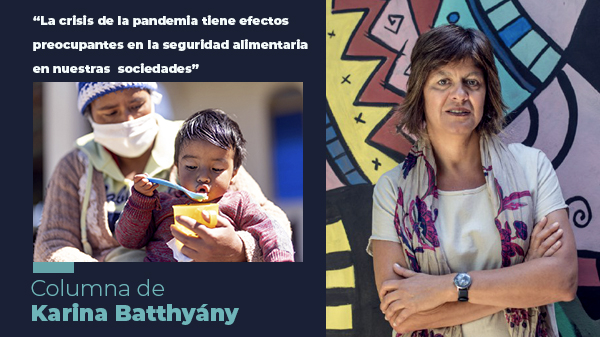
(Transcription of Karina Batthyány's Column)
(In InfoCLACSO – December 8, 2021)
We are exploring the themes of our Ninth Conference #CLACSO2022 in June at UNAM in Mexico and invite those who have not yet done so to send their contributions to ensure they can be present at the Ninth Conference presenting their work, their reflections, their research advances.
In this journey through our 34 axes, today I propose that we work around the axis of Food Sovereignty based on a report that was released a few days ago by the Food and Agriculture Organization of the United Nations, better known as the FAO, which shows worrying data and we have to include in our reflection for Latin America and the Caribbean on one of the dimensions of Food Security or Food Insecurity, which is the issue of hunger.
What does this report show us? First, it shows us a very worrying scenario of the effects that the COVID pandemic crisis has had on food security in our Latin American and Caribbean societies.
The report published last week forces us to recognize that in late 2020 and early 2021, nearly 60 million Latin Americans and Caribbeans were suffering from hunger. According to the FAO, during 2019 and 2020, hunger increased more dramatically in our region than in any other. In 2020, the prevalence of hunger in Latin America and the Caribbean was 9%, the highest figure in the last fifteen years. During the pandemic, and in just one year, the number of people living with hunger in the region increased by almost 14 million, a 30% increase.
We already knew that Latin America and the Caribbean was one of the regions most affected by the pandemic in health terms: with only 8,4 percent of the world's population, our region suffered 27,8 percent of the deaths from COVID-19 worldwide.
We also knew that the economy was significantly impacted, with declines in gross domestic product in all countries. To recap: the region's GDP is estimated to have fallen by nearly 8 percent in 2020, and the unemployment rate increased by almost 3 percentage points.
The decline in economic activity means that a large percentage of people and families in the region do not have sufficient income to purchase food in the quantity and nutritional quality necessary to maintain good health and development. This has also had an unprecedented impact on poverty, hunger, and food insecurity.
In addition to the proportion of people experiencing hunger, the FAO (in this report) develops other indicators that attempt to measure the proportion of the population facing obstacles in obtaining sufficient food over the course of a year. Moderate food insecurity, for example, describes a situation in which a person's ability to obtain food is subject to certain uncertainties; and these uncertainties force them to reduce, sometimes for a year, the quality and/or quantity of the food they consume. The FAO also addresses severe food insecurity, which refers to a scenario in which a person is very likely to run out of food, suffer from hunger, and, in its most extreme form, go several days without eating, putting their health and well-being at risk.
Indeed, if we look at the evolution of these indicators—that is, moderate and severe food insecurity—the report shows us that beyond the recent crisis of the pandemic, hunger and food insecurity have steadily increased in our region over the last six years. Between 2014 and 2020, the number of people experiencing moderate or severe food insecurity rose by 74 percent, from 153 million to 267 million. The most significant increase, with 60 million more people affected in just one year, occurred between 2019 and 2020. Consider these figures. The crisis unleashed by the pandemic, once again, as we have seen in other dimensions of inequality, only exacerbated an existing trend that largely explains what we have been stating in each column of the "Networks of Inequalities in Latin America and the Caribbean," the most unequal region on the planet.
But this report also describes a phenomenon we've discussed several times in this column: how lockdowns, stay-at-home orders, and mandatory quarantines disrupted established household arrangements for domestic and caregiving tasks, and how this also affected nutrition. Lockdowns and income losses led to reduced access to food in the quantity and quality necessary for survival, forcing people to replace more expensive foods with diets that are perhaps less healthy, such as those high in sugar, fat, and other unhealthy ingredients.
So, the FAO is warning us that food insecurity also shows a gender gap, because it affects women more than men. For example, in 2020, almost 42% of women suffered from food insecurity, compared to 32% of men. This is also (probably) related to the drop in women's labor force participation during the pandemic. It's worth remembering that, according to the ILO, nearly 12 million women left the workforce in our region due to the destruction or loss of their jobs, particularly paid domestic work, which accounts for a significant proportion of this.
This situation I have just described to you is undoubtedly alarming: Today, four out of every 10 people in the region do not eat adequately every day, and almost one out of every 10 lives in conditions of hunger.
Clearly, if we don't seek effective solutions to this problem that modify these food security criteria, we are facing a serious situation in the region. I believe this is a point we must incorporate when discussing the Webs of Inequalities in Latin America, and particularly when considering—as we have done in other columns—social protection and welfare programs. This dimension of food security must also be taken into account.
While listening to you, I was thinking about food security and food sovereignty, and how some systems unfortunately don't have the scale they should. For example, agroecological farming systems in different parts of Latin America and the Caribbean are growing (and growing significantly) but aren't necessarily given the necessary space, even though they are very powerful in terms of the environment and also in providing access to food for people. So many things need to change, and we also see how the presence of the State is fundamental in regulating these things. While there are large fields linked to the most common and traditional farming methods, agroecology offers an alternative approach.
Absolutely. That's why we always emphasize the need to combine all these dimensions and to develop solutions—not just superficial ones, but solutions that address the structural dimensions of the problem of inequality in Latin America, where food sovereignty, sovereignty in terms of production decisions related to agroecology and, more generally, the environmental dimension, is one of the issues that must concern us. Of course, this is always within the framework of what we are trying to build at CLACSO and also from this platform (Info CLACSO), which aims to create more just, more democratic, and more egalitarian societies, based on principles of sovereignty in these areas.
If you would like to receive more information about CLACSO's training programs:
[widget id=”custom_html-57″]
to our email lists.

