
The epochal crisis of global capitalism and the genocide in Gaza
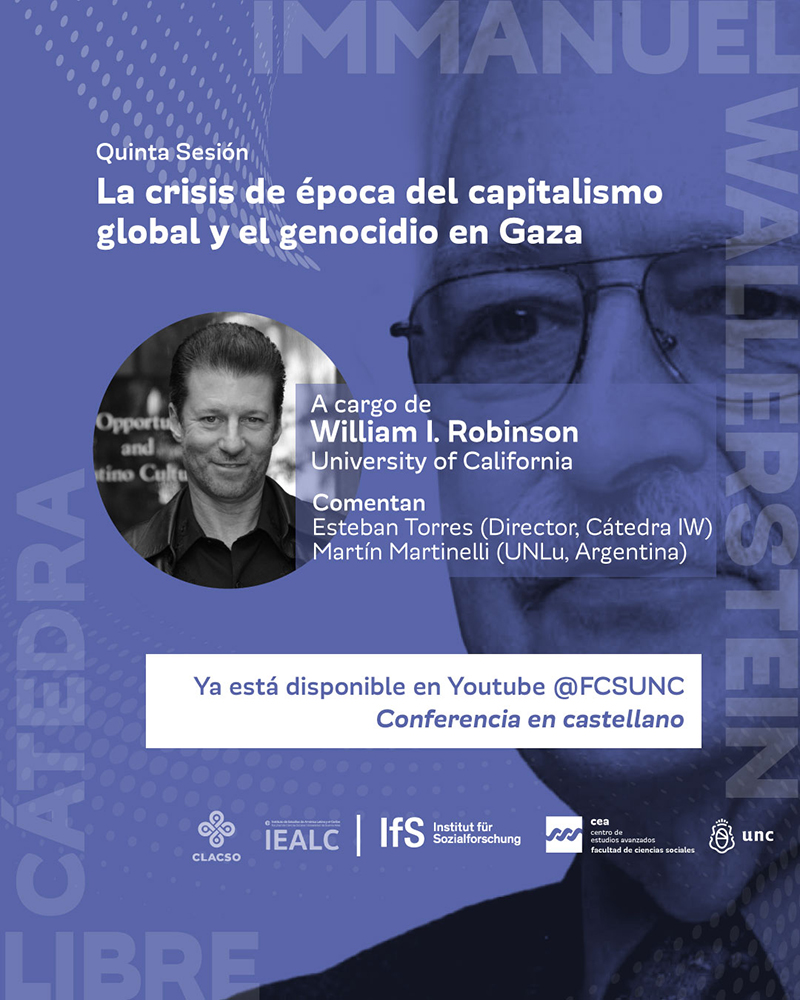
The Immanuel Wallerstein Chair presented its fifth session, entitled “The crisis of the era of global capitalism and the genocide in Gaza”, led by sociologist William I. Robinson (University of California, USA).
At a time marked by the worsening crisis of global capitalism, Robinson proposes a profound analysis of the structural dynamics that drive new forms of predatory expansion based on digitized extraction, war, territorial dispossession, and the advance of authoritarian and fascist forms of the capitalist state.
The conference also examined the historical nature of the global intifada for Palestine, which has placed the barbarity of the Israeli genocide in Gaza at the center of international debate. Robinson goes beyond the media coverage to situate these events within the global historical context in which they occur, identifying the economic and political processes that make them possible and the challenges they pose for humanity.
They commented:
Esteban Torres (Director of the Immanuel Wallerstein Chair)
Martin Martinelli (UNLu, Argentina)
William I. Robinson is one of the leading contemporary theorists of global capitalism. His work addresses political economy, the structure of social change, and new configurations of transnational power.
He began his career as a journalist during the Sandinista Revolution in Nicaragua and later earned his master's degree in Latin American Studies and his doctorate in Sociology from the University of New Mexico. He is currently a professor of Sociology at the University of California and a member of international parliamentary and civil society research initiatives.
Among his most outstanding works are Can Global Capitalism Endure?, Global Civil War: Capitalism Post-Pandemic, Into the Tempest and A Theory of Global Capitalism, reference works for understanding the development of capitalism in its transnational phase.
The Immanuel Wallerstein Chair is a space jointly organized by the Center for Advanced Studies (CEA) of the Faculty of Social Sciences at the National University of Córdoba (FCS-UNC) and the Institute for Social Research (IfS). It also has the participation, as an associated institution, of the Latin American Council of Social Sciences (CLACSO).

