
"The Construction of Latin America"
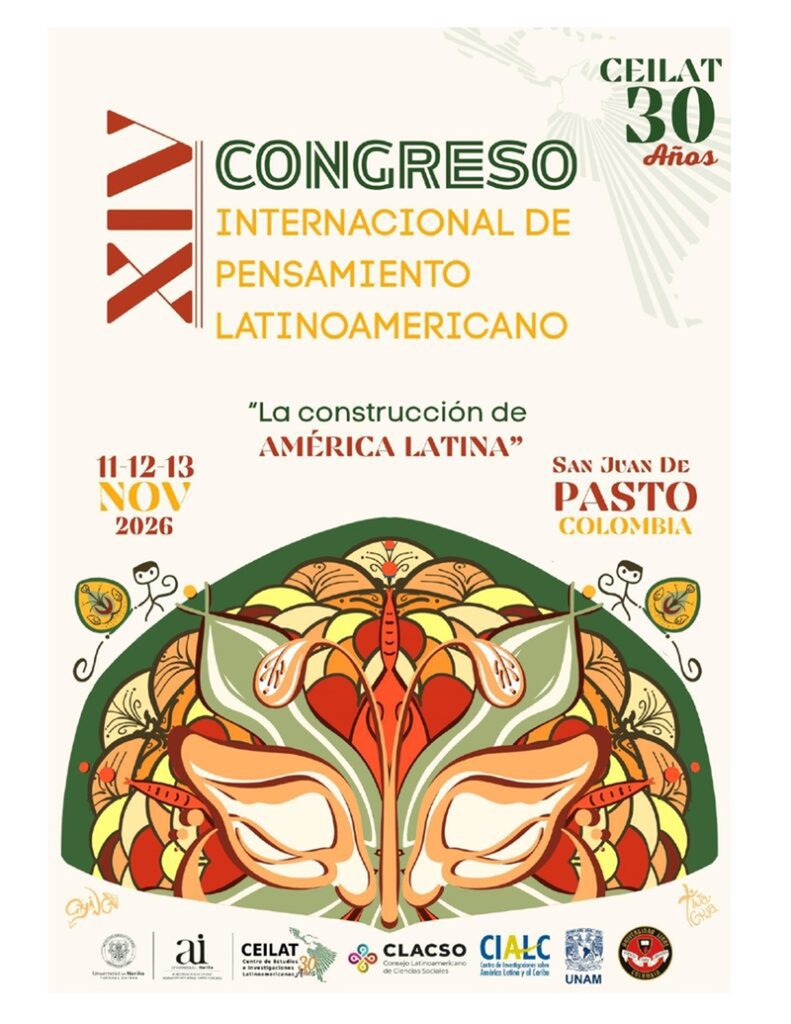
The University of Nariño in Colombia is hosting the XIV International Congress of Latin American Thought “The Construction of Latin America” , a meeting and reflection space that brings together academia and civil society to discuss the main challenges of the region.
Speakers:
Carlos Gilberto Zarate Botia (Colombia)
Jhonnatan Curiel (Mexico)
Rose de Melo Rocha (Brazil)
Diana Paola Garcés (Colombia)
Jorge Wilson Gómez Agudelo (Colombia)
Yilver Mosquera Vallejo (Colombia)
Eimer Alexis Barajas Roman (Colombia)
Elissa Loraine Lister Brugal (Colombia)
At the congress, CLACSO member centers in Colombia have proposed a panel dedicated to Transborder Thinking to present paper proposals that recognize that borders are not merely territorial expressions and that this perspective stems from a strong critical current in Latin American thought concerning the historical configurations of boundaries between countries, between perspectives of knowledge, between ways of inhabiting the world, and between visions of the past and the future. All of this has allowed for a profound questioning of epistemic, political, and cultural hegemonies.
The congress includes thematic panels dedicated to historical, cultural and educational thought; economic, political and legal thought; philosophical, literary and aesthetic thought; and conflicts and peacebuilding processes in Latin America.
Throughout its previous editions, the Congress has fostered critical and constructive dialogue on the cultural, social, and political dynamics of the region, facilitating an exchange of ideas and experiences that enriches both academic thought and the action strategies of civil society. Over the years, it has established itself as a pluralistic forum for the exchange of ideas regarding the social, cultural, and political dynamics of Latin America. In the current context, marked by geopolitical transformations, economic and environmental crises, and tensions within democratic systems, the event offers a critical perspective on the processes unfolding in the region.
The 2026 edition takes place within the framework of the 30th anniversary of the Center for Latin American Studies and Research (CEILAT), reaffirming its trajectory as a space for the production of knowledge and debate on Latin American identity and thought.

