
"CELAC rejected the imposition of unilateral coercive measures contrary to international law."
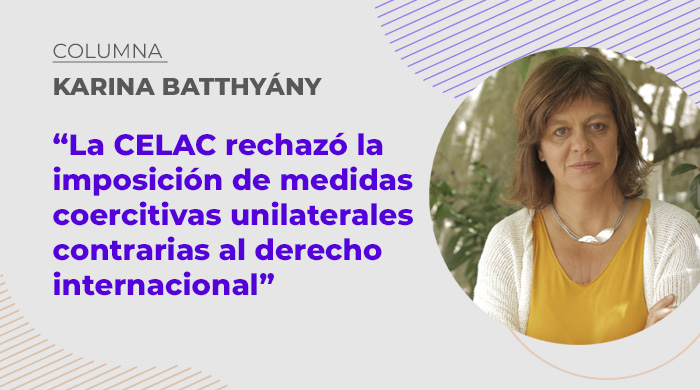
Transcript of Karina Batthyány's column
in InfoCLACSO – April 16, 2025
On April 9, the Ninth Summit of Heads of State and Government of the Community of Latin American and Caribbean States (CELAC), which comprises 33 countries from Latin America and the Caribbean, was held in Tegucigalpa, the capital of Honduras. The importance of this meeting, at a time of great upheaval both regionally and globally, was underscored by the presence of eleven heads of state, including Lula da Silva of Brazil, Claudia Sheinbaum of Mexico, Gustavo Petro of Colombia, Miguel Díaz-Canel of Cuba, Yamandú Orsi of Uruguay, and Bernardo Arévalo of Guatemala, in addition to the host, Xiomara Castro.
It was Xiomara Castro who, by opening the meeting, set the tone, calling for unity and the defense of the region's peoples against the colonialism of the great powers and in response to the trade and tariff war unleashed in recent days by Donald Trump, President of the United States. Her proposal resonated with her Colombian counterpart, Gustavo Petro, who warned that if we fall into the trap of solving problems individually, we are headed straight for destruction. Among other leaders, Yamandú Orsi of Uruguay and Bernardo Arévalo of Guatemala endorsed the proposals for regional integration as a key and central response to the crises.
Mexican President Claudia Sheinbaum used the occasion to call for a Summit for the Economic Well-being of Latin America with the aim of advancing greater regional economic integration based on shared prosperity and respect for the sovereignty of each country and their respective trade agreements.
Along the same lines, Brazilian President Lula da Silva recalled that history teaches that trade wars have no winners, and warned that Latin America and the Caribbean are currently facing one of the most critical moments in their history, in which their autonomy is under threat from attempts to restore old hegemonies.
Another major theme of the Summit was the rejection of the U.S. policy of persecuting migrants, with mass deportations of undocumented people to their countries of origin, to Guantanamo, or to a mega-prison in El Salvador. President Petro even compared the handcuffed migrants to the African slaves who arrived in chains on the continent during the colonial era. CLACSO has repeatedly addressed this issue, and we will continue to do so, to maintain that migration is a right for everyone. Human mobility is one of the great challenges of our time. It affects millions of people in Latin America and other parts of the world and is linked to politics, economics, and also to the issue of climate change.
After a day of debates, the final declaration of CELAC last week rejected by a large majority the imposition of unilateral coercive measures contrary to international law, a text that was challenged by the representative of Argentine President Javier Milei, one of Trump's great allies in the region, disagreeing with the section that refers to the customs tariffs imposed by the White House.
Paraguay also did not adopt the final document, due to the reference in the text to “gender equality” which the representative of President Santiago Peña sought to replace with “equality between men and women”.
Another issue that loomed over the CELAC Summit was the situation in Panama, with the blatant offensive by the US administration to regain control over the strategic bi-oceanic canal. This prompted a statement from the Steering Committee of our Council, warning, among other concerns, that the Panamanian government is showing itself to be cooperative and subservient to the imperialist aggressions of Donald Trump, and that the recent signing of the memorandum of understanding between the two countries is not only unconstitutional and violates the Canal Neutrality Treaty, but also allows for the return of military bases and represents a setback in the Panamanian people's struggle for their sovereignty.
Indeed, no sooner had he taken office in January than Trump set his sights on the Panama Canal, a waterway that regained its full sovereignty in 1999, forcing the current authorities of the Central American country to hand over control of the canal's ports to a consortium led by the US fund manager BlackRock, that is, none other than one of the large vulture funds that have been causing so much damage to the so-called emerging economies.
When, anticipating what was to come, Colombia proposed a resolution within the framework of CELAC to support the government of Panamanian President José Raúl Mulino, it was once again Argentine Javier Milei who opposed it, reaffirming his alignment with the United States and running counter to the historical tradition of defending sovereignty in Latin America and the Caribbean against the interference of other powers. And when we speak of Argentina, we are referring to a country with a long-standing dispute with the United Kingdom over the Falkland Islands, a matter dishonored by Milei himself when he referred to the illegitimate Falkland Islanders as "Malvinenses," and whose recovery was again demanded by several heads of state at the recent CELAC summit.
The calls for unity, for closing ranks among democratic peoples and governments, expressed in Tegucigalpa, are imperative steps that cannot be delayed. We said it before, and we repeat it now: we are living through a time of great and dizzying changes that could lead to greater freedoms or greater authoritarianism; the struggle is fierce. And it depends on each and every one of us to work for greater well-being and equality so that the scales tip once and for all in favor of social justice and progressivism—in short, the strengthening of democracy in our region.
This topic, like those we have been addressing in InfoCLACSO in recent times, will be a priority in different tables, panels and workshops during our X Latin American and Caribbean Conference of Social Sciences #CLACSO2025 which will take place from June 9, in Bogotá, Colombia.
– Just a few years after the recovery of the Panama Canal and with a political change in between, there is an attempt to reverse a central situation of regional sovereignty, isn't there?
– Absolutely. We're barely a quarter of a century in and this issue is already being called into question again with imperialist attempts to get their hands on the Canal.
If you would like to receive more information about CLACSO's training programs:
[widget id=”custom_html-57″]
to our email lists.

