
“Women’s economic autonomy has suffered a historical setback in the region”
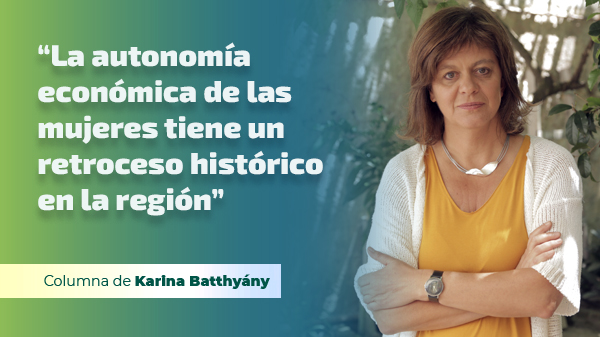
(Transcription of Karina Batthyány's Column)
(in InfoCLACSO – March 16, 2022)
Gabriel Boric's inauguration in Chile
Karina, you were in Santiago. What's your take on the launch of Boric's new government in Chile?
What we have witnessed is a profound sense of hope and expectation among the people of Chile with this change of government. To paraphrase President Boric, who stated during his campaign that Chile was the cradle of neoliberalism and that it will also be its tomb, these first few days have indeed been marked by symbolism. President Boric's greeting upon entering La Moneda Palace, pausing and gesturing toward the statue of former President Salvador Allende, was symbolic in every respect.
In Chile, I participated in a panel discussion (we have to be physically present for our presentations) with leading figures in Latin American and global social sciences, including Manuel Garretón, Fernando Calderón, and Manuel Castells. We analyzed Chile's perspectives within the Latin American context, and I must say that some interesting insights emerged regarding the challenges the Chilean government will face, beyond the symbolic, hopeful, and expectative aspects placed on this new team taking office. These challenges are related to the intercultural nature of the people (as the president himself described it), to feminisms, to the feminist governance or management approach being proposed in Chile, to the environmental dimension, and to issues concerning the life cycle of different generations and care work. These are some of the points of discussion regarding how to bring about more structural transformations stemming from this political process, whose major milestone was Boric's inauguration on Friday, March 11th.
We really need to closely monitor what will be happening in these first few months. Let's not forget, moreover, the dual challenge facing this new government and, on the other hand, the constitutional process that we've discussed so much at InfoCLACSO.
Women's Month
What's happening in Chile is fascinating; it's great to have a firsthand view to explore what these changes entail... If you'd like, we can move on to the other big topic you had planned for today, related to Women's Month.
This March, we are observing Women's Month, as we at CLACSO have designated it for the past three years, in addition to the ongoing challenges facing Latin America and the Caribbean. Therefore, I propose we address one of its key elements: women's economic autonomy. As always, we will use the available data and reports for our Latin American and Caribbean region as a reference. A recent report from the International Labour Organization (ILO) indicates that women's economic autonomy has suffered a historic decline in the region, very similar to the findings of ECLAC in reports we have also shared in our columns. Specifically, the ILO shows how Latin American and Caribbean women have been the most affected by the COVID-19 crisis in the labor markets of our Latin American and Caribbean countries. Women's employment in our region fell by 9.4% between 2019 and the end of 2020 precisely because of the effects of the COVID-19 pandemic. While for men, the decline was 7%. This represents an increase in the existing gap between men and women in the labor market. And, of course, it represents the largest decline in women's employment in Latin America compared to other regions of the world. In other words, the impact on the female labor market in Latin America has been the greatest compared to other regions of the world. This is also related to the fact that the economic recovery that began in 2021 and is continuing into 2022 is clearly slower in sectors of activity that are typically female or feminized—that is, where women are the majority of the workforce. The greatest impact in terms of the labor market is associated with the greater female presence in economic sectors that were severely affected by the crisis, such as hotels, services, restaurants, the food industry in general, and the domestic work sector, which was undoubtedly the hardest hit of all. The ILO also adds to this in its analysis the importance of considering informality. Informality, it should be remembered, implies the absence of any kind of social protection mechanisms for workers, and informality is always higher among women.
For its part, ECLAC, coinciding with Women's Month this March, released its 2021 Social Panorama of Latin America, focusing (in part of the report) on women's employment. It provides an in-depth analysis of how the paid domestic work sector was affected, showing a 20% drop in employment within this sector. ECLAC also reveals that approximately 13 million people worked in paid domestic work before the pandemic, 90% of whom were women. Therefore, we can see how this 20% decline in the sector directly impacts women's employment. Furthermore, it's important to remember that in this sector, only one in four workers is actually employed in the formal sector and, therefore, has social security and social protection rights. This data, of course, predates the pandemic and, consequently, the aforementioned decline.
Furthermore, there is another problem that adds to this analysis, in addition to job losses: the recovery is occurring in a highly segmented manner. The ILO shows us that in the first half of 2020, a total of 26 million jobs held by men and 24 million jobs held by women were lost. However, it states that most of the jobs held by men were recovered very quickly by the beginning of the third quarter of 2021, while the jobs held by women were only partially recovered. So, here we have some data and elements that allow us to see how economic autonomy has been affected.
Let's remember that when we talk about women's economic autonomy, we're talking about participation in the labor market and the ability to earn their own income. And often, this income is what allows women to exercise other rights. For example, it's very difficult for women experiencing gender-based violence to escape those situations without the economic autonomy to do so.
In addition to this data, we must not forget something we already know: the wage gap between women and men that existed before the pandemic and continues to exist today in our region. Of course, a final element is how the pandemic also affected all the unpaid domestic and care work that was largely assumed by women, and how this is also related to this dimension of economic autonomy and the possibility of women returning to the jobs they previously held.
How many years will it take us to recover from the effects of the pandemic and the deepening of inequalities?
It depends on where you place the emphasis… But the analyses are showing us that it will take at least 10 years, and some analyses even suggest up to 20 years, to recover to pre-pandemic levels in these areas we are dealing with.
If you would like to receive more information about CLACSO's training programs:
[widget id=”custom_html-57″]
to our email lists.

