
Chile: Youth and precariousness in times of pandemic
Guillermo Rivera Aguilera[1]
In 2011, the English economist Guy Standing published the book The precariat: a new social class'(The precariat: the new dangerous classIn general terms, it refers to an emerging social class, formed as a result of the new economic order and the global transformations of recent decades. For Standing, the precariat is a dangerous class in the sense that it rejects the old political ideologies of the 20th century. He describes this new social class, represented mainly by young people (and not so young), as individuals who have to accept unstable jobs, without an occupational narrative for their lives. He also defines some subjective effects associated with this new social class, which he calls the four "A's": anomie (a feeling of hopelessness), anxiety (in the face of uncertainty), alienation (a feeling of being unable to do what they would like to do), and anger (in the face of an unequal system). Although this book has been reviewed and commented on by social scientists and researchers in labor studies in Latin America, it has been presented as a European reference point distant from our regional context.
In the current scenario, where we are facing a new economic crisis resulting from the Covid-19 pandemic, I consider it important to review Standing's ideas and apply them in Chile, especially after the social uprising in October of last year.
In recent weeks, the government has developed resolutions to address the pandemic, implementing initiatives such as the Employment Protection Law, which was designed as a support system for workers and companies that can demonstrate they have been affected by the crisis. The measure has drawn criticism from various social and political actors. We have witnessed large service and retail companies taking advantage of this law, generating strong public backlash against the business sector.
On May 1st, young workers from unions at companies such as Starbucks, H&M, Cornershop, Ripley Companies, among others, published the “Manifesto for Labor Dignity in Times of Crisis,” where they explain that the last few weeks have been critical for thousands of families who have seen their income decrease as a result of the Employment Protection Law enacted by the Government.
Along the same lines, they reject paying their salaries with their own unemployment insurance savings, because this leaves them unprotected against very likely future layoffs, preventing them from facing real unemployment. Likewise, young workers are organizing in several countries to denounce multinational corporations that profit from young people as cheap labor, violating their labor rights.
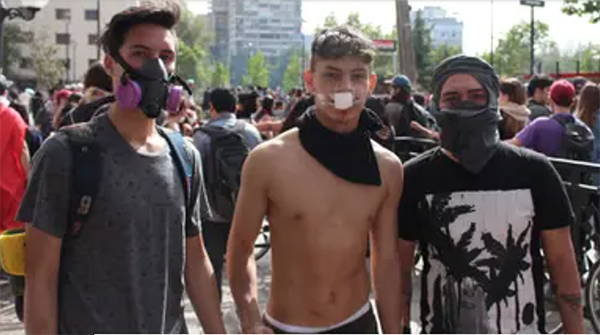
2019 was a year of massive mobilizations. In Chile, we experienced the social uprising in October; however, these expressions were also seen in cities like Hong Kong, Paris, Quito, Barcelona, and Bogotá. Precarious young people represent a disillusioned generation, tired of an unequal economic system that makes no sense to them and that urgently needs changing. In the Chilean case, young people have taken over public spaces as stages to voice their demands, using tools developed from exclusion, with codes and forms of protest learned in the streets and on the margins.
It is important to pay attention to what is coming in 2020, and for this, Standing's ideas regarding the precariat become relevant and useful in present-day Chile. It is worrying that both the government and the business sector are producing and reproducing exclusionary practices against young people, practices already seen in other economic crises. Currently, there is a broken social contract regarding employability, where distrust prevails among an entire social class, not only towards the economic system, but also towards the government and a business sector that only looks after its own interests. The consequences of what we are witnessing suggest new forms of social unrest (which for some were left unresolved from March), where there will be new demands for labor rights. We will surely see how Standing's four "A's" (anomie, anxiety, alienation, and rage) will continue to materialize among young Chileans, who threaten to return to the streets, forming a more radicalized social body, with more anger and nothing left to lose.
[1] Academic at the School of Psychology, PUCV, Chile. Original text published in https://www.elmostrador.cl/noticias/opinion/2020/05/12/juventud-y-precariado-en-tiempos-de-pandemia-no-hay-nada-que-perder/.
If you would like to receive more information about CLACSO's training programs:
[widget id=”custom_html-57″]
to our email lists.

