
Together with Dilma Rousseff, for a free Lula and justice for Marielle
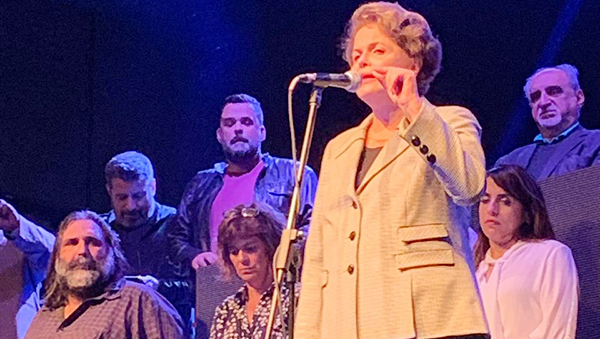
In what constituted the launch in Argentina of the “Committee for the Freedom of Lula and Justice for Marielle”, CLACSO accompanied the former president of Brazil, Dilma Rousseff, on Thursday, April 25, both in the meeting with labor unions, public universities, social movements, political parties and human rights organizations at the Metropolitan University for Education and Labor (UMET), and in the crowded public event in which the demand for “Free Lula and Justice for Marielle” was loudly proclaimed.
Before Dilma spoke, the following individuals expressed their solidarity with the struggles of the Brazilian people: the rector of the National University of Quilmes, Alejandro Villar; his counterpart from the National University of General Sarmiento, Gabriela Diker; national deputies José Ignacio De Mendiguren, Gabriela Cerrutti and Victoria Donda; former foreign minister Jorge Taiana; the leader of the Evita Movement, Fernando “Chino” Navarro; the general secretary of Suteba, Roberto Baradel; Nobel Peace Prize laureate Adolfo Pérez Esquivel (who is promoting Lula's candidacy for the Nobel Peace Prize); and the Executive Secretary of CLACSO, Karina Batthyány.
Lidia Borda and the duo La Chicana, Dolores Solá and Acho Estol, contributed their music.
[spreaker type=player resource=»episode_id=17779179″ width=»100%» height=»200px» theme=»light» playlist=»false» playlist-continuous=»false» autoplay=»false» live-autoplay=»false» chapters-image=»true» episode-image-position=»right» hide-logo=»false» hide-likes=»false» hide-comments=»false» hide-sharing=»false» hide-download=»true» ]Lula embodies the revolt of the Brazilian people.
“Lula is not just a political prisoner, he is not just an innocent man convicted. Lula represents the possibility of embodying the revolt of the Brazilian people,” Dilma Rousseff declared in her closing speech. She also delivered a moving tribute to Marielle Franco, the Rio de Janeiro councilwoman assassinated in March of last year, who described herself as “a feminist, Black, and a daughter of the favela.”
The former president of Brazil drew a parallel between her country and Argentina, noting that there are also political prisoners and unsolved crimes in Argentina. She mentioned Milagro Sala, the leader of the Tupac Amaru organization imprisoned in the province of Jujuy; Santiago Maldonado, the artisan killed after a repressive operation by the Gendarmerie in the south; and Rafael Nahuel, the young Mapuche man murdered by security forces in Patagonia.
“Lula said that a world that gave opportunities to all the marginalized and oppressed of Latin America was possible,” Dilma Rousseff concluded her hopeful message for the future.


