
Youth and reconfigurations of the public sphere: readings from the pandemic
Melina Vázquez and Pablo Vommaro [1]
The configuration of the relationship between the public and private spheres is one of the defining features of modernity. However, contexts of crisis and social change have shown that its boundaries are porous. In this text, we examine the relationship between these two spheres through the lens of youth dynamics during the pandemic and their transformations.
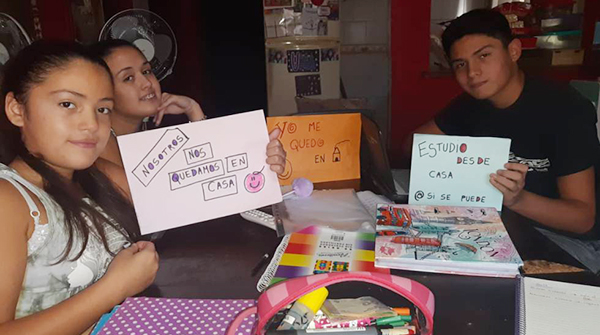
The mandatory preventive social isolation (ASPO) in Argentina produced a new arrangement of the routines that organize social life. The virtualization of work, education, and a large part of social interactions are an expression of this. But how are these processes of reconfiguration of the public and private spheres being processed among young people? What are the conditions that made #StayHome possible? How are these changes expressed through the pluralistic, diverse, and unequal dynamics that shape youth experiences?
#Stay at home
Young people are far from being a homogeneous social group. Staying home presents specific conditions of (or perhaps impossibility) when schoolwork is done in overcrowded homes without access to water or other public services; when distance learning takes place without access to a computer or with connectivity problems; or when different tasks must be coordinated in a single space. From this perspective, #StayHome could represent a slogan with a class bias that highlights the unequal opportunities to develop equivalent caregiving, hygiene, and social distancing practices.
Staying home often leads to an increase in violence. In April, UNICEF warned about the “invisible victims” of the pandemic: children who are abused in their homes. Furthermore, according to the National Femicide Registry of the Mumalá Observatory, between January 1 and August 30, 2020, a total of 181 femicides were recorded, 118 of which occurred during the mandatory social isolation period (ASPO). Of all femicides, 32% took place in the home shared with the perpetrator. According to the Minister of Security, this is the only crime that has not decreased during the ASPO.
Disputing the uses of public space
The pandemic transformed the relationship between the public and private spheres, both as concepts and as social practices. The revaluation of the public sector was manifested in the social value attributed to caregiving, education, healthcare, and the production of scientific knowledge. Another example is the recognition of access to telephone, internet, and television services as public utilities. Beyond their importance in times of virtualization of daily activities, this demonstrates the centrality of state regulation in the management of services considered essential during exceptional times and transforms the individualistic (consumer-client) perspective from which these types of consumption are typically viewed.
Changes in the use of public space and increased traffic controls have had a profound impact on young people, especially those living in working-class neighborhoods who find their access to street corners and parks restricted as places for socializing and meeting. Undoubtedly, the social and sense of belonging inherent in public space cannot be entirely replaced virtually.
Furthermore, the use of public space is mediated by the development of violent practices against young people with discredited identities. The mandatory social isolation measures (ASPO) increased police harassment and institutional violence through persecution, arbitrary arrests, torture, and even the disappearance and murder of young people. A study of people living in low-income neighborhoods in the Province of Buenos Aires states that 20% of respondents reported increased harassment by security forces during the ASPO (UNGS Report, 2020).
What is essential is visible to the eyes
The isolation measures redefined the principles of legitimacy for social practices that were usually invisible. There was a reconversion of participatory practices among young people, strongly influenced by the management of the crisis from below. Social movements, political parties, student centers, among others, deployed their repertoires of militant actions in the neighborhoods. The distribution of food, the organization of soup kitchens, and the production of hygiene products invite us to consider the markedly territorial component of political actions and the importance of community organizing in confronting this and other pandemics to which working-class communities have been subjected for years. The leading role of workers in the informal economy is a central part of this political-community-productive network. Their work, although often unpaid, is also essential and is part of an alternative narrative to that of the “entrepreneur,” highlighting the collective and grassroots management of the daily lives of working-class communities.
Finally, the pandemic revealed the “essential” nature of precarious, heavily youth-dominated jobs that ensure the delivery of all kinds of goods, precisely when a large part of the population had to stay home. According to a CIPPEC study (2019), one in three people working on online platforms are under 30; only 55% have pension contributions (90% through the simplified tax system for small businesses and self-employed individuals), and 40% have health insurance. Various delivery worker organizations brought their demands to the forefront during the pandemic. The youthful creativity of the names they chose for their groups is noteworthy: Glovers Unidos (United Glovers), Rappis y furioses (Rappis and Furious), and ATR, an acronym that plays on the youthful expression “a todo ritmo” (at full speed) to designate the Delivery Workers Association. Faced with the difficulties of carrying out protest actions among "non-essential" workers, these organizations staged marches, strikes, and social media campaigns demanding everything from hygiene supplies to the recognition of basic labor rights such as basic salary, workers' compensation, Christmas bonus, and sick leave, precisely in the midst of a pandemic.
What you see when you see me. Protests and (new) modes of production of the public
Street mobilization is one of the main ways in which bodies and demands are made visible in politics. Isolation measures led some emblematic youth protests to move online or expand their digital repertoires with Twitter campaigns, hashtags, and Zoom meetings. Much of the street mobilization was contested by right-wing sectors, less accustomed to using public space for protest. The so-called “libertarian youth” and the right-wing's organization of visible collective actions—such as flag-waving demonstrations, mask burnings, or anti-quarantine marches—are not massive, but they constitute one of the emerging aspects of the moment.
Rethinking the public and the common
The effects of this pandemic will exacerbate existing and emerging inequalities with a strong generational impact. Possible solutions to the crisis appear in disputes over the public sphere, which, broadly speaking, recognize two main frameworks. One is reflected in the phrase "no one is safe until everyone is safe," suggesting that the way out of the social crisis will be collective and mediated by the public sector. The other is rooted in a tradition that defines itself as liberal and exacerbates individualistic views, conceived as a counterpoint to the public-state sphere. The first is linked to the right to have rights; the second interprets the privileges of some in terms of (always individual) rights.
Finally, we propose to recover the most significant experiences of present and past youth activism that have been important social laboratories in the construction of collective commitments and that took part in practices that produce the widening of the margins of the public sphere.
[1] Melina Vázquez: Sociologist, Master in Research and PhD in Social Sciences (UBA). Postdoctoral Fellow in Social Sciences, Childhood and Youth. Professor at the Faculty of Social Sciences of the UBA. Co-coordinator of the CLACSO Working Group on Childhoods and Youth and the Group for the Study of Policies and Youth (GEPoJu, IIGG-UBA). She is an Adjunct Researcher at CONICET.
Pablo Vommaro: Historian and PhD in Social Sciences (University of Buenos Aires). Postdoctoral Fellow in Social Sciences, Childhood and Youth. Professor at the Faculties of Social Sciences and Philosophy and Letters of the University of Buenos Aires. Director of Research at CLACSO and member of the CLACSO Working Group on Childhoods and Youth. Co-coordinator of the Group for the Study of Policies and Youth (GEPoJu, IIGG-UBA). Adjunct Researcher at CONICET and coordinator of the book series "Argentine Youth Today" (GEU), with 34 published titles.
Article published at https://www.elpaisdigital.com.ar/contenido/jvenes-y-reconfiguraciones-de-lo-pblico-lecturas-desde-la-pandemia/28518
If you would like to receive more information about CLACSO's training programs:
[widget id=”custom_html-57″]
to our email lists.

