
John Saxe-Fernández: an anti-imperialist intellectual committed to the peoples of Our America
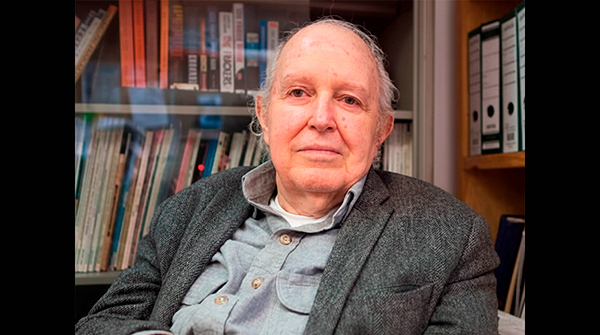
Josefina Morales 1
I met John during his first stay in our city, in the early seventies when he directed the Lázaro Cárdenas Project on the Strategic Condition of Mexican Oil.
He was an extraordinary professor at our university for over fifty years; he taught hundreds of classes to, surely, thousands of students, and directed dozens of undergraduate, master's, and doctoral theses. Among them was his participation on the doctoral advisory committee of Aníbal García Fernández, whose thesis I directed: “Imperialism, Hegemony, and Dependency: The Privatization of PEMEX in Mexico (1970–2018).”
He was a professor in the Master's Program in Geopolitics and National Security at the Center for Naval Studies of the Mexican Navy Secretariat, where he invited several academics to participate; I taught two semester courses on geopolitics.
John was my doctoral advisor. I worked with him at my institute, the Institute of Economic Research at UNAM, where he directed the Seminar on Development Theory for eight years, from the late 1990s to the early 2000s. During this time, he deepened its multidisciplinary character, paying particular attention to the new geoeconomic and geopolitical dimensions of U.S. imperialism while simultaneously debating the paradigm of globalization. He invited prominent American and Latin American intellectuals to seminars and conferences, such as Michel Tanzer, an oil specialist; Richard Barnett, a profound expert and critic of transnational corporations; James Petras, a sociologist and political scientist; and Latin Americans like Fernando Martínez Heredia.
He was a generous man and readily established relationships and contacts with international academics. On my first visit to the United States, to Washington, he gave me the phone numbers to contact a U.S. military officer, a general, I believe; an interview I was unable to arrange. He also connected several students with the Economic Policy Institute in the same city.
He had an extraordinary theoretical background and studied with prominent American intellectuals, including Horowitz and Marcuse, where he completed part of his undergraduate and master's degrees at Brandes University in Massachusetts. He earned his doctorate here at UNAM. His first book was "Hemispheric Projections of the Pax Americana," published in 1971, and among his later works is "The Purchase and Sale of Mexico," Plaza y Janés, 2002, a seminal work. Among the numerous accolades for his academic work, he received the Jesús Silva Herzog Prize and the National University Prize in 2000; he was named an emeritus researcher of the National System of Researchers in 2021; he won the National Journalism Prize in the International Analysis category in 2008; and he published more than 1300 journalistic articles, primarily in La Jornada.
For several years he coordinated the program “The World in the 21st Century” of the Center for Interdisciplinary Research in Social Sciences and Humanities, with a close friendship and collaboration with Pablo González Casanova.
His latest line of research was the environmental crisis of capitalism
We must keep in mind his 23 books, both individual and those he edited. His lines of research, particularly on U.S. imperialism in its energy (oil, oil, oil) and military dimensions, are also important. He was a relentless critic of the International Monetary Fund and the World Bank, instruments of U.S. imperialism. I contributed the chapter “The Economic Relations between Mexico and Cuba” to the book Geoeconomics and Geopolitics of Mexico, Cuba, and the Caribbean, edited by John and published in 1977 by the IIEc-UNAM.
He also had an extraordinary solidarity with the Cuban revolution. This is demonstrated by the book he coordinated with seventeen contributions, * Yo soy Fidel* (I Am Fidel), with a prologue by Roberto Fernández Retamar, published by CLACSO, Buenos Aires, 2018, and republished as * Fidel 17 aproximaciones* (Fidel: 17 Approaches) by CLACSO and the Fondo de Cultura Económica in the popular collection in Mexico, 2022.
The last time we met was at the CLACSO meeting in Bogotá last year, where we agreed that I would come to her house for lunch one Sunday when her daughter and grandson were visiting. Unfortunately, I wasn't able to make it.
She loved music and played the piano; she took piano lessons with a great Mexican pianist, Guadalupe Parrondo.
John's presence will be permanent in the work of critical thinking in Our America.
- Mexico. Member of the CLACSO Working Group on Crisis and the World Economy. Senior Researcher at
Institute of Economic Research of the UNAM.
Personal testimony.
↩︎

