
IX International Postgraduate School: Critical Paradigms of the Emancipation of the Caribbean and Latin America
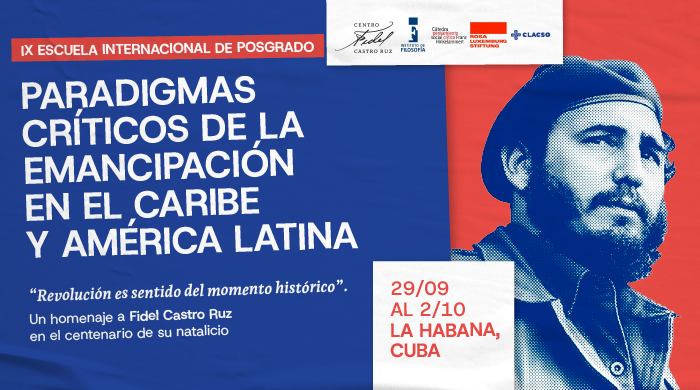
“Revolution is a sense of historical moment”
A tribute to Fidel Castro Ruz on the centenary of his birth
Havana, Cuba | September 29 to October 2, 2026
On the occasion of the centenary of the birth of Fidel Castro Ruz, the Latin American Council of Social Sciences (CLACSO), the Institute of Philosophy, the Fidel Castro Ruz Center, and the Office for work in Mexico, Central America and Cuba of the Rosa Luxemburg Foundation (RLS) , invite advanced master's and doctoral students, researchers and scholars of Latin American and Caribbean critical thought, and social actors committed to the study of forms of thought and transformation in Our America to submit their applications to participate in the IX International School of Postgraduate and Theoretical-Political Training “Critical Paradigms of Emancipation in the Caribbean and Latin America”, as a tribute to Fidel Castro Ruz, thinker and symbol of the idea and act of revolution.
Venues: Fidel Castro Ruz Center and the Institute of Philosophy (Havana, Cuba)
Up to 30 scholarships will be awarded to students from Latin America and the Caribbean.
ORGANIZING INSTITUTIONS:
- Institute of Philosophy. Chair of Critical Thinking “Franz Hinkelammert” (Cuba)
- Fidel Castro Center.
- Latin American Council of Social Sciences (CLACSO)
- Office for work in Mexico, Central America and Cuba of the Rosa Luxemburg Stiftung (RLS)
ACADEMIC COMMITTEE
- Felix Valdés García (Institute of Philosophy, Havana)
- Yohanka León del Río (Institute of Philosophy, Havana)
- Pablo Vommaro (Executive Director of CLACSO, Argentina)
- Gloria Amézquita (Academic Director of CLACSO, Argentina)
- Georgina Alfonso González (Institute of Philosophy, Havana)
- René González Fidel Castro Study Center
- Bárbara E. Flores Casamayor Fidel Castro Center
- Gerold Schmidt. (Rosa-Luxemburg-Stiftung, Mexico)
ORGANIZING COMMITTEE
- Alejandro Gambina (Director of Training at CLACSO, Argentina)
- Patricia Zapata Alamilla (Rosa-Luxemburg-Stiftung, Mexico)
- Felix Valdés García (Institute of Philosophy, Havana)
- Georgina Alfonso González (Institute of Philosophy, Havana)
- Yohanka León del Río (Institute of Philosophy, Havana)
RESULTS
We thank all master's and doctoral thesis students, public policy officials, and representatives of social organizations for the positive response to this call.
We received 83 applications that were evaluated by an international jury made up of members of the organizing committee. This entire team was responsible for considering the quality, relevance and coherence of the applications according to the terms of the call for applications.
In accordance with the above, the selected participants in the School are:
| Name and Surname | Country of residence |
| Aline Recalcatti de Andrade | Brazil |
| Camila Alvarado | Colombia |
| Cristhian David Gavilán Domínguez | Mexico |
| Cristian Camilo Mosquera | Ecuador |
| By Simone San Romão Miguel Ângelo | Brazil |
| Edgar Ruales | Ecuador |
| Eduar Stiven Velasquez Bonilla | Colombia |
| Felipe Ponce | Mexico |
| Felix Gerardo Miranda Ortega | Mexico |
| Gladys Seña Solano | Colombia |
| Gleice Carlos Nogueira Rodrigues | Brazil |
| Juan Lombo | Colombia |
| Lucia Dias da Silva Guerra | Brazil |
| Luciana Benavente | Argentina |
| Luis Ángel Montiel Jiménez | Mexico |
| Magno Francisco Da Silva | Brazil |
| Mario Rafael Ocampo Juárez | Mexico |
| Michele de Mello | Brazil |
| Natalia Sylwia Álvarez Grzybowska | Mexico |
| Osvaldo Montero Salas | Chile |
| Rodrigo Fregoso Garduño | Mexico |
| Valentín Val | Mexico |
This ruling is final and irrevocable.
The theme of revolution has been a constant source of inspiration in the intellectual work of Latin American and Caribbean thinkers. It has posed an urgent challenge at different times, while simultaneously shaping generations of men and women fully committed to the revolutionary cause. In the Caribbean, two major revolutions have altered the course of global events: the Haitian Revolution (1792-1804) and the Cuban Revolution (1959). These are joined by revolutions in Grenada, Venezuela, Nicaragua, Mexico, Bolivia, and other insurgent movements that have made this notion a central theme, expressed not only in political discourse and behavior, but also in novels, poetry, art, theoretical essays, and political philosophy. Revolutionary processes have led to the creation of a new subjectivity, new forms of human interaction and sociability, in their attempt to overcome antiquated racial, patriarchal, class, and gender relations. They have also shifted the very foundations of human action and knowledge. But revolutions have their dangers, such as facing attacks that seek to distort, silence, or trivialize the event, attacks that threaten memory in order to construct false narratives that now dominate social media and its algorithms and influence the assumptions of academic studies.
In the case of the Cuban Revolution, numerous studies have addressed the topic, encompassing history, political science, literature, and art. The Cuban Revolution of 1959 occupies a central place as the final phase of a process that sought independence, national sovereignty, and complete emancipation, positioning itself within socialism as a viable alternative. The thought and systematic actions of Fidel Castro, Ernesto "Che" Guevara, Raúl Castro, and other Cuban leaders and intellectuals have placed this theme at the heart of the matter. The idea of revolution and its practical realization are inextricably linked. It is not the idea, the project, or the reflection that governs the action, but rather the very event that refines and radicalizes the idea, imbuing the theory with concrete historical content. It is in the concrete act that the idea, the concept, is actualized.
On the centenary of Fidel Castro's birth, it is imperative to address the polysemy of the concept of revolution, the practical urgency of studying it, and the significance of the event. This is essential to confront narratives that take events out of context, attempt to diminish their importance, erase what happened, silence them, and trivialize them, transforming them into non-events or trivial occurrences. The battle for memory is a field that must be defended, just as historical accuracy and rigorous research are.
The School “Critical Paradigms of Emancipation in the Caribbean and Latin America” aims to discuss and delve deeper into the study of this topic due to its relevance to the social sciences, humanities, and philosophy, as well as to foster the political and ideological development of activists and scholars committed to science and the practical transformation of reality. As in previous schools, we will have printed materials, books, and information useful for academic work and political training.
- To provide a space for learning and dialogue about the revolution in its theoretical and practical implications, focusing on reflection about the work and actions of Fidel Castro Ruz.
- To exchange knowledge among participants on theoretical and ideological issues and their concrete practical correlates, revealing their importance for current times.
- To advance in the construction of networks of scholars and social activists interested in the knowledge and dissemination of critical thinking forms and critical paradigms of emancipation, sponsored by CLACSO and the centers that convene the school.
The School is an intensive, in-person, postgraduate-level training program that aims to deepen understanding of the realities of Latin America, critical thinking, and paradigms of emancipation. The main focus of this edition will be the revolution, and within that, the enduring significance of Fidel Castro Ruz's thought and actions, as a tribute on the centenary of his birth.
The working methodology includes participation in conferences and panels, a workshop for reading and discussing selected texts, and a documentary screening (film discussion). The presentation of research projects is also planned, upon request from participants.
The proposed activities will be led by specialists with experience in the study of culture, thought and history, articulating in their activities the academic dimension and the political commitment to transformation.
The call for applications is aimed at:
- Master's or doctoral students with thesis projects related to the study of critical thinking, Marxist thought, history and current reality of the region, particularly Cuba, the Caribbean, Africa and Latin America.
- Public policy officials, social activists, student leaders and social movement leaders interested in the study of the emancipatory critical tradition, whether or not linked to regular academic life.
Candidates should preferably be linked to a CLACSO member center or be studying a postgraduate course in the CLACSO Postgraduate Network.
Participation in the School is free for all selected applicants.
Latin American and Caribbean participants who do not reside in Havana will have their accommodation in shared rooms and food covered during the days of the School.
The institutions organizing the school do not assume or cover air or land transport costs, nor medical insurance or other expenses beyond what is mentioned in this call for applications.
It is a requirement for scholarship recipients to attend all activities planned by the School.
An international jury, comprised of members of the academic committee and other designated evaluators, will select the participants. The evaluation will consider academic, geographic, and institutional criteria to ensure the participation of students from diverse countries and institutions. The jury's decision will be final and cannot be appealed.
Up to 30 students will be selected.
The result will be announced on the CLACSO websites.
Those interested should register on the CLACSO website. To do so, they must complete the following requirements:
- Online form with personal data
- Summary of your research project (graduate students) / territorial intervention plan project (representatives of civil society organizations and public policy officials). The document should be a maximum of 5 pages.
- Curriculum vitae or summary resume
- Letter of intent
- Letter of endorsement (mandatory requirement for representatives of civil society organizations and public policy officials)
Applications open until August 4, 2026
Certificates of participation will be given to all students who attend all the activities proposed by the School.
Email inquiries: [email protected]
WhatsApp inquiries: +54 9 11 3880 – 1388

