
IV ISA Sociology Forum
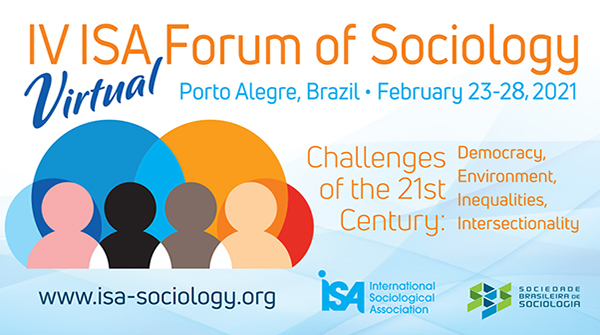

Under the title of “Challenges of the 21st Century: Democracy, Environment, Inequalities, Intersectionality”, the IV ISA Forum of Sociology, the International Sociological Association based in Porto Alegre, Brazil, is taking place from Tuesday 23 to Saturday 28 February, with more than 800 sessions, 3.000 presentations and the participation of sociologists from 125 countries, including Michael Burawoy, Isabel Casimiro, Manuel Castells, Ashish Kothari, Rita Segato, Boaventura de Sousa Santos and Maristella Svampa, with active participation from the Latin American Council of Social Sciences.
“This Forum will be a unique opportunity to gather the results of our research and analysis of the extraordinary time we are living through and studying, its impact on individuals and societies, and the four global challenges it has intensified: democracy, the environment, inequalities, and intersectionality,” say Sari Hanafi and Geoffrey Pleyers, respectively president of the ISA and the IV Forum of Sociology.
“The pandemic has highlighted how deeply interdependent we have become and has underscored the need for a more global sociology. Epistemologies of the Global South and intersectional perspectives on democracy, ecology, and social justice are more than just alternative options for sociology in the 21st century. They are at its core and have profoundly transformed it. Opening up more spaces for our colleagues from the Global South has been a central objective of this Forum. We are especially pleased to host semi-plenary sessions organized by the Brazilian Sociological Society with the Porto Alegre Local Organizing Committee, by the Latin American Sociological Association, and by the Latin American Council of Social Sciences, and that the President of the Council on the Development of Social Science Research in Africa will join us for the closing session,” add Sari Hanafi and Geoffrey Pleyers.
Plenary Sessions
Tuesday, February 23 – 12:30 – 15:45 (BRA-ARG-URU-CHI) (GMT-3)
Opening plenary session: Global challenges during and after the pandemic: Democracy, Environment, Inequalities, Intersectionality
-Welcome speech by Sari Hanafi, President of the ISA, American University of Beirut, Lebanon
-Welcome speech: Global sociology in the pandemic and beyond: Geoffrey Pleyers, FNRS-CriDIS/UCLouvain & CEMondiales, Belgium
-The utopia of democracies or the democracy of utopias: Boaventura de Sousa Santos, University of Coimbra, Portugal
-The pandemic: Trigger and scanner of possible futures: Rita Segato, University of Brasilia, Brazil
-Radical ecological democracy: Towards a sustainable and equitable pluriverse: Ashish Kothari, Kalpavriksh, India
-The South-North dialogue: an opportunity for a critical sociology, a future for democracy: Jean-Louis Laville, Collège d'Etudes Mondiales, France
Session available in open access:
Wednesday, February 24 – 12:30 – 14:00 (BRA-ARG-URU-CHI) (GMT-3)
Democracy, Environment, Inequalities, Intersectionality in Latin America – Session organized by CLACSO.
The aim is to discuss the topics of democracy, inequalities, and ecology from an intersectional approach, recognizing the contributions to the debate from Latin American social movements.
Organizer: Pablo Vommaro (CLACSO)
Panelist: Rita Segato, University of Brasilia
Commentator: Mônica Martins, State University of Ceará, Brazil
Presentations:
-Transnationalism and postnational identities: The three lives of a Latin king: Carles Feixa, Pompeu Fabra University, Spain
-Can democracy solve the new problems of society in Latin America?: Manuel Antonio Garretón Merino, University of Chile, Chile
-Action and discourse of social movements: from demands on the State towards questioning power: Fernando Mayorga, Universidad Mayor de San Simón, Bolivia
Session available in open access:
Thursday, February 25 – 12:30 – 14:00 (BRA-ARG-URU-CHI) (GMT-3)
-Democracy and Inequality. Organized by the Brazilian Society of Sociology and the COL
17:45 – 20:00 (BRA-ARG-URU-CHI) (GMT-3)
-Democracy, inequalities, intersectionality: A tribute to Marielle Franco, a 38-year-old Brazilian sociologist, single mother, human rights defender, and city councilor in Rio de Janeiro. She was murdered on March 14, 2018. Since then, she has become a global symbol of the struggle against racist, colonial, heteropatriarchal domination and police violence, and for social justice, human rights, and democracy.

Session organizers: Lucia Rabello De Castro, Universidade Federal do Rio de Janeiro. Geoffrey Pleyers, FNRS/UC Louvain & Coll.Etudes Mondiales
Presentations:
-The life and struggles of Marielle Franco: Lia de Mattos Rocha, Universidade Estadal do Rio de Janeiro, Brazil.
-Intersectionality as an everyday life experience. The life and struggles of Marielle: Mônica Francisco, Universidade Estadal do Rio de Janeiro, Brazil
Friday, February 26 – 12:30 – 14:00 (BRA-ARG-URU-CHI) (GMT-3)
-Environmental Challenges. Organized by the Brazilian Sociological Society and the COL
-Tribute to Immanuel Wallerstein
Saturday, February 27 – 12:30 – 14:00 (BRA-ARG-URU-CHI) (GMT-3)
-The role of sociological associations in an increasingly authoritarian world.
Session organized by the AIS Research Coordinating Committee
Session organizer: Geoffrey Pleyers, FNRS/UC Louvain & Coll.Etudes Mondiales
Panelists: Sari Hanafi, American University of Beirut. Karina Batthyány, FCS UDELAR, Executive Secretary of CLACSO. Isabel Casimiro, CODESRIA. Jaime Ríos Burga, National University of San Marcos. Elisa Reis, Federal University of Rio de Janeiro.
17:45 – 19:45 (BRA-ARG-URU-CHI) (GMT-3)
-Closing plenary session. Challenges of the 21st century: Democracy, Environment, Inequalities, Intersectionality
Sunday, February 28 – 10:45 – 12:15 (BRA-ARG-URU-CHI) (GMT-3)
Care policies and gender equality
Session organizers: Bila Sorj, Federal University of Rio de Janeiro. Karina Batthyány, FCS UDELAR, Executive Secretary of CLACSO.
Chair: Bila Sorj, Federal University of Rio de Janeiro
If you would like to receive more information about CLACSO's training programs:
[widget id=”custom_html-57″]
to our email lists.

