
IV International Graduate School – Beyond the International Decade for People of African Descent
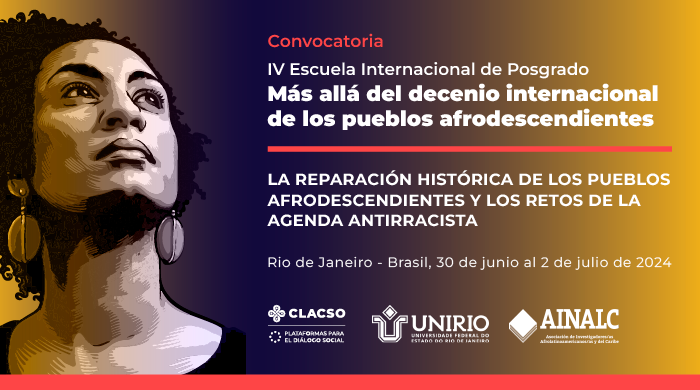
The historical reparation of Afro-descendant peoples and the challenges of the anti-racist agenda.
Rio de Janeiro, Brazil | June 30 to July 2, 2024
The Latin American Council of Social Sciences (CLACSO), the Working Group (WG) Afro-descendants and counter-hegemonic proposals and the Federal University of the State of Rio de Janeiro (UNIRIO) invite advanced master's and doctoral students, public policy officials, and leaders and activists from organizations of the Afro-descendant movement in Latin America and the Caribbean to submit their applications to participate in the IV International Postgraduate School Beyond the International Decade for People of African Descent. Historical reparations for Afro-descendant peoples and the challenges of the anti-racist agenda.
APPLICATION DEADLINE: JUNE 3
ORGANIZING INSTITUTIONS:
- Latin American Council of Social Sciences (CLACSO)
- CLACSO Working Group (WG) Afro-descendants and counter-hegemonic proposals.
- Federal University of the State of Rio de Janeiro (UNIRIO)
COLLABORATING INSTITUTIONS:
- Association of Afro-Latin American and Caribbean Researchers (AINALC).
- Performativities, race and Intersectionalities – (Unirio/Cnpq)
- Nelson Mandela Chair of Studies on Afro-descendants.
- CLACSO Working Group on Epistemologies of the South.
- CLACSO Working Group on International Health and Health Sovereignty.
- Museum of Afro-Brazilian history and culture.
- Department of Social Work, Catholic University of Temuco, Chile.
- International Network of Afrofeminist Voices.
- PhD in Communication. University of La Frontera-Austral University of Chile.
- Coordination of Gender Equality Culture, Faculty of Medicine, National Autonomous University of Mexico.
- South-South Center for Postcolonial Studies. Performance, Afro-Diasporic Identities, Feminisms, National University of San Martín, Argentina
- Center for Afro-descendant and Indigenous Studies (NEABI)
- Center for Research and Higher Studies in Social Anthropology (CIESAS Pacific South), Mexico.
- Research Group on Social Theory, Decolonial Studies and Critical Thinking G-TEP.
- Rosa Campoalegre Septien (Cuba) - GT Afrodescendants and counter-hegemonic proposals (CLACSO); Nelson Mandela Chair (Cuba), University of La Frontera (Chile); Austral University of Chile; Catholic University of Temuco (Chile).
- Pablo Vommaro - Latin American Council of Social Sciences (CLACSO).
- Karina Bidaseca - GT. Epistemologies of the South and GT Afrodescendants and counter-hegemonic proposals (CLACSO) and South-South Nucleus of Postcolonial Studies. Performance, Afro-diasporic Identities Feminisms, National University of San Martín (UNSAM, Argentina).
- Anny Ocoró-Loango - Association of Afro-Latin American and Caribbean Researchers (AINALC); Working Group on Afro-descendants and counter-hegemonic proposals (CLACSO); National University of Tres de Febrero (UNTREF) and CONICET (Argentina).
- Roberto Carlos da Silva Borges (Brazil) - GT Afrodescendants and counter-hegemonic proposals; Association of Afro-Latin American and Caribbean Researchers (AINALC).
- Claudia miranda - GT Afrodescendencias y propuestas contrahegemónicas and Universidad Federal do Estado do Rio de Janeiro (UNIRIO, Brazil).
- Nilma Gomes - Federal University of Minas Gerais (UFMG, Brazil) and GT Afrodescendence and counter-hegemonic proposals (CLACSO).
- Glenda Valim de Melo - Post-graduation program in social memory, Federal University of Rio de Janeiro (Brazil).
- Santiago Arboleda Quiñones - Universidad Andina Simón Bolívar (UASB, Ecuador) and GT Afrodescendencias y propuestas contrahegemónicas (CLACSO).
- Lina Rosa Berrio Palomo – Center for Research and Higher Studies in Social Anthropology (CIESAS Pacifico Sur, Mexico) and GT Afrodescendence and Counter-hegemonic Proposals (CLACSO).
- Paulo Vinicius Baptista da Silva - Federal University of Paraná (UFPR, Brazil).
- Felicitas López Sotolongo - GT Afrodescendencias y propuestas contrahegemónicas (CLACSO) and Centro de Investigaciones Psicológicas y Sociológicas (CIPS, Cuba).
- Carlos Alvarez - GT Afrodescendants and counter-hegemonic proposals (CLACSO).
- Elia Avendaño Villafuerte - National Autonomous University of Mexico (UNAM) and GT Afrodescendants and counter-hegemonic proposals (CLACSO).
- Odeth Santos - National Autonomous University of Mexico (UNAM) and GT International Health and Health Sovereignty (CLACSO).
- Gonzalo Basile – Latin American Faculty of Social Sciences (FLACSO, Dominican Republic) and GT International Health and Health Sovereignty (CLACSO).
- Yeison Arcadio Meneses Copete - South Colombian University (USCO, Colombia)
- Priscilla Pinto Ferreira - University of North Carolina (United States).
- Jane Santos da Silva - Federal University of Rio de Janeiro (Brazil).
- Arbey Bustamante - San Buenaventura University (USB, Colombia).
The International Decade for People of African Descent, proclaimed by the United Nations for the period 2015-2024, has come to an end, yet no significant progress has been made. Following the arrival of COVID-19, the impact of racialized and feminized pandemics intensified. Faced with this global crisis, Afro-descendant communities have been among the primary victims, but at the same time, they have forged an alternative path (Campoalegre, 2020).
In this critical global context, new initiatives have emerged, such as the United Nations International Forum for People of African Descent (2021), which has held three sessions since 2022 with the participation of governments, international organizations, international cooperation mechanisms, and the Afro-descendant movement. It is essential that these avenues be infused with the essence of a truly Afrocentric anti-racist agenda.
As systemic and structural racism reconfigures itself and deepens in its most aggressive forms, the agency of the Afro-descendant movement is also strengthened. In this critical global context, new initiatives have emerged, most notably the United Nations International Forum for People of African Descent, which, since 2022, has held three sessions with the participation of governments, international organizations, international cooperation agencies, and the Afro-descendant movement. It is essential to implement an anti-racist agenda that develops concrete actions for the historical redress of Afro-descendant peoples in all spheres of society. The 4th International Postgraduate School thus presents itself as a propitious space for reflection and the development of strategies that contribute to building a more just and equitable world for all.
At the heart of the struggles of the Afro-descendant movement are two major objectives: the proclamation of the International Declaration on the Rights of People of African Descent and the establishment of a Second International Decade for People of African Descent. Both objectives are grounded in the right to comprehensive and intersectional historical reparations, both in material and symbolic terms.
It is in this context of emergencies and critical re/existences that the Working Group (WG) “Afro-descendants and counter-hegemonic proposals” convenes the IV International Postgraduate School on “The historical reparation of Afro-descendant peoples and the challenges of the anti-racist agenda”.
This Working Group, established in 2016, is the pioneering space for collaboration between academia and the Afro-descendant movement within the Latin American Council of Social Sciences (CLACSO). Since 2017, it has been developing the academic and anti-racist program “Beyond the Decade,” which lends its name to the CLACSO International Graduate Schools in this field. The fourth School is moving from Havana to “Little Africa,” specifically Rio de Janeiro, Brazil. The city of the legendary leader Marielle Franco, and Brazil, the country with the largest Afro-descendant population and a strong anti-racist history in “Ladino Africa” (Gonzalez, 1998), will be the ideal setting for our School.
It is an intensive postgraduate training program that integrates critical Afrocentric, Afrofeminist, decolonial, intersectional, and comparative perspectives. It has been running since 2017 and is currently in its fourth edition. It is aimed at activists and leaders of Afro-descendant movement organizations, master's and doctoral students, and professionals responsible for the formulation, management, and evaluation of public policies. The distinctive feature of this program is its collaboration between academia and the Afro-descendant movement in Latin America and the Caribbean.
The central theme of the School is the right to historical reparation for Afro-descendant peoples, on the threshold of an International Declaration of Rights and in the struggle for a Second Decade for our peoples, these being key challenges from the Global South.
The main thematic axes of the School are the following:
- Afroepistemic Perspectives in Latin America and the Caribbean.
- Black decolonial feminisms and the Afro-descendant women's movement.
- Culture, Health, Violence and Racism
- Rights and public policies in the face of a Second International Decade for People of African Descent.
The school will be taught in person and will consist of 21h
- To collectively build a space for critical analysis and anti-racist action to influence public policy for the promotion, defense and guarantee of the right to historical reparation for Afro-descendant peoples.
- To make visible the thought and political action of academics, activist leaders of the Afro-descendant movement.
- To contribute to the construction of the anti-racist agenda as a premise for the successful realization of a second International Decade for People of African Descent.
- Promoting the development of Afro-diasporic networks in the fight against racism.
The call for applications is aimed at:
- Young Afro-descendant postgraduate students who have studied and addressed the topic and representatives/leaders of Afro-descendant organizations, with an emphasis on women.
- Master's or doctoral students with thesis projects related to the School's theme.
- Representatives of public policy, NGOs and cooperation agencies involved and interested in the topic.
The selection fee covers participation in the School and accreditation. The organizing institutions of the school do not assume or cover costs for air or ground transportation, lodging, or food.
An international jury, made up of members of the academic committee and other designated evaluators, will select the participants.
The evaluation will take into account academic, geographic, and institutional criteria to ensure the participation of students from diverse countries and institutions. The decision will be final and cannot be appealed.
A total of 50 participants will be selected.
The results will be published on the CLACSO websites.
Those interested should register on the CLACSO website. To do so, they must complete the online form and submit the following requirements:
- CV
- Letter explaining the reasons that motivate you to participate in the IV International Postgraduate School – Beyond the International Decade for People of African Descent.
- Summary of your research project (in the case of postgraduate students).
- Letter of endorsement (in the case of public policy representatives or social organizations).
The selection fee covers participation in the School and accreditation. The organizing institutions of the school do not assume or cover costs for air or ground transportation, lodging, or food.
An international jury, made up of members of the academic committee and other designated evaluators, will select the participants.
The evaluation will take into account academic, geographic, and institutional criteria to ensure the participation of students from diverse countries and institutions. The decision will be final and cannot be appealed.
A total of 50 participants will be selected.
The results will be published on the CLACSO websites.
Digital certificates of participation will be given to all students who attend all the activities proposed by the School.
Email inquiries: [email protected]
WhatsApp inquiries: +54 9 11 3880 - 1388

