
Quantitative research in the social sciences: open science and free software
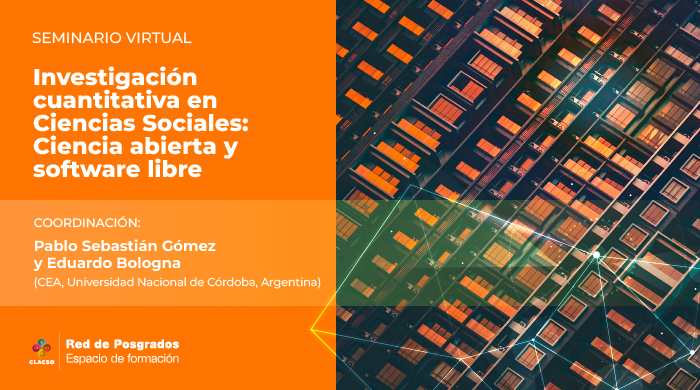
Seminar 2254
ChairCLACSO
Coordination: Pablo Sebastián Gómez (Center for Advanced Studies, FCS, National University of Córdoba and CONICET, Argentina) and Eduardo Bologna (Center for Advanced Studies, FCS, National University of Córdoba, Argentina)
Home: 27/07/2022 | Registration: 05/05/2022 to 26/07/2022
Workload: 12 weeks – 90 hours.
One of the pillars of open science is the use of free software that allows for the analysis of quantitative data and the open dissemination of results. In the Latin American context, this issue is particularly relevant given the high cost of specialized programs. This training program focuses on providing a space that prioritizes free software as an analytical tool, presenting it through its applications.
Increasingly, in many Latin American countries, there is a growing demand for the public release of data produced by national and subnational governments, and responses are gradually being obtained that involve making raw data sources available to the public. This information is valuable because it frees researchers from the dependence on using only the charts that the statistics office has chosen to publish. However, analyzing this data requires skills that are not always sufficient among social researchers.
In Latin America, the analysis of quantitative data has occupied a comparatively minor place in undergraduate and graduate studies. While the use of experts is necessary for the application of advanced analytical techniques, an initial understanding of quantitatively structured data is required to facilitate the dialogue between theory and observation.
At the same time, the reproducibility of the findings can only be achieved if the recipients of the research products have the original data and detailed descriptions of the operations that led to the results shown.
Therefore, we believe it is necessary to offer training that enables young researchers to use collaboratively developed analytical tools made available under free software licenses. These tools are increasingly accessible and suitable for generating research outputs without the high cost of proprietary licenses. This proposal consists of providing basic elements of data analysis using the free software R and R Studio, and aims to be a starting point for those who complete it to delve deeper into more sophisticated and specific tools for their area of knowledge and epistemic community.
Objective
To introduce social researchers to quantitative data analysis tools in the field of social sciences through the use of the free software R and R Studio.
Specific objectives
That the students:
- Make use of the information available in open data format to build knowledge about local issues.
- Recognize the importance of the field of statistics as a research tool and the place it occupies in the process of generating social knowledge.
- Achieve autonomy in the use of basic procedures for describing and analyzing quantitative data.
- Recognize the most appropriate procedures to use in data processing according to the objectives of the inquiry and the type of variables being worked with.
- Visualize quantitative information efficiently.
- Open Science and Free Software in quantitative data analysis: characteristics and importance
- Information search. Open data sources
- The initial description. Variables and their types. Univariate statistics
- Data visualization
- “Explaining” from a quantitative perspective
- The reproducibility of the results
- Testing theoretical models
- Modeling of continuous variables
- Modeling of categorical variables
- The reproducible publication
- Amat Rodrigo, J. (2016). Simple and multiple logistic regression.
- IDB (2020). Panorama of Public Administrations Latin America and the Caribbean 2020. Chapter 8. Open Government Data.
- Boccardo Bosoni, G. and Ruiz Bruzzone, F (2019). RStudio for Descriptive Statistics in Social Sciences. chapter 9.
- Bologna, E. (2020). A tour of quantitative research methods on board R.
- Goicoa, T. (2017) Basic R Markdown.
- López Peñaranda, A (2019). ggplot2 Tutorial.
- Pacios Izquiero, D. (2019) Course of R.
|
|
Discount for one payment until 15/07 |
In one payment after 15/07 |
|
CM Plenos |
$75 |
$150 |
|
CM Associates |
$95 |
$190 |
|
No link |
$95 |
$190 |
FAQ
The basic requirements for taking a seminar are:
- Availability of at least 4 hours per week to dedicate to the seminar course.
- Internet access.
- Reasonable handling of communication and computer tools.
- Language proficiency in the language in which the course will be taught. The official languages are Spanish and Portuguese.
|
|
Discount for one payment until 15/07 |
In one payment after 15/07 |
|
CM Plenos |
$75 |
$150 |
|
CM Associates |
$95 |
$190 |
|
No link |
$95 |
$190 |
More information: [email protected]

