Open Lecture Intervozes
The main objective of the Chair in Online Communication and Ativism is to discuss theoretical aspects and exchange practical knowledge about the possibilities of social movement activities in the digital public space. There are also specific objectives of the Chair: a) reflect on the relationship between Direito àComunicação, freedom of expression and democracy; b) expand the debate on the functioning of the Internet, especially sociotechnical, political and economic aspects; c) provide contributions to qualify the critical presence of social movements on different platforms and digital networks.
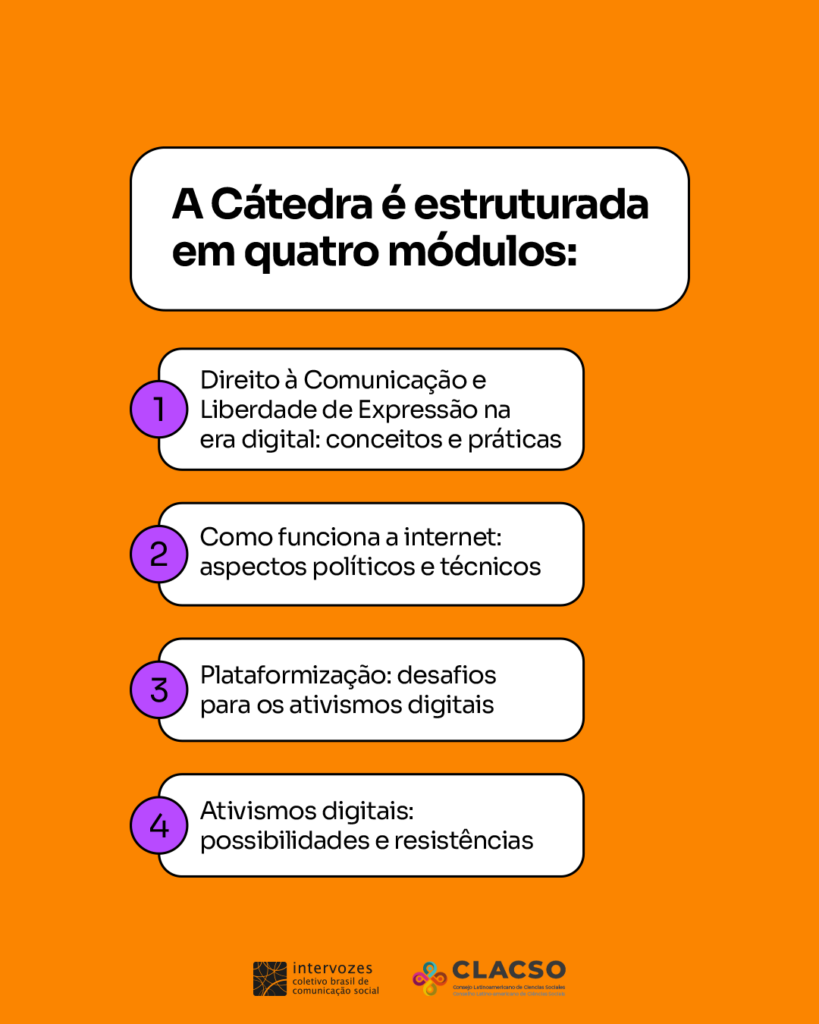
Session 1 – Direction to Communication and Freedom of Expression in the Digital Age: Concepts and Practices
Session 1 – The right to communication and freedom of expression in the digital age: concepts and practices
In Session 1 is presented a conceital and historical panorama on freedom of expression and direction in communication, with practical examples of materialization or violation of these directions discussed, in addition to pointing out the possibilities and challenges relative to the direction of communication on the Internet.
SUPPLEMENTARY MATERIALS
AMORIM, Eduardo. Silenced voices : What do you want to do to mourn two sem-terra? [on-line]. Jun. 2023. Available in: https://www.brasildefato.com.br/2023/06/19/vozes-silenciadas-quem-quer-calar-a-luta-dos-sem-terra Access in: 29 set. 2023.
SOCIEDADE occupies TV: the case of Direitos de Resposta eo controle public da media/ [edição Bia Barbosa e Giovanna Modé]. São Paulo: Intervozes – Coletivo Brasil de Comunicação Social, 2007.
APC – Association for Progressive Communications. The Feminist Principles of the Internet [on-line]. Aug. 2016. Available at https://feministinternet.org . Access on June 26. 2023.
BARBOSA, Beatriz Costa. Human rights violations and content regulation on TV : Brazil in perspective compared to France and the United Kingdom. 2013. 161 f. Dissertação (Professional Master in Management and Public Policies). Escola de Administração de Empresas de São Paulo da Fundação Getúlio Vargas – FGV EAESP. Available in: https://bibliotecadigital.fgv.br/dspace/handle/10438/11289 Access in: July 6. 2023.
RESPONSE DIRECTIONS. São Paulo: Intervozes, 2006. Available at: https://www.youtube.com/watch?v=hTPddDInpvw&t=181s . Access in: July 6. 2023.
FREENET? Directed by Pedro Ekman. São Paulo: Instituto Brasileiro de Defesa do Consumidor (Idec), Centro de Tecnlogia e Sociedade da Fundação Getúlio Vargas (CTS/FGV), Instituto Nupef e Intervozes, 2016. Available at: https://libreflix.org/i/freenet . Access in: July 6. 2023.
GOMES, Raimunda Aline Lucena. Communication as a human direction : a concept in construction. 2007. 206 f. Dissertação (Mestrado em Comunicação). Center for Arts and Communication, Federal University of Pernambuco, Recife, 2007.
INTERVOICES. Contributions to the construction of communication direction indicators . São Paulo: Intervozes – Coletivo Brasil de Comunicação Social, 2010.
INTRODUÇÃO to the thematic universe: main concepts, international references and Brazilian legal framework – Module 1 / Brazil. Ministry of Women, Family and Human Rights; Conselho Nacional dos Direitos da Criança e do Adolescente; ANDI Comunicação e Direitos, Brasília, 2020.
RAISE your voice! Directed by Pedro Ekman. São Paulo: Intervozes, 2009. Available at: https://vimeo.com/7459748 . Access in: July 6. 2023.
MACBRIDE COMMISSION. Many voices, one world: towards a new more just and more efficient world information and communication order. International Commission for the Study of Communication Problems. Kogon Page, London/Unipub; New York/Unesco, Paris: Unesco,1980.
MÍDIA without Violações de Direitos. São Paulo: Intervozes, 2017. Available at: https://www.youtube.com/watch?v=et7KBlQnuTM . Access in: July 6. 2023.
MOM Brazil (Media Owner Monitor Brazil). Who controls half of Brazil? [online]. Available at: https://www.mom-gmr.org . Access in: July 6. 2023.
OBSERVACOM. Padrões para a democratic regulation of large platforms that guarantee the freedom of online expression and a free and open Internet. Jul. 2020. Available at: https://www.observacom.org/wp-content/uploads/2020/09/Padroes-para-uma-regulacao-democratica-das-grandes-plataformas.pdf . Access em: Aug 27, 2021.
SILVA, Wellington Araújo. «The direct communication in Brazil». Revista Opinião Filosófica , Porto Alegre, v. 08; No. 02, 2017.
TERSO, Tâmara. «Politicians in the Middle East violate the Constitution and weaken democracy» [on-line]. Set. 2022. Available at: https://diplomatique.org.br/politicos-donos-da-midia-violam-a-constituicao-e-fragilizam-a-democracia . Access em: 29 Sep 2023
Session 2 – How the Internet works: political and technical aspects
Session 2 – How the internet works: political and technical aspects
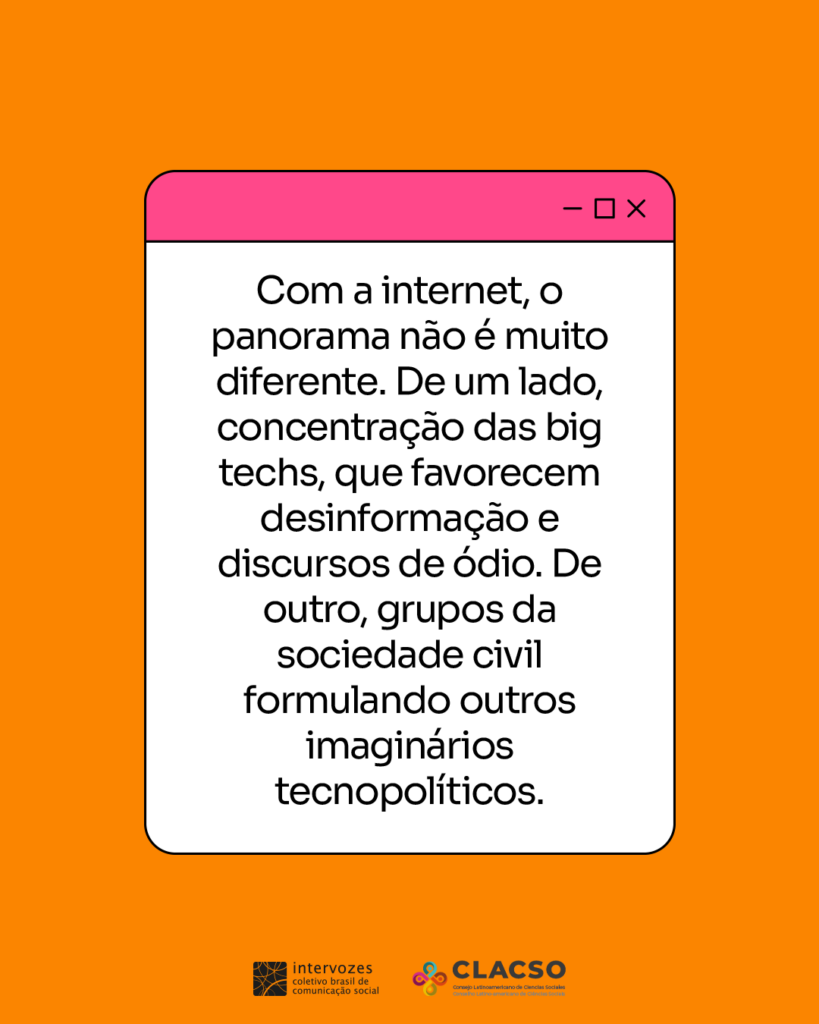
Session 2 addresses sociotechnical dimensions, power disputes and internet governance mechanisms, and debates questions such as freedom of expression, informational capitalism, digital oligopolies and the need for democratic regulation of digital platforms.
SUPPLEMENTARY MATERIALS
Raise Your Voice, ep. Fake News and Ameaças à Democracia:
VALENTE, J.; PITA, M. Digital monopolies: concentration and diversity on the internet. São Paulo: Intervozes, 2018.
BARBOSA, B.; MARTINS, H.; VALENTE, J. Fake News: how platforms confront disinformation. São Paulo: Intervozes, 2020.
Session 3 – Platformization: challenges for digital activism
Session 3 – Platformization: challenges for digital activism
Session 3 is dedicated to the analysis of platforms as a business model and access to the Internet, reflecting how this phenomenon – especially when applied to public policies – can deepen digital inequalities, reduce rights and enhance disinformation and hate speech.
SUPPLEMENTARY MATERIALS
SRNICEK, N. Platform Capitalism. Caja Negras: Buenos Aires, 2018.
SILVA, T. Algorithmic Racism in Digital Platforms: microagressões and discrimination in code. In: COMMUNITIES, ALGORITHMS AND DIGITAL ATIVISMS, p. 121, 2019.
ECLAC. Universalizing access to digital technologies to address the effects of COVID-19. ECLAC, 2020.
https://repositorio.cepal.org/bitstream/handle/11362/45938/4/S2000550_es.pdf
Open letter to Mark Zuckerberg in defense of network neutrality in India: https://intervozes.org.br/carta-aberta-a-mark-zuckerberg-em-defesa-da-neutralidade-de-rede-na-india/
Debate Platformization of social policies in Brazil
E. Tendayi Achiume on Racial Discrimination in the Design and Use of Emerging Digital Technologies
Rural black women have networks of knowledge
https://diplomatique.org.br/mulheres-negras-e-rurais-tecem-redes-de-conhecimento/
Livres territories, Livres technologies
Session 4 – Digital activisms: possibilities and resistances
Session 4 – Digital activism: possibilities and resistances
In Session 4 there are comments on the potential of Educomunicação and da Comunicação Popular in the fights for emancipation and power, and also discussed the importance of intersectionality in digital activism, in addition to guidelines for adaptation in the network and the insurgent models of governance of the internet.
SUPPLEMENTARY MATERIALS
BARBERO, JM (org.) Between disposable knowledge and indispensable knowledge [country agenda from communication] . Bogotá, 2009.
BONFIM, C.; HERCOG, B. Comunicação com CEP: invitations to continue communicating(-us). Iberoamerica Magazine, 2019.
CALAZANS, R.; FACINA, A.; LOPES, AC, SILVA, D.; TAVARES, J. Letters of survival: stitching voices and stories. 2018.
UPTADE INSTITUTE. Political Emergency Research Peripheries. 2018. Link: https://emergenciapolitica.org/periferias/
INTERVOZES COLETIVO BRASIL DE COMUNICAÇÃO SOCIAL, REPÓRTER SEM FRONTEIRAS. MOM Brazil: Quem Controla Mídia no Brasil. Link: https://brazil.mom-rsf.org/br/
Mapa da Mídia Independente – Marco Zero Conteúdo: https://mapadamidiape.marcozero.org/coletivo/marco-zero-conteudo/
PAIVA, R.; SODRÉ, M. Cidadania, media e direitos sociais. XXVI Annual Meeting of Compós. 2018.
PERUZZO, C. Social movements, citizenship and community communication in public policies.
Rádio Yandê: https://www.instagram.com/radioyande/
Pipoco – another map of Salvador: https://www.pipocoufba.com/
Diffusion kit