
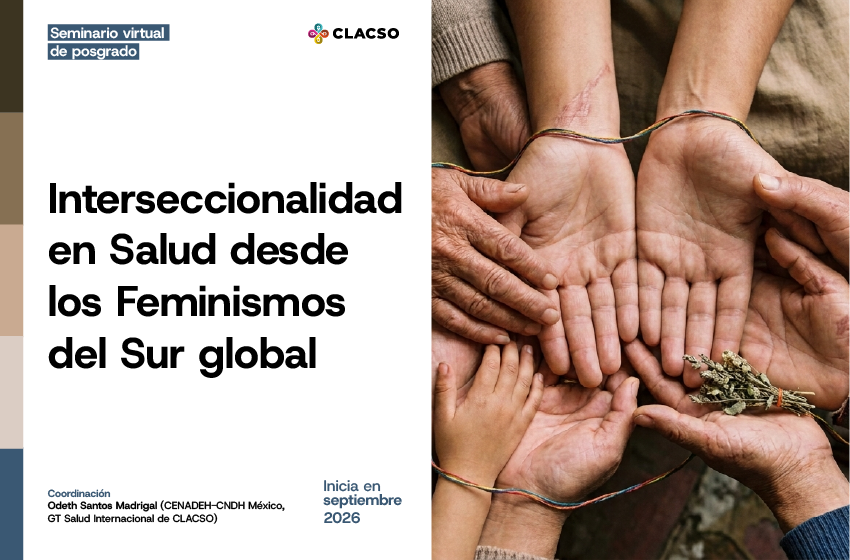
Intersectionality in Health from the Feminisms of the Global South
EXECUTIVE
Odeth Santos Madrigal (CENADEH-CNDH Mexico, CLACSO International Health Working Group)
Start: 17/09/2026 | Registration: 02/06/2026 to 16/09/2026
Workload: 10 weeks – 90 hours.
This Postgraduate Seminar seeks to open a space for training in critical thinking about the theories and strategies that support the use of intersectionality in public health and critical epidemiology from the epistemologies and practices of the Feminisms of the Global South.
This Seminar proposes the need to review, update and build an intersectionality strategy in the field of women's health from the decolonial, black and community feminisms of our Latin American and Caribbean region based on our contexts and knowledge of the Global South.
It also seeks to discuss and map the genealogy of intersectionality, the key contributions of decolonial, Black, and community feminisms to thinking about and addressing the multiple oppressions and imbrications of racial-colonial, social class, and gender domination that condition and permeate health care and life in the Global South, especially in Abya Yala.
At the same time, the proposal contributes to a rigorous and in-depth study of the epistemology of Anglo-Saxon Eurocentric feminisms (known as white Western feminism) of Western modernity in the Global North, which universalized a set of frameworks for understanding and reproducing agendas based on the implantation of the category of gender and a type of patriarchy inserted from the hierarchical orders of the coloniality of the Global Centers in our communities of life.
The Seminar introduces critical studies on the coloniality of gender and its current use in an epistemic-methodological emptying of the concept of intersectionality in an additive application in public health and epidemiology that are currently reproduced in global and regional public policy agendas of management and government, in academies and training schools, in various geopolitics of knowledge in global health of the North and of medical-social pan-Americanism in our region. (Neo)liberal multiculturalism has reduced and emptied the hierarchies of domination and oppression into simple additive aggregates of loose variables where the intertwined oppressions that impact the health and lives of women and men in the Global South are simplified, giving multicultural faces by skin color and ethnic-racial and/or diversity to the institutions of the State, Westernized universities and/or in companies through identity policies as if these multiple oppressions were isolated risk factors and determinants that can be added, quantified and mitigated in a clinical and population-based way.
The use of the category of gender and intersectionality within the field of modern Western health sciences, from clinical biomedicine, European/Latin American social medicine to functionalist public health, from Pan-American international cooperation agendas in health to contemporary liberal global health, (re)produces a logic of additives and affirmative actions, transforming the multiple intertwined oppressions into isolated variables such as racism in counting morbidity and mortality cases by skin color, gender in the distribution of diseases and deaths by sex, and social class reduced to the socioeconomic level of inequalities by individual and/or population income.
The foundations for updating and decolonizing Latin American critical thought in Health from the South and Critical Epidemiology draw on diverse intersections, trajectories, and new contributions as theoretical, epistemic, and methodological groundwork for understanding the racial and colonial determinants of health, the geopolitics of dependency in theories and agendas of international cooperation on women's health imposed by the Global North, and other factors. In other words, this Seminar proposes to stop importing gendered categories and frameworks of understanding, as well as liberal multiculturalism, from epistemologies of global centers that have never considered the problems and oppressions faced by women in Abya Yala (the Americas).
This program focuses on the key implications of decolonial, Black, and community feminisms for women's health in the Global South and a critical epidemiology of racism, giving primary importance to the voices, struggles, practices, knowledge systems, and wisdom of Indigenous and Black women, and of the diverse communities of life in our region. It also contributes knowledge from critical epidemiological theory and its applications to the intersectional and territorial monitoring of health and life care.
The Seminar is part of continuing education spaces and strengthening of study groups of the CLACSO International Health Working Group network, seeking to be a high-level theoretical-academic exercise and to constitute a regional training proposal for researchers, academics, social movement activists, NGOs, public managers, planners and evaluators in the field of international health and public health policies.
GENERAL PURPOSE
Develop specialized training on critical intersectionality applied to addressing the determinants of women's health from the feminisms of the Global South.
SPECIFIC OBJECTIVES
- To study the coloniality of gender in health and in the social sciences of Latin American and Caribbean public health and its expressions of colonial dependence in gender studies in the 21st century
- Identifying the foundations and contributions of Global South Feminisms to critical thinking in Health and Epidemiology for the 21st Century
- To problematize and discuss the implications of the current use of an intersectionality perspective subordinated to the epistemologies of white Eurocentric feminisms of European/Latin American social medicine, the Pan-Americanism of public health and the global health agendas of the North
- Understanding the critical epidemiology of racism as a public health problem and reflecting on the racial-colonial determination of the health of women in the Global South
- To understand the practices, struggles, methodologies, and strategies of territorial intersectional health monitoring from decolonial, Black, and community feminisms in Latin America and the Caribbean
- Modern-colonial scientific thinking in women's health in the Global South
- Coloniality of Gender in Health.
- Decolonizing Gender Studies in Health.
- Coloniality of the International Cooperation Regime and global agendas of “Population and Development” in the health of women in the South
- Introduction to Decolonial Feminisms for the study and approach to the intersections of multiple oppressions
- Introduction to Black Feminisms for the study and approach to the racial-colonial determinants of the health of women in the Global South
- Introduction to Community Feminisms for the integral and intercultural care of Mother Earth, health and life in Abya Yala
- Critical Thinking on Women's Health from the Global South
- Intersectionality as a theory and strategy for a critical epidemiology of racism in the 21st century
- Voices, Struggles, Knowledge Systems and Health Wisdom of Indigenous, Black and Community-Popular Women of Abya Yala
- Basile, Gonzalo. (2025). Challenges of Critical Thinking in Health from the South today. Dossier XII "Health from the South" of CLACSO International Health Editions.
- Lugones, María. (2008). Coloniality and gender. Tabula rasa, (09), 73-101.
- Odeth Santos. (2024). Challenges of Decolonizing Gender and Health Studies: Decolonial, Black, and Community Feminisms Towards Health from the South. Book "Mexico in Latin American Critical Thought on Health from the South." CLACSO Publishing House.
- Espinosa Miñoso, Y. (2009). Ethnocentrism and coloniality in Latin American feminisms: complicity and consolidation of feminist hegemonies in the transnational space. Venezuelan Journal of Women's Studies, 14(33), 37-54.
- Yuderkys Miñoso, E. (2016, May). Why decolonial feminism is necessary: Differentiation, co-constitutive domination of Western modernity and the end of identity politics. Solar.
- Mendoza, B., & Muñoz, Karina. (2021). Presentation: debate on coloniality and decolonial feminisms in the global south. Tabula Rasa, (38), 11-23.
- Santos Madrigal, Odeth. (2024). Towards decolonial, black and community feminisms to decolonize gender and health studies. Cuadernos de Pensamiento Crítico Latinoamericano CLACSO.
- Werneck, Jurema. (2016). Institutional racism and health of the black population. Health and Society, 25, 535-549.
- Rosel, MDL Á. C., Contreras, MA, & González, OCC Towards a critical theory of race in Mexico.
- Fanon, Frank. (2017). Colonialism and Medicine in “Black Skin, White Masks”.(1952). Espacio Abierto, 26(3), 273-303.
- Grosfoguel, Ramón. (2013). Epistemic racism/sexism, westernized universities and the four genocides/epistemicides of the long 16th century. Tabula rasa, (19), 31-58.
- Paredes, J. (2015). Depatriarchalization. A categorical response from community feminism (decolonizing life). Bolivian Studies Journal, 100-115.
- López-Andrada, C., & de las Vacas, SMP (2020). Interview with Adriana Guzmán on the decolonization of feminisms in Mérida (Extremadura). Polyphōnía. Journal of Inclusive Education, 4(2), 304-311.
- Santos Madrigal, Odeth. (2024). Decolonizing theories and policies in health systems from decolonial feminisms. Health Management and Policies, 23, 1-41.
- Vigoya, Mara Viveros. (2016). Intersectionality: a situated approach to domination. Feminist Debate, 52, 1-17.
- Basile, G; et al. (2021). Epidemiology of domestic work: the process of living, working, getting sick and dying of domestic workers in the Dominican Republic. FES Caribbean Edition and FLACSORD and CLACSO International Health Program, in Santo Domingo, 2021.
| Early registration (until 10/08) | General registration (11/08 to 10/09) | Registration without discount (11/09 to 16/09) | |
| Full or Associate Member Center | $100 | USD 150 | $200 |
| No link | $150 | USD 225 | $300 |
Inquiries: [mail protected]

