
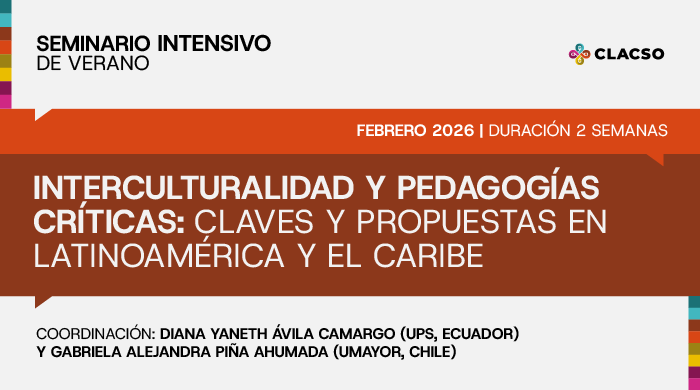
Interculturality and Critical Pedagogies: Keys and Proposals in Latin America and the Caribbean
EXECUTIVE
Diana Yaneth Ávila Camargo (UPS, Ecuador) and Gabriela Alejandra Piña Ahumada (UMayor, Chile)
Home: 23 / 02 / 2026 | Registration: 04/12/2025 al 22/02/2026
Format: Virtual with live classes and exclusive materials
Workload: 90 hours
Duration: 2 weeks
In Latin America and the Caribbean, interculturality is both a hotly contested category and a long-standing political and pedagogical tradition that has emerged from the struggles for recognition, collective rights, and self-determination of Indigenous peoples, as well as from historical commitments to popular education capable of transforming relations of domination. This CLACSO summer course offers a critical exploration of theoretical debates and concrete experiences in the field of interculturality and intercultural education, engaging in dialogue with critical, decolonial, feminist, and anti-racist pedagogies, and examining their foundations, proposals, and contemporary disputes.
In the current context, these agendas face renewed challenges: on the one hand, the increase in internal and transnational migration strains traditional frameworks of interculturality by complicating the landscape of diversity in schools, communities, and public policies; on the other hand, political climates hostile to cultural pluralism, rights-based approaches, and equality are intensifying, demanding analytical and pedagogical tools to combat racism, sexism, and multiple forms of exclusion. Drawing on experiences from Mexico to Argentina, the course connects discussions on lifelong learning, from early childhood education to higher education and community spaces such as family, neighborhood, and organizations, with an examination of recent public policies, seeking to strengthen perspectives on social justice and educational democratization in the region.
Finally, the course encourages theoretical reflection through the analysis of concrete experiences, both in the field of public policy and in community-led initiatives: curricular innovations, the production of educational materials, language revitalization processes, the development of local pedagogies, and proposals that intertwine feminisms, anti-racist education, and pedagogies situated in specific territories, at different educational levels. Within this framework, students are invited to share and critically examine experiences from their own contexts in order to construct comparative analyses and critical intervention tools relevant to the specific problems and contexts of regional diversity.
- Interculturality: reflections on the category of interculturality, types of interculturality, validity and transformations.
- Critical Pedagogies: reflections on critical, decolonial, popular education, feminist and anti-racist pedagogies.
- Intercultural Education: an approach to the role of intercultural education in Latin America and the Caribbean, concept, characteristics, actors, validity and transformations.
- Intercultural education and lifelong learning: an approach to and reflection on the role of intercultural education from early childhood education, basic and higher education, and other learning spaces such as the family, neighborhood, etc. Review of curricular proposals for Intercultural Bilingual Education in the region.
- Public policies and intercultural education: an approach to changes in public policies in recent years in the region, in relation to intercultural education, highlighting specific cases regarding budgets, access, among others.
- Anti-racist Education: reflections within the framework of access to education, affirmative action policies, and problems in the educational context.
- Education and gender: As part of critical pedagogies, this paper proposes a reflection on gender and the educational space. It draws on experiences from intercultural education and feminist pedagogies, with an emphasis on women from Indigenous and Afro-descendant communities, as well as rural and urban women.
- Education and migration: problems of internal and external migrations in the region, access, inclusion and exclusion in the educational field.
- Review of experiences from Mexico to Argentina: it is proposed to review significant experiences in the region, in the field of intercultural bilingual education and other educational proposals, in which critical pedagogies are present.
The course will be delivered online, combining synchronous and asynchronous sessions. Over the two weeks, a total of ten classes will be taught, eight of which will be live and two will be available as recordings for asynchronous viewing.
Live classes will be held on Tuesdays and Thursdays from 2:00 PM to 5:00 PM (MEX/Central America) / 3:00 PM to 6:00 PM (COL/ECU/PERU) / 5:00 PM to 8:00 PM (ARG/URU/BRA/CHI) via the Zoom platform, allowing for direct interaction among participants. In addition, students will have access to exclusive materials, available in the virtual classroom, that will complement the content covered in each session.
| Early registration (until 08/07) | General registration (May 6th to May 14st) | Registration without discount (15/08 to 26/08) | |
| Full or Associate Member Center | $100 | USD 150 | $200 |
| No link | $150 | USD 225 | $300 |
Inquiries: [mail protected]

