
Economic impact of violence against women
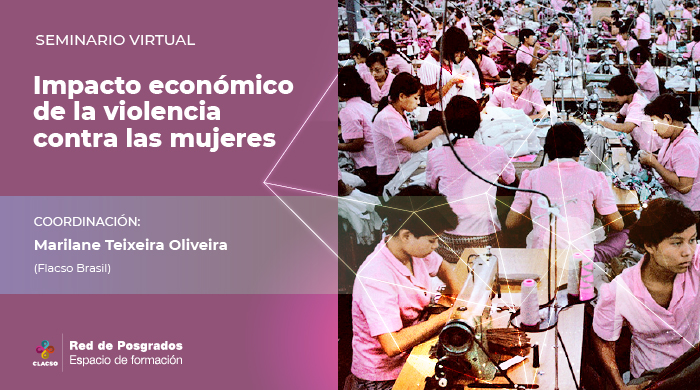
Seminar 2212
ChairCLACSO
Coordination: Marilane Teixeira Oliveira (Flacso Brazil)
Home: 20/04/2022 | Registration: 20/12/2021 al 19/04/2022
Workload: 12 weeks – 90 hours.
This seminar aims to develop an interdisciplinary approach that articulates the various areas of social sciences and economics to reflect on the need to reconceive the thermowork incorporating new dimensions. The sphere of work reflects social values that attribute a secondary role to women and contribute to the reproduction of these values, or that can be observed through the sexual division of work, occupational segmentation, barriers to access, permanence and promotion without employment, There are fewer possibilities of access to professional qualifications and remuneration equal to two men and a higher incidence of violence against women, including the work environment.
Além disso, as recent changes in capitalism have led to a tendency to flexibilization of work affecting women in a differentiated way. As we have developed contracting modalities in which the rights are neglected, for example domicile work, or paid domestic work, to terceirização, occupations carried out mainly by women and without protection. This condition of greater vulnerability exposes women to situations of greater violence.
The precariousness, which affects women more acutely, justifies the formulation of public policies that ensure access to basic rights and benefits against wage inequalities and discriminatory practices in the labor market. On the other hand, our region is being subjected to austerity and fiscal adjustment policies with more accentuated impacts on women, understanding how these policies are implemented and how they further affect gender is one of the purposes of this seminar.
This seminar is situated within a perspective of historical and social processes and discusses how an economic approach that removes women from their economic role was formed. The assumption is that what is worked is that there is an influence from the predominant economic theory in the definition of the economic role of women devoid of social values.
The seminar is structured in three moments. We first propose to answer the models recommended for the predominant economy and propose a new approach that integrates economic dynamics and reproduction work as part of a single system. It stands out, this approach, that which places the sustainability of human life at the center.
The second moment analyzes the reproductive dimension and the predominant aims to value solely the market sphere as the privileged space for the realization of the process of capitalist accumulation, or the system relegates women to the private dimension and removes any evidence of social recognition of their productive work and the need to develop it. strategies that allow us to survive in these two spheres. Women are forced to enter the labor market in poorer conditions and enter occupations that pay less. Attempts to naturalize these relationships appear in the predominant paradigms and a contrast to these approaches that gain visibility among feminist movements, feminist researchers and economists.
The third moment will address the theoretical contributions that seek to build an explanation for the inequalities between women and men in the world of work. The hypothesis adopted assumes that inequality in the process of insertion of women in the productive world is the underlying cause and, therefore, as its starting point, the segregation of gender and race/ethnicity determined by factors of material and cultural order.
The conditions of incorporation of women in the regional labor market will also be discussed. To analyze the objective of placing the importance of women in the formation process of our societies. The bibliography includes contributions from authors of the sociology of work and the economics of work, once it establishes the best connections between sexes, classes and races/ethnicities as structural elements of the social relations of sex and the sexual division of work.
- Gender and work: rethinking the definition of work
- Labor market and family organization: productive and reproductive work
- Structural inequalities in the region: class, gender and race/ethnicity
- Gender relations and theories on segregation and discrimination in the labor market based on race/ethnicity and gender perspectives
- Violence in the work environment: moral and sexual
- Taxation policies and their impacts on poverty, inequality and violence
- The effects of austerity policies for the confrontation of violence against women and analysis tools
- International instruments, conventions and recommendations for the protection of women in the work environment
- ABRAMO, L.; VALENZUELA, ME time of paid and unpaid work in Latin America. In: ABREU, A.; HIRATA, H.; LOMBARDI, MR (org) Gender and work in Brazil and France: intersecting perspectives. World of Work Collection. São Paulo: Boitempo, 2016.
- BALBO, L. The double presence. In: BORDERÍAS, C.; CARRASCO, C.; ALEMANY, C. (ed) Women and work: conceptual ruptures. Barcelona-Madrid: Icaria – Fuhem, 1994.
- BENERIA, Lourdes. Introduction. Women and Gender in the Economy: An Overview. Gender, Development and Globalization. Copyright, 2004
- BURCHELL, Brendan.; HARDY, Vincent.; RUBERY, Jill. And SMITH, Marx. A new method to understand occupational gender segregation in European labor markets. European commission. Luxembourg: publication office of the European Union. 2014
- CARRASCO, C. Feminist economics: A commitment to another economy. In: VARA, Maria Jesús (coord.). Studies on gender and economics, Madrid: Ed. Akal, 2006.
- ________________. The sustainability of human life: a women's issue? Barcelona: Mientras Tanto Magazine, no. 82. Icaria Editorial, 2001.
- ECLAC, Afro-descendant women in Latin America and the Caribbean Divided by equality. Publicação das Nações, Unidas. Chie, 2018.
- ESQUIVEL, V. The care economy in Latin America. Putting care workers at the center of the agenda. San Salvador: UNDP, 2011.
- ILO. World Employment and Social Outlook: Trends, 2020. International Labour Office – Geneva: ILO, 2020.
- ILO. World Employment and Social Outlook: Trends 2019 International Labour Office – Geneva: ILO, 2019.
- OROZCO Pérez, Amaia O. Gender Economics and Feminist Economics. Reconciliation or Rupture? Venezuelan Journal of Women's Studies. Caracas. January-June 2005, Vol. 10, no. 24
- PICCHIO, Antonella. Analytical and political visibility of social reproduction work. In: CARRASCO, Cristina (ed.) Women and the economy. New perspectives for old and new problems. Barcelona: Icaria, 1999. p. 201-42.
- RUBERY, J. Women and austerity the economic crisis and the future for gender equality. In: KARAMESSINI, M. & RUBERY, Jill. Women and recession to women and austerity: a framework for analysis. Routledge, 2014.
- SOARES, Cristiane & MELO, Hildete & BANDEIRA, Lourdes. The work of Brazilian women: an approach based on two demographic censuses from 1982 to 2010. Work presented at the XIX National Population Studies Meeting, ABEP. Held in São Pedro/SP – Brazil, from November 24 to 28, 2014.
- YUONG, Kate. Reflections on how to address women's needs. In: GUZMÁN, V. Portocarrero and VARGAS, PY (eds.). A new reading: gender in development. Lima: Flora Tristán Ediciones, Col. Entre Mujeres, 1991.
- TEIXEIRA, M. Feminist economics is a critique of the predominant economic paradigm. Themes, v.26, n.52, p.135-166, dez.2018.
- ZARETSKY, Eli. O Capitalism, family and private life. Lisbon: Editorial Initiatives, 1976.
|
|
Discount for one payment until 16/03 |
In one payment after 16/03 |
|
CM Plenos |
$75 |
$150 |
|
CM Associates |
$95 |
$190 |
|
No link |
$95 |
$190 |
FAQ
The basic requirements for taking a seminar are:
- Availability of at least 4 hours per week to dedicate to the seminar course.
- Internet access.
- Reasonable handling of communication and computer tools.
- Language proficiency in the language in which the course will be taught. The official languages are Spanish and Portuguese.
|
|
Discount for one payment until 17/04 |
In one payment after 17/04 |
|
CM Plenos |
$75 |
$150 |
|
CM Associates |
$95 |
$190 |
|
No link |
$95 |
$190 |

