
III Graduate School of the Network of Contemporary Latin American and Caribbean Social Studies
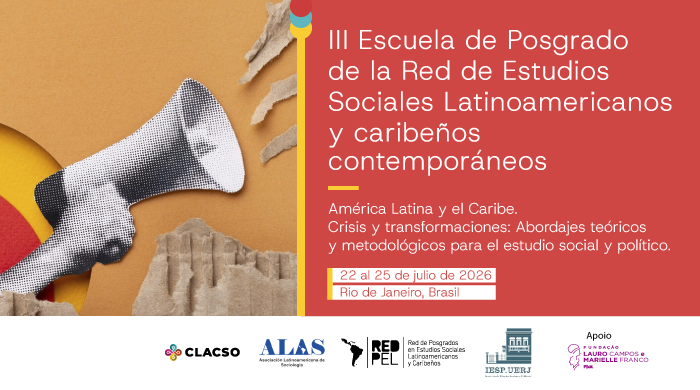
Latin America and the Caribbean. Crisis and transformations: Theoretical and methodological approaches for social and political study
Rio de Janeiro, Brazil | July 22 to 25, 2026
The Latin American Council of Social Sciences (CLACSO), the Latin American Sociological Association (ALAS), the Network of Postgraduate Programs in Latin American Social Studies (REDPEL), and the State University of Rio de Janeiro, with the support of the Lauro Campos and Marielle Franco Foundation and the nine social science and sociology programs of the state of Rio de Janeiro, invite master's and doctoral students—preferably in the first half of their programs and in the initial formulation of their thesis projects—as well as public policy officials and leaders and activists from civil society organizations in Latin America and the Caribbean, to apply to participate in the 3rd International Postgraduate School of the Network of Contemporary Latin American and Caribbean Social Studies (REDPEL), which will be held from July 22 to 25, 2026 in Rio de Janeiro, Brazil.
The Network of Contemporary Latin American and Caribbean Social Studies (REDPEL) was created in 2019 from an agreement between ALAS, CLACSO and the Postgraduate Program in Latin American Studies of UNAM, within the framework of the preparatory activities of the ALAS Congress of 2022.
The third edition, entitled “ Crisis and Transformations in Latin America and the Caribbean: Theoretical and Methodological Approaches ”, will be held at the Institute of Social and Political Studies of the State University of Rio de Janeiro (IESP-UERJ) and will focus on the methodological strengthening of research projects and on the discussion of theoretical and thematic approaches for the contemporary study of the region from an interdisciplinary and critical perspective.
Up to 25 scholarships will be awarded to students from Latin America and the Caribbean.
ORGANIZING INSTITUTIONS
- Latin American Sociological Association (ALAS)
- Latin American Council of Social Sciences (CLACSO)
- Network of Postgraduate Programs in Latin American Social Studies (REDPEL)
COORDINATE
- Institute of Social and Political Studies of the State University of Rio de Janeiro, Brazil (IESP/UERJ)
- Postgraduate Program in Latin American Studies of the National Autonomous University of Mexico (PPEL/UNAM)
- Bimodal Master's Degree in Contemporary Latin American Studies, University of the Republic, Uruguay (UdelaR)
SUPPORT
- Lauro Campos and Marielle Franco Foundation
- Post-Graduation Program in Social Sciences of the University of the State of Rio de Janeiro (PPCIS-UERJ)
- Post-Graduation Program in Sociology of the Institute of Social and Political Studies of the University of the State of Rio de Janeiro (IESP-UERJ)
- Post-Graduation Program in Sociology and Anthropology of the Federal University of Rio de Janeiro (PPGSA-UFRJ)
- Post-Graduation Program in Political Sociology of the Cândido Mendes University (PPGSP-UCAM)
- Post-Graduation Program in Social Sciences of the Federal Rural University of Rio de Janeiro (PPGCS-UFRRJ)
- Post-Graduation Program in Social Sciences of PUC-Rio (PPGCIS-PUC-Rio)
- Post-Graduation Program in Sociology of the Federal Fluminense University (PPGS-UFF)
- Post-Graduation Program in Social Sciences in Development, Agriculture and Society (CPDA-UFRRJ)
- Post-Graduation Program in Political Sociology of the Northern Fluminense State University (PPSP-UENF)
ORGANIZING COMMITTEE
- Ana Rivoir (ALAS)
- Breno Bringel (UERJ, Brazil)
- Efraín León (UNAM, Mexico)
- José Maurício Domingues (UERJ, Brazil)
- Nayar López (UNAM, Mexico)
- Alejandro Gambina (CLACSO)
ACADEMIC COMMITTEE
- Alberto Riella (UDELAR, Uruguay)
- Ana Rivoir (ALAS)
- Angélica Cuellar (UNAM, Mexico)
- Breno Bringel (UERJ, Brazil)
- Efraín León (UNAM, Mexico)
- Gloria Amézquita (CLACSO)
- José Maurício Domingues (UERJ, Brazil)
- Karina Batthyany (UDELAR, Uruguay)
- Nayar López (UNAM, Mexico)
- Pablo Vommaro (CLACSO)
- Maria Villarreal (UFRRJ, Brazil)
- Fabricio Maciel (UENF, Brazil)
- Fabricio Pereira (UNIRIO, Brazil)
RESULTS
We thank all master's and doctoral thesis students, public policy officials, and representatives of social organizations for the positive response to this call.
We received 138 applications that were evaluated by an international jury made up of members of the academic committee and the organizing committee. This entire team was responsible for considering the quality, relevance and coherence of the applications according to the terms of the call for applications.
In accordance with the above, the selected participants in the School are:
| Name and surname | Country of residence | Application type |
| Amanda Krein Antonette | Brazil | Master's/PhD student |
| Amanda Alves Mathias | Brazil | Master's/PhD student |
| Ana Lidia Resende Paula | Brazil | Master's/PhD student |
| Angie Lorena Parra Galindo | Colombia | Representative of social organizations |
| Carla Agustina Zarate | Argentina | Public policy officer |
| Daniela Lillo Muñoz | Chile | Master's/PhD student |
| Gregorio Sánchez Cortés | Mexico | Master's/PhD student |
| Ivan Darío Rojas Moreno | Chile | Master's/PhD student |
| Jhoan Miguel Almonte Mateo | Dominican Republic | Master's/PhD student |
| Joaquina Perochena | Mexico | Master's/PhD student |
| Johanna Nathalia Veloz Sánchez | Ecuador | Master's/PhD student |
| Keylor Antonio Robles Murillo | Costa Rica | Master's/PhD student |
| Landy Edith Rafael | Mexico | Master's/PhD student |
| María Laura García Perazzo | Argentina | Master's/PhD student |
| Mariana Morales Ramírez | Mexico | Master's/PhD student |
| Mathias Miguel Llabres Ramorino | Uruguay | Public policy officer |
| Mauricio Venegas Borde | Uruguay | Master's/PhD student |
| Nisley Alvarez | Uruguay | Master's/PhD student |
| Noam López | Peru | Master's/PhD student |
| Oswaldo Moisés Bolo Varela | Peru | Master's/PhD student |
| Palthy Alvarado | Nicaragua | Representative of social organizations |
| Robson Gabriel Santos de Oliveira | Brazil | Master's/PhD student |
| Rocío Denisse Rebata Delgado | Peru | Master's/PhD student |
| Sandra Lizette Morales Patzi | Uruguay | Master's/PhD student |
| Victoria Miño | Argentina | Master's/PhD student |
List of substitutes:
| Name and surname | Country of residence | Application type |
| Adilson Viana Major | Brazil | Master's/PhD student |
| Blanca Daniela Rezago Flores | Mexico | Master's/PhD student |
| Cecilia Quispe Fuentes | Bolivia | Master's/PhD student |
| Duban Mardones | Mexico | Representative of social organizations |
| Francielle Czarneski | Brazil | Master's/PhD student |
| Guido Podesta | Argentina | Master's/PhD student |
| Micaela Anahí María Aguirre | Mexico | Master's/PhD student |
| Sofia Valentina Rojas Gallardo | Chile | Master's/PhD student |
This ruling is final and irrevocable.
The Network of Contemporary Latin American and Caribbean Social Studies (REDPEL) was created in 2019 from an agreement between ALAS, CLACSO and the Postgraduate Program in Latin American Studies of UNAM, within the framework of the preparatory activities of the ALAS Congress of 2022.
The Graduate Schools were created in response to the challenge of developing a high-level theoretical and methodological training space in Latin American and Caribbean studies, a field of knowledge that has produced fundamental contributions to critical social theory for understanding the complexity and uniqueness of the region. To date, two editions have been held: the first in Mexico in 2022 and the second in Santo Domingo in 2024.
The third edition, entitled “ Crisis and Transformations in Latin America and the Caribbean: Theoretical and Methodological Approaches ”, will be held at the Institute of Social and Political Studies of the State University of Rio de Janeiro (IESP-UERJ) and will focus on the methodological strengthening of research projects and on the discussion of theoretical and thematic approaches for the contemporary study of the region from an interdisciplinary and critical perspective.
The School's main objective is to offer an intensive training space for graduate students in Latin American and Caribbean social studies, as well as for professionals linked to social organizations and public policy. The School seeks to:
- To provide fundamental theoretical and methodological tools for the development of thesis projects.
- To promote a panoramic and critical view of contemporary debates in Latin America and the Caribbean.
- Promote dialogue between academia, civil society, and institutional actors.
- To contribute to the advancement and quality of ongoing research, based on the contributions of Latin American critical social theory.
- Stimulate networks and strengthen ties between critical research in Latin America and the Caribbean.
The program is organized around two cross-cutting themes:
- methodological axis
A workshop designed to guide and strengthen thesis writing skills, with an emphasis on methodological design, formulating the research problem, and bridging theory and empirical evidence. The final project for the School should ideally be linked to each participant's thesis proposal.
- Theoretical and thematic axis
Panels and colloquia focused on debates relevant to the contemporary study of Latin America and the Caribbean, grouped into five main blocks:
- Authoritarianism, democracies and rights
- Political ecology, ecosocial transitions and socio-environmental justice
- Persistent inequalities and intersectionality
- Digitization, artificial intelligence and platform capitalism
- Social movements, systemic alternatives and horizons of change
- Certificate of participation: They will be given to all students who participate in carrying out the set of proposed activities.
- Certificate of approval: Only for those who complete and pass the final project for the School. This will be submitted after the School's completion.
The School will be taught in person and requires full-time dedication. It is aimed at:
- Master's and doctoral students in social sciences and related fields. Especially those who are formulating their thesis project or in the first half of their programs.
- Public policy officials.
- Leaders and activists from social organizations in Latin America and the Caribbean interested in the topic.
The selection process includes both participation in the School and accreditation.
Latin American and Caribbean participants will have their accommodation in shared rooms covered from the night of July 21 to the night of July 25.
The institutions organizing the school will not cover air or land transport expenses, food or other lodging beyond what is mentioned in this call for applications.
An international jury, made up of members of the academic committee and other designated evaluators, will select the participants.
The evaluation will take into account academic, geographic, and institutional criteria to ensure the participation of students from diverse countries and institutions. The decision will be final and cannot be appealed.
A total of up to 25 participants will be selected.
The results will be published on the CLACSO websites.
Those selected will be able to register for free at XXXV Latin American Congress of Sociology of ALAS (https://alas2026.
Those interested should register on the CLACSO website. To do so, they must complete the following requirements:
- Online form with personal data
- Summary of your research project (graduate students) / territorial intervention plan project (representatives of civil society organizations and public policy officials). The work must align with one of the school's established themes mentioned above. The document should be a maximum of 5 pages.
- Curriculum vitae or summary resume
- Letter of intent
- Letter of endorsement (mandatory requirement for representatives of civil society organizations and public policy officials)
Applications open until March 23, 2026
Publication of results: April 6, 2026
Inquiries: [mail protected]

