
III CELAC-EU Academic and Knowledge Summit
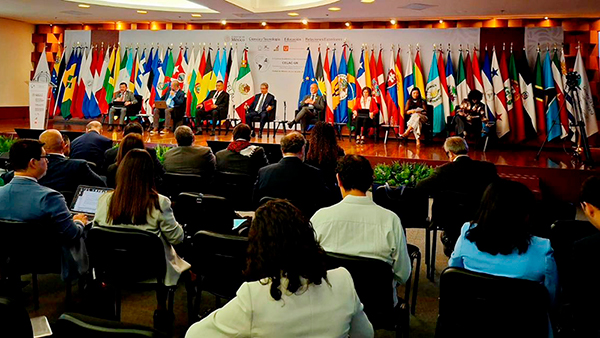


On July 10 and 11, in Mexico City, the “III CELAC-EU Academic and Knowledge Summit – Consolidating the Common Space for Higher Education, Science, Technology and Innovation”, a meeting that seeks to strengthen cooperation between the European Union and Latin America and the Caribbean in the field of higher education, science, technology and innovation.
CLACSO was one of the partner organizations of this Summit and was invited to actively participate in the program. Within this framework, Pablo Vommaro, Executive Director of CLACSO, participated on Thursday the 10th in two plenary sessions.

- "Towards a Common Knowledge Space CELAC-EU: Shared Visions and Challenges"
In his presentation, he analyzed that "We live in a world in polycrisis (political, economic, social, cultural, environmental)," wherefore "At CLACSO, we agree that it is essential to build a common space of knowledge between CELAC and the EU based on shared visions and challenges. Therefore, as a Latin American and Caribbean network of social sciences, humanities, and critical arts with a Global South perspective and a global reach, we propose 10 concrete actions to build this common space:

Promote shared visions between CELAC and the European Union to take advantage of and enhance the cooperation opportunity presented to both regions, in which Europe has the possibility of regaining regional and global leadership based on mutual learning.
Create a bi-regional program to support Higher Education, science, technology and innovation based on the principles of science and education as common goods, public goods and rights for all, and that advances the production of inputs to achieve the effective integration of higher education and science systems between both regions.
To build and support knowledge networks based on collaborative and reciprocal logics to counteract asymmetries and to defend democratic values, the culture of peace (highlighting the declaration of Latin America and the Caribbean as a zone of peace and denuclearized by CELAC in 2014), just transitions, academic freedom, open science, the guarantee of rights and ecologically and environmentally sustainable processes.

Promote practices and policies that foster multilingualism and cultural diversity in higher education and science. This includes implementing responsible and relevant evaluation processes for higher education and science based on the principles of multilingualism and open science, in order to consolidate high-impact academic and scientific cooperation between CELAC and the EU.
To create innovative devices that influence the dispute of meaning, awareness and public conversation, to promote more democratic, fair and participatory practices and spaces, that challenge and incorporate especially the new generations.
Building digital capabilities based on democracy, the promotion of a culture of peace and justice, and capable of counteracting social inequalities by embracing plurality, diversity, and coexistence without authoritarianism. This includes critically and proactively addressing artificial intelligence as a key challenge.
To protect and safeguard academic, scientific and intellectual work from attacks, persecution, censorship and budget cuts by denialist, anti-science and authoritarian forces by implementing concrete support actions.
To promote social dialogue among academia, civil society organizations, and public policymakers, fostering shared visions and proposals to positively impact the living conditions of the most discriminated and marginalized social groups, and to address current development challenges and just transitions through relevant and socially responsible science. CLACSO offers the Platforms for Social Dialogue—collaborative, multi-stakeholder, and multi-sectoral mechanisms, one of which focuses on Higher Education—to achieve this goal.
To build and strengthen horizontal bi-regional cooperation initiatives in the academic and scientific fields on new foundations, promoting the right to science, higher education and socio-ecologically sustainable development.
To create effective monitoring mechanisms for the right to science and higher education in both regions, highlighting relevant and significant practices, systematizing experiences and lessons learned, and recording and reporting situations of violation and attack on these rights.

- "Knowledge Diplomacy: Knowledge for building a culture of peace and strengthening global citizenship«

In the José María Morelos y Pavón room, Ministry of Foreign Affairs, Av. Juárez 20, Colonia Centro, Cuauhtémoc, CP 06010, Mexico City.
The main objective of the III CELAC-EU Academic and Knowledge Summit, an initiative linked to the preparation of the IV CELAC-EU Summit of Heads of State and Government, is to promote the construction of a common Euro-Latin American and Caribbean space for higher education, science, technology and innovation, through knowledge generation, the design of common lines of action, as well as bi-regional integration and strategic cooperation.
The Summit is organized around the following specific objectives:
Evaluate the progress made since the II Academic and Knowledge Summit.
Establish new priorities for action around the three thematic axes defined for the III Summit: higher education, science, technology and innovation, and culture of peace.
Strengthen the CELAC-EU University Council as a body for consultation and promote collaboration in the governance of the CELAC-EU Common Area of Higher Education, Science, Technology and Innovation.
Develop guidelines for a new 2025-2027 Action Plan that will serve as a roadmap for bi-regional academic and scientific collaboration.
The event is supported by the CELAC Pro Tempore Presidency, as well as other leading institutions, and will bring together rectors and officials from Latin American, Caribbean, and European universities and higher education institutions, members of the academic and scientific community, and representatives from government and civil society. The detailed academic program and website for the event will be available shortly.

If you would like to receive more information about CLACSO's training programs:
[widget id=”custom_html-57″]
to our email lists.

