
III Latin American and Caribbean Biennial of Childhoods and Youth: Inequalities, Challenges to Democracies, Memories and Re-existences
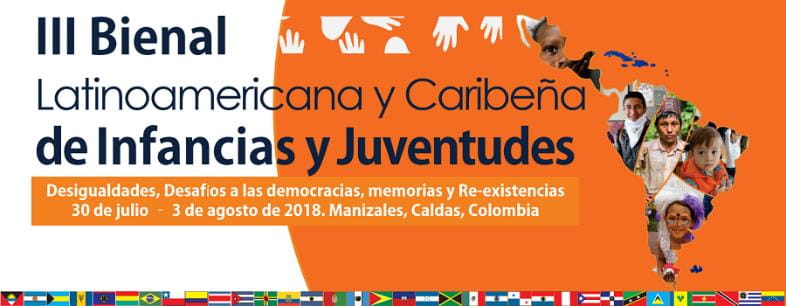
Manizales, August 3, 2018
General Manifesto
The Scientific Committee of this III Latin American and Caribbean Biennial of Childhoods and Youth wishes to recognize and thank all those who have shared their words and thoughts through their conferences, presentations, and aesthetic, playful, and artistic expressions; the children and young people who contributed their own expressions and perspectives; the representatives of so many collectives, organizations, and institutions that have supported this gathering in countless ways; and, in general, all those who, through their thinking, actions, questions, suggestions, and presence, have contributed to the development of this Encounter. To them we dedicate this Manifesto, which acknowledges that this has been a fundamental experience for establishing diverse dialogues and proposals for re-existence that intertwine academia with play, aesthetics, ethics, and, of course, politics.
- In this Manifesto, we reiterate our unwavering desire to transform a world where the lives of children and young people are empowered through the deepening of democracy, through memory, and through Re-existence. For this reason, because of the importance this project has held for all of us who believed in it, and because of the need to strengthen inter-institutional and interdisciplinary ties—but above all, ties of humanity and solidarity between social research, social struggle, and the development of increasingly public policies—we have sought to amplify the voices of those who have spoken out generously and forcefully within the framework of this Third Biennial, raising their voices and making their voices heard.
- This manifesto considers the contexts that have emerged during the Biennial, but also the polyphonies, pluralities, and potentialities for continued existence. Latin America and the Caribbean remain territories marked by the themes that have brought us together for this III Biennial. On the one hand, there are the inequalities that have become explicit in the very settings of this gathering… the obscured and wounded democracies that we are challenged to uphold… the memories of the peoples we have been, are being, and are casting forward with a vision of the future… and on the other hand, there is the insistence on the polyphonies, pluralities, and diversities from which we inhabit and challenge these same inequalities, and which we confront and continue to exist…
- These challenges remain present today, current and perhaps more acute than ever due to the persistence of a war that, as in Colombia, and after a signed peace agreement, has resulted in the murder of more than 300 social leaders, the displacement of nearly 18.000 people in the first half of 2018, and more than 17.000 cases of violence against women in Colombia in just the first five months of this year. These challenges are also evident in the ongoing human rights violations in other countries, such as the arbitrary prevention of Lula's release in Brazil, the abuses suffered by thousands upon thousands of migrants at borders, like the 2.500 children separated from their families in the United States, and the confrontations affecting civil society, as in the case of Nicaragua, among many other cases we have addressed in the various forums of this Third Biennial.
- In the face of these realities, and despite them, this III Biennial showcased emerging expressions of re-existence in the voices and actions of children and young people who have demonstrated their capacity to produce new realities; to establish alternative ways of being, appearing, and presenting themselves in our societies, which are often made invisible and degraded; to institute other ways of being together that stem from the recognition of diversity, non-violence, plurality, the radical renunciation of all forms of patriarchy, and the establishment of expressions and dynamics of creation through art, demonstrating that it is possible to continue living, despite everything, to continue Re-Existing.
- In this Manifesto of the Third Biennial, we urge policymakers and implementers to recognize children and young people as subjects and protagonists, capable of participating in the decisions regarding the aims, implementation, and resources of those public policies that affect their lives, without impositions or hegemonies. We invite you to pause; to stop and reflect, to observe the different forms of expression and lived experience, the histories and memories; a waiting period that invites action, not contemplation, to fight hand in hand, demanding laws that allow us to change reality, to stop institutionalized and normalized violence. Children and young people cry out to be heard, to live, to be allowed to dream, to be allowed to think about possible futures. It is essential to incorporate a generational, gender, and ethnic approach into the work with children and young people, establishing public policies for equality that are accompanied by a differential, participatory, and situated approach.
- We urge educators to recognize that pedagogies must consider alternative forms of education that demystify schools as the only spaces for education, opening their doors to the community and creating spaces of re-existence through the recovery of memory, play, poetics, and emotions. They must also question the types of knowledge being shaped and their relationship to contexts, whether they recognize communities as a validating force for scientific knowledge, and how to recover popular knowledge and the voices of children and young people to make visible the richness of their knowledge and feelings.
- It is necessary to mobilize popular education experiences in public school contexts, which are articulated with territorial, community and contextual processes, oriented towards reading, problematization and the attention to social problems from an interdisciplinary dimension, allowing students and teachers to work for their own communities, generate intergenerational dialogues, dialogical constructions of historical memory, identity and care, which decentralize the territories and allow them to build their own identities, as a platform for political construction and social, pedagogical and academic strategy to reduce social gaps, inequity and inequality in the territories.
- It is necessary to implement a revolutionary educational practice that involves thinking about the social role of the teacher as a social pedagogue, who understands social realities and the need to train in civic, democratic and political practices, who recognizes diversity and attends to differences and who generates investigative processes with and by communities and individuals.
- We urge academics and researchers to work from a situated, critical, de-victimizing, and generative research perspective with children and young people and their relational agents, as an opportunity to foster critical thinking in our communities, strengthen subjectivities and political identities, and build communities of shared meaning. This will help expand epistemic horizons and shape social narratives and memories capable of establishing alternative forms of relationship. In this sense, it is necessary to continue generating inter- and transdisciplinary research with educational and community-based components that allow us to articulate theory and practice, and everyday knowledge with scientific understanding.
- We urge you to recognize the diversity and plurality of children and youth, to acknowledge their multi-ethnic character, their gender, their own ways of inhabiting the world from their generational development, to let ourselves be surprised by the unpredictability of their words and actions in order to read in their practices the clamor sometimes frozen by institutionalism… to listen to voices, noises, laughter, cries, the history to be built.
- It is necessary to link academic and knowledge production with a liberating and transformative practice in the contexts of profound inequality experienced by children, particularly those in their early years, as well as by young people. From this springs our knowledge, our theories, situated in the voices, and also in the silences, in the circumstances, in the life experiences of individuals on the continent, on the land, in the territories of the body, the street, the countryside, the city, daily life, and subjectivities. From this springs our denunciations, our urgent calls, also for peace and for...
- life, for continuing to live in the courage of truth and dignity, without lies and without death, without false positives.
- It is essential to make rural children and youth visible and to highlight the serious threats facing their territories and family farming due to mining, toxic agribusiness, the expansion of productive frontiers, and the inequitable distribution of land. We must make them visible by recognizing their socio-historical, cultural, environmental, economic, and productive richness, considering processes of self-organization and the social and solidarity economy, so that these communities can access dignified living conditions, land rights, and sustainable production models, and so that they can autonomously and freely decide how and where they want to develop their life projects.
- We urge the collectives and organizations of children and young people in Latin America and the Caribbean to recognize and make explicit how, in the multiple initiatives in which they participate, causes rooted in their experiences and territories are embodied and claimed, within the framework of intercultural and intergenerational dialogues that are expressed in knowledge and practices, ceasing to be audiences, and legitimizing their being social agents with particular, critical, mobilizing and generative perspectives and narratives from which they constantly challenge the deficit-based, paternalistic and adult-centric views and logics from which they are defined.
- The children and young people of this Biennial continue to teach us that there are many ways to be a child and a young person; that they seek a space to reflect on themselves and do so creatively, peacefully, and in resistance; that they are proof of RE-EXISTENCE, that which is built day by day, collectively, permanently. They show us that they are standing strong, they resist, they live, and they do so with the confidence that their words, their art, their ideas are being heard; they claim spaces, not to survive, but to LIVE.
- It is with them, from them, and for them that we must work, recognizing their abilities and potential, but also sharing limitations, risks, shortcomings, and areas of opacity that enable us to promote the life experiences they build daily, identifying challenges and new paths to explore. From within these communities, it is essential to build bridges and foster strong intergenerational dialogues, taking into account the voices and needs expressed by children and young people themselves.
- Children and young people, many of whom actively participated in this Biennial, must play a leading role in both knowledge production and the recognition of traditional knowledge, as well as in the design, implementation, and evaluation of public policies. We know that this alone is not enough, but without them, the tasks we have set for ourselves are not possible.
- Once again, in our demonstration, we insist that it is ultimately necessary to draft a document that publicly outlines a shared purpose. In this way, we believe that a declaration of this nature must encompass not only assessments based on a specific theme—in this case, the theme of each roundtable, forum, or panel—but also a political, ethical, and intellectual commitment that embodies the fundamental interest of designing proposals to improve the lives of children (from their earliest years) and young people in Latin America and the Caribbean.
- This is why, in the new words that are beginning to occupy our minds—like childhoods, re-existences, polyphonies, territorializations—it will be possible to continue dreaming, coming together, and acting collectively. And what better way to do so than among peers, among equals, yet different in who we are, what we think, and what we do, based on the particularities of our contexts, institutions, and our own challenges, which become everyone's challenges. And what better way to do so than through affection, recognition, and full respect for those differences, where instead of distancing ourselves, we come together to continue debating the ideas that allow us to stay together, dreaming of our Latin America and our Caribbean.
IN CLOSING: Let this be an opportunity to instill a desire and an aspiration, which will only become reality if we are able to produce the political mediations that distinguish the realities, needs and priorities of the countries and territories as a banner and as a symbol.
Other stories, other places of enunciation, other keys to interpretation; other challenges for the Social Sciences on the Continent. In our land and in diverse territories, the voices of the subjects cry out.
Many social actors and social movements demand that we listen, that we not give up the struggle, the full dignity of existence. It is not the paradigms of hegemonic conceptual debate, nor the methodological hypotheses of conventional social science that matter, when in rural areas and cities, in our very bodies, in our streets, voices of resistance rise up, fighting with hope against oppression, against loneliness and abandonment, against death, and celebrating the commitment to living together, to being together.
To declare, in short, that our history is utopia, that our history is a desire to live, that our history is struggle, nonconformity and enigma, that it is our human condition in suspense that exalts and vindicates us, always on the path hand in hand with others, never alone.
We invite you to join these efforts, to continue building networks, uniting wills, and strengthening capacities to work together towards a dignified life for the children and young people of Latin America, the Caribbean, and the world we inhabit. Let us continue working together, pursuing our dreams and aspirations, but also remaining capable of outrage and taking action against the growing injustices.
We will continue to connect in the spaces we share and in those we will create based on the experiences we've had these past few days. And of course, we invite you all to join us again and continue working and dreaming together at the 4th Biennial, for which this city will reopen its doors in 2020!
Thank you!

