
Second Interinstitutional Meeting: Territory, Participation and Interculturality. Critical Perspectives from the South-South
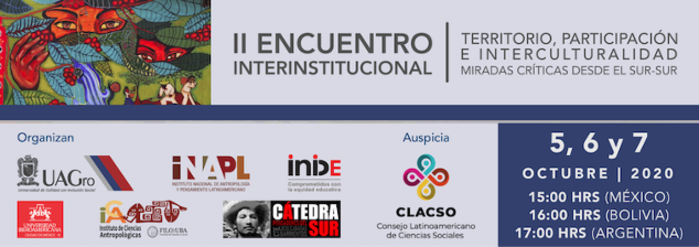
5, 6 and 7 October
15 hours Mexico
16 hours Bolivia
17 hours Argentina

PRESENTATION
With the arrival of progressive governments in Latin America during the first decade of the 21st century, worldviews that transcend the political, economic, and intellectual narratives emanating from the Global North emerged forcefully or became more visible. The Western worldview, imposed as dogma, was insufficient to understand the new and complex social dynamics rooted in capitalist rationality, many of which were perceived as an attack on the basic principles of democratic life. Phenomena such as migration, violence, colonialism, conservatism, classism, racism, and patriarchy are the focus of Latin American thought, which has found in the word "South" a means of political, territorial, global, and intellectual resistance, and a way of understanding the world.
The Second Interinstitutional Meeting “Territory, Participation, and Interculturality: Critical Perspectives from the South-South” follows the line of Latin American critical thought. Its objective is to contribute to the understanding of territorial resistance and tensions, social, political, and educational participation, and intercultural processes in Latin America. Its immediate antecedents are the First Interinstitutional Meeting “Territory, Participation, and Interculturality: Experiences from Guerrero, Chiapas, and Colombia,” held at the Ibero-American University in Mexico City in March 2020, and the First National Forum on Critical Pedagogy “Emancipatory Educational Perspectives,” held at the Faculty of Philosophy and Letters of the Autonomous University of Guerrero (Mexico) in November 2019.
We are committed to emerging fields in knowledge production, such as intercultural studies based on a critical political, epistemic, and pedagogical stance that advocates for the recognition of sociocultural and linguistic diversity and the importance of valuing the knowledge-generating practices of different peoples. We also draw on the perspectives of socio-territorial movements, which enrich our understanding of social and political struggles in the face of territorial disputes.
We value the analytical perspective on processes and transformations in diverse areas and the need to identify contested territories. We believe that the political significance of practices in and from these territories has revealed the multiplicity of historical experiences, the challenges and possibilities for social, political, and educational participation, as well as the heterogeneity of relationships built in situations and processes shaped by power relations and structural inequality, allowing us to understand current scenarios.
The Second Interinstitutional Meeting will be organized around two keynote addresses and three panel discussions that will contribute to the reflection on the themes described above. The questions that will guide the debate are: What are the social, political, economic, and educational problems that affect the socio-territorial contexts in which the research or educational intervention project is situated? How do these problems relate to the proposed themes? How can a co-constructive dialogue be fostered and carried out among the communities, the various grassroots organizations, and the academic community, enabling collaborative work and the recognition and understanding of diverse social, political, educational, and cultural practices?
MONDAY, OCTOBER 5
WORDS OF WELCOME
KEYNOTE ADDRESS:
LUIS ENRIQUE LÓPEZ-HURTADOHonorary Professor. Universidad Mayor de San Simón, Cochabamba, Bolivia
TABLE 1. Interculturality, education and languages in dialogue
Moderator : Erik Said Lara Corro (UBA/LICH-UNSAM/CONICET)
Patricia Ames. Department of Social Sciences, Pontifical Catholic University of Peru. Peru
AMILCAR FORNO. Center for Regional Development Studies and Public Policies, CEDER. Chile
ANA CAROLINA HECHT. National Institute of Anthropology and Latin American Thought/CONICET. Argentina
CARLOS SÁNCHEZ AVENDAÑO. University of Costa Rica. Costa Rica
NOELIA ENRIZ. Institute of Advanced Social Studies, UNSAM/CONICET. Argentina
MARIANA GARCÍA PALACIOS. Institute of Anthropological Sciences, UBA/CONICET. Argentina
OCTOBER 6 TUESDAY
TABLE 2. Territory, participation and socio-political struggle
Moderator : Patricia Ames (Department of Social Sciences, Pontifical Catholic University of Peru)
ELISA CRAGNOLINO. “María Saleme de Burnichon” Research Center, National University of Córdoba. Argentina
BETZABÉ MÁRQUEZ ESCAMILLA. Department of Educational Research, CINVESTAV. Mexico. ERNESTO GARCÍA MESTIZO
Ibero-American University. Mexico
DIANA YANETH ÁVILA CAMARGO. Center for Research in Social Sciences, Humanities and Education, Salesian Polytechnic University. Ecuador
ERIK SAID LARA CORRO. Human Sciences Research Laboratory, UNSAM/CONICET. Argentina
Paola Ortelli. Ibero-American University. Mexico
JOSÉ LUIS GARCÍA. Cátedra Sur / FFyL, Autonomous University of Guerrero. Mexico
WEDNESDAY, OCTOBER 7
KEYNOTE ADDRESS: ELSIE ROCKWEL L. Emeritus Researcher, Department of Educational Research, CINVESTAV, Mexico
TABLE 3. Interculturality, territory and indigenous epistemologies
Moderator: Ana Carolina Hecht (CONICET/UBA/INAPL)
DANIEL QUILAQUEO RAPIMÁN. Research Center for Education in Indigenous and Intercultural Contexts, Catholic University of Temuco. Chile
GUADALUPE MENDOZA ZUANY. Veracruzana University. Mexico
ALEXANDRE HERBETTA. Takinahaki Nucleus, Federal University of Goiás. Brazil
Adelina Peña. Institute of Intercultural Studies, Pontifical Javeriana University, Cali, Colombia
MARIO CESAR CONSTANTINO. Veracruzana University. Mexico
STEFANO SARTORELLO. Institute for Educational Development Research, Ibero-American University. Mexico
CLOSING REMARKS
coordinate
Ana Carolina Hecht. CONICET. INAPL. UBA, Argentina
José Luis García. South Chair. FFyL-UAGro, Mexico
Erik Said Lara Corro. UNSAM. UBA. CONICET, Argentina
Stefano SartorelloINIDE – Ibero-American University, Mexico
Organized by
Autonomous University of Guerrero, Mexico
National Institute of Anthropology and Latin American Thought, Argentina
Institute for Educational Development Research, Ibero-American University, Mexico
SUR Chair
National Institute of Anthropology and Latin American Thought, Faculty of Philosophy and Letters, University of Buenos Aires, Argentina
Sponsored by CLACSO
The CLACSO Working Group on Education and Interculturality participates
DIGITAL CERTIFICATES WITH CURRICULAR VALUE WILL BE ISSUED.
This is a free and open event via Zoom. To receive the link and digital certificate, please register using the following form:
If you would like to receive more information about CLACSO's training programs:
[widget id=”custom_html-57″]
to our email lists.

