
“Today, more than a third of Latin Americans are poor.”
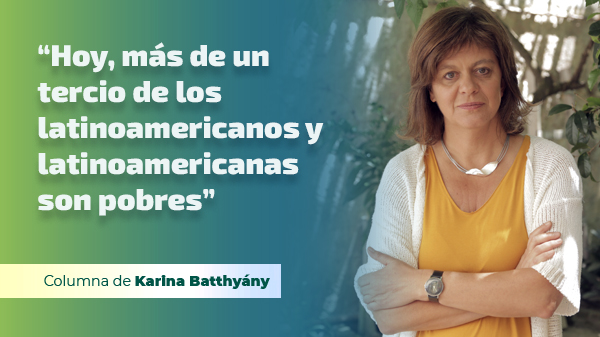
(Transcription of Karina Batthyány's Column)
(In InfoCLACSO – July 13, 2022)
Today I am in Colombia to participate in a seminar that discusses the central issues of development, organized by several Colombian universities, such as the University of Antioquia, UNAULA (Latin American Autonomous University), the Development Ethics Network and several CLACSO Member Centers.
Furthermore, to experience the social and political climate of expectation regarding what will happen in less than a month with the change of government and the assumption of office by Gustavo Petro and Francia Márquez, and where we reaffirm CLACSO's commitment to supporting this process that is beginning and that generates so much expectation, of course, not only for Colombia, but for all of our America, which will begin shortly: supporting the process from our 100 Colombian Centers in Colombia and of course from the various programs that CLACSO develops in Research, Training, Communication and in the Publishing area.
We always say: CLACSO's purpose is to generate social transformations and influence public policy. And what better context, then, than this first progressive government that Gustavo Petro and Francia Márquez will be assuming in Colombia in just a few days?
"It's truly a very important change, we've discussed it on several occasions. The photograph we saw and the circulation of the one-on-one meeting you had with Francia Márquez came at a key moment for the region and for Colombia in particular. I understand that there's the possibility of a new landscape opening up in the context of a country that has often been forced into more conservative processes. It's a change that could generate a new paradigm at the regional level."
Yes, absolutely. It's the first time a progressive government will take office in Colombia, and that's important to highlight. A progressive government that prioritizes peace, democracy, human rights, justice, and equity—and those are precisely the processes that we at CLACSO want to support. That's why, in addition to participating in this seminar, we'll be holding several meetings in preparation for this political process that will begin in Colombia in just a few days. We would have liked to meet in person with Francia Márquez, but due to scheduling conflicts and being in different parts of the country, we had to hold our meeting virtually. We will certainly be meeting with her and other members of this Colombian political process in person soon.
-Following up on what you were saying about Colombia and the situation in our America, I understand from your presentation last week, which allowed us to discuss each of these central themes or core issues—where our America stands—that one of them concerns poverty, which seems to be increasingly complex and linked to the logic of inequality. Could you tell us what you have planned for today?
I propose we begin with one of the dimensions or manifestations of inequality: poverty. Why start with this topic? Because it is indeed an issue that is significantly affecting our Latin American and Caribbean region. Today, with 2021 data, we can say that more than a third of Latin Americans live in poverty. Specifically, they represent 34% of the population, or almost 210 million people. Furthermore, we know that this situation has worsened as a result of the pandemic, because the pandemic has damaged a social fabric that was already extremely vulnerable, leading to a significant increase in poverty and inequality. Some measurements show that the Gini index, which measures inequality, would have increased by 5.6% compared to 2019 if the region's governments had not implemented the policies they did during the pandemic to try to alleviate the situation. Today we see that the Gini coefficient has indeed increased by 3%, reflecting inequality in Latin America. Furthermore, as we have consistently argued in our InfoCLACSO columns, we know that this does not impact the entire population equally. And women, in this case as well, have been among the most affected groups. According to ECLAC data, during the 2020-2021 pandemic, 13.4% of men had no income of their own, while the percentage of women in that situation was almost double that, at 26%. The implications of not having one's own income are clear and are one of the indicators used to describe poverty. Therefore, we must work on women's economic autonomy, particularly through care policies. Many of these women who lacked economic autonomy during the 2020-2021 pandemic were unable to work due to caregiving responsibilities or the need to care for their household members.
Furthermore, we also know that extreme poverty surged with the pandemic: the extreme poverty rate in the region rose from 13.1% in 2020 to almost 14% in 2021 (and we don't yet have the 2022 data). This also shows us how the reduction in both inequality and extreme poverty in our region over the past decade was reversed. Just recall that between 2003 and 2013, the percentage of people living in extreme poverty fell from 24% to 11.5%. But when we look at the data of almost 14% for 2021, we see how the trend not only stopped but reversed, and the figure is now rising. This occurred despite an economic upturn in 2021, meaning there was growth in most Latin American and Caribbean economies.
Furthermore, we can also say that the group of vulnerable people is growing—those who are on the verge of poverty or on the edge of the middle class. That is to say, people who are currently formally part of the middle class due to their income level, but who, faced with any reduction in the job market, a decrease in wages, or even the loss of some social protection policies they receive, very quickly fall into poverty. This is what is called the informal middle class, which in 2019 represented 37% of the population, while the formal middle class represented 38% of the population in our region. Now, vulnerable people, or this vulnerable middle class, have reached almost 40%. This figure must be taken into account because, while they are not formally included in poverty statistics today, we know that any change in their circumstances will cause them to swell those lamentable poverty figures.
The data that has come to light also highlights the low levels of savings capacity, a point I want to emphasize because savings are often the safety net people have, particularly in times of economic crisis. In Latin America and the Caribbean, people have a low level of savings capacity: 30% of Latin Americans could subsist without income for between one and three months. Meanwhile, one in four Latin Americans could only survive for a maximum of one month on their savings. In other words, the ability to survive or respond to a crisis like the pandemic, which for many people meant a sudden loss of income, is very low. Furthermore, at the extreme end of this spectrum, we find that 15% of people, with their current savings or savings capacity, would not be enough to survive a week—seven days—if they lost their source of income or job. All of this is, of course, closely linked to the prevalence of informal employment in Latin America and the Caribbean and to low levels of social protection.
I want to mention that there is also—and it was released at the end of 2021—what is called the Multidimensional Poverty Index. Because up until now, what I've shared with you refers to the more traditional poverty measurements that basically focus on income. But we also have this Multidimensional Poverty Index, calculated globally by the United Nations Development Programme and the Oxford Poverty and Human Development Initiative. In addition to income, it also measures poverty using indicators such as poor health, insufficient education, and low living standards; that is, it incorporates other indicators. This shows us that the latest report, from 2021, which was conducted for 109 countries and therefore covered almost 6 billion people, shows interesting results, also combined with dimensions that we at InfoCLACSO have addressed, such as gender, ethnicity, and race, in more than 40 countries. This is the first time this Multidimensional Poverty Index has appeared, allowing for these cross-referencings, which we will see in other reports, including those related to race, gender, and ethnicity. And the results clearly show us the impact that these dimensions of race, gender, and ethnicity have on poverty from a multidimensional point of view.
The overall picture shows that around 1.300 billion people worldwide live in multidimensional poverty. Approximately half of those living in multidimensional poverty are under 18 years old, and 8% are 60 or older. This figure provides an initial age distribution and comes at a time when the importance of investing in children, adolescents, and youth from a development perspective is being discussed and addressed in Latin America. Of course, this also has an impact on Latin America, although it is not the most affected region according to the results of this multidimensional poverty indicator. The most affected regions are in Africa, particularly sub-Saharan Africa, and in some parts of Asia. We must keep these data in mind because they show us how the age-old issue of poverty, which in many cases disappears from research or policy concerns, remains absolutely relevant in our region and the world, especially as a consequence of these two years of pandemic, which have only exacerbated this situation.
I also think about the logic of children, especially in their early years, who are clearly living in poverty, which implies a future sentence. That is, the possibility of having adequate nutrition, access to education—I think about how complex it is to address such an issue, one that doesn't simply end with a solution that can be found in the coming months or years. Each group of children exposed to situations of significant exclusion faces a very serious long-term sentence.
Absolutely. That's why I emphasize it, because ultimately, we're perpetuating what's called generational reproduction of poverty. If we don't invest, if we don't work, if we don't address this situation in childhood—that is, for children and adolescents—we'll unfortunately continue to discuss these issues for several generations to come. I also bring this up because in the discussion of social protection systems in Latin America, this issue must be a very clear priority in universal social protection for all children and adolescents in our region.
If you would like to receive more information about CLACSO's training programs:
[widget id=”custom_html-57″]
to our email lists.

