
“Today, Brazil’s political culture is racist and misogynistic.”
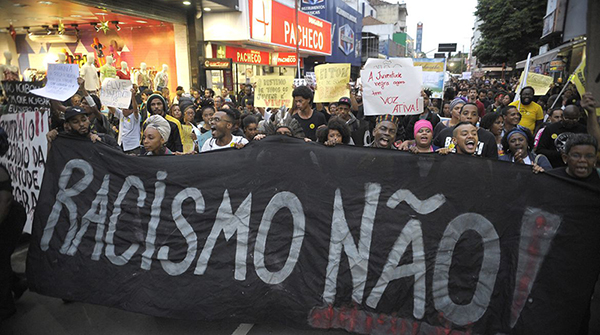
Rio de Janeiro – Em ato Contra o Genocídio da Juventude Negra, demonstrators protest against the death of five young black men by MPs last Saturday (28), in Costa Barros, in the northern zone (Tomaz Silva/Agência Brasil)
Lia Pinheiro BarbosaA researcher at the Faculty of Education of Crateús at the State University of Ceará, Brazil – a CLACSO Member Center – and a newly appointed member of the CLACSO Steering Committee for the Bolivia, Brazil and Peru Region, participated in the weekly InfoCLACSO program on August 31, where she analyzed the first round of elections in her country on Sunday, October 2, with two major contenders: current President Jair Bolsonaro and former President Luiz Inacio Lula da Silva.
“Thinking about Brazil’s next elections requires a historical exercise and a deep political process,” said Pinheiro Barbosa, for whom “Brazil is polarized and the 2022 election process will be a violent moment,” in a context where “democracy is not yet consolidated, there is a process of depoliticization.”
He added: “Today, Brazil’s political culture is racist, misogynistic, with a discourse of domination and power over the poor.”
Interviewed by Gustavo Lema
-Together for Brazil
The campaign to gather signatures from social scientists in Latin America and the Caribbean continues in support of Luis Inacio Lula da Silva's government program, formulated by the Broad Front team for the October elections, included in the BRAZIL'S RECONSTRUCTION AND TRANSFORMATION PROGRAM.
If you would like to receive more information about CLACSO's training programs:
[widget id=”custom_html-57″]
to our email lists.

