
“Today, women’s economic autonomy is a central issue.”
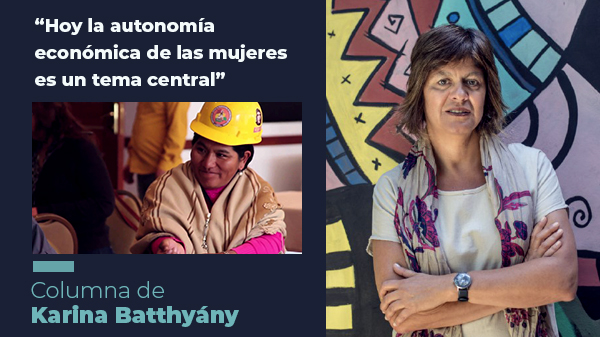
(Transcription of Karina Batthyány's Column)
(In InfoCLACSO – March 17, 2021)
This March, Women's History Month, we are dedicating these spaces on InfoCLACSO to addressing different dimensions of gender inequality. And today I wanted to refer to the issue of economic autonomy, which is obviously a central theme in terms of gender inequality. I am making this comment particularly after reading a recent report from ECLAC (Economic Commission for Latin America and the Caribbean) on how the pandemic has impacted women's economic autonomy, as well as the Social Panorama report that was presented recently, an annual report that ECLAC produces on the social landscape of Latin America and the Caribbean. Precisely then, based on the estimates that the Economic Commission for Latin America and the Caribbean is making, we clearly observe the strong economic contraction resulting from the pandemic that we all feel and experience daily in our countries, and that this is also having a particular and differential impact on employment and working conditions in our region, which, in the case of women, represents, according to ECLAC estimates, a setback of more than 10 years in participation in the labor market as a result of what 2020 has been, data that are taken for this analysis.
The decline in labor market participation makes it important to remember the starting point: the gap between the female and male economically active population already existed. That is, depending on the country, the difference in terms of incorporation and participation in the labor market for men and women is approximately 20 percentage points. Now this gap will widen even further, potentially returning us to 2010 levels. This is due to the effects the pandemic has had on employment and income for the population in general, but for women in particular. It's worth recalling that ECLAC reports a drop in gross domestic product in Latin America and the Caribbean of almost 8% – 7,7% to be more precise – and a general increase in unemployment in the region of 10 percentage points. Obviously, all of this has a negative impact on household income. However, if we consider the overrepresentation of women in poor households, we would be looking at an estimated 120 million Latin American women living in poverty in 2021. Furthermore, according to the ECLAC report, the unemployment rate for women is estimated to exceed 20%, reaching 22% for the year that just ended (2020). Specifically, the unemployment rate for women is estimated to reach 22,2% in 2020 (assuming the same participation rate as in 2019), representing a 12,6 percentage point year-on-year increase.
We must also bear in mind that, according to impact assessments conducted by ECLAC and the International Labour Organization (ILO), the greatest impact on economic activity and employment will occur precisely in those sectors that are highly feminized: commerce, manufacturing, tourism, and domestic service. It's important to remember that more than half of the women in Latin America and the Caribbean are employed in these sectors, which are currently experiencing the greatest impact in terms of employment and income in our region. These sectors, which are at greatest risk, not only employ the majority of working women, but also—recall some analyses we conducted last year on this topic—are characterized by high rates of informality, precarious employment, low wages, and low skill levels among their workforce.
Let's also remember the low percentage of women in these economic sectors who are registered with or contribute to social security. Specifically, 35% in commerce, 45% in manufacturing, 26% in tourism, and a mere 24% in domestic service. This highlights the lack of protection and social security for these women. We must also remember that one in three women in these economic sectors is self-employed, and these jobs are often, though not always, associated with lower-quality employment.
But also, allow me to make a brief comment about the health sector, the one that concerns us so much in all our countries, and to which we are so attentive with this pandemic situation: we know that in Latin America and the Caribbean, women are a crucial part of what is called the front line of the pandemic response. Why? Because 73% of those employed in the health sector are women who, during this year (2020 and so far in 2021), have had to face extreme working conditions: extended work hours, a greater risk of exposure to the virus, in a context of wage discrimination. Because, as I mentioned, while women make up 73% of those employed in the health sector, the income of women who work in the sector, and who are the majority in the health sector, is almost 25% lower than that of men employed in the same sector. So, there we have, in a very stark way, these inequalities we were talking about in the sector that is currently worrying so many of us.
Finally, we must add another dimension resulting from the pandemic: digital platforms. We know very well that the arrival of COVID-19 and the measures taken to mitigate its spread accelerated the digital transformation of Latin American and Caribbean societies, and consequently, their connection to the digital economy. This also poses a significant challenge in terms of economic autonomy—which is what we are discussing today—and gender equality. Why? Because when we consider the intersection of poverty, the digital divide, and gender inequality, the result is that opportunities for women in the lowest income brackets to earn a living are further undermined. This is a direct consequence of the acceleration of the digital economy.
Nearly 40% of women in the first quintile households, that is, the poorest households, do not have their own income and have great difficulties accessing any connection or connectivity device that would allow them, for example, to work remotely, which is so common today.
Even many of these platforms are closely linked to supposedly self-employed work, but are very much tied to informality with no accountability from the employer, which again presents a difficult situation in establishing work that is not precarious…
Absolutely. Without any kind of coverage from a security or social protection standpoint. And there you have the first barrier in terms of job quality and security. But the second is also the difficulty of eventually being able to meet the rapidly increasing demands of teleworking when there is no access to the necessary connections and devices. Ultimately, what is this all about? Once again, it's about what we've already discussed here on other occasions: the need to revisit the social contract, moving beyond mere rhetoric about equality between men and women to its concrete implementation, to real progress toward gender equality. And returning to the ECLAC report, they argue that a new fiscal pact is also necessary, one explicitly aimed at preventing the widening of these gender gaps we've mentioned, which are also related to women's access to equality and their rights. Fiscal pacts need to incorporate these dimensions into their discussions, including concrete and effective fiscal measures to prevent the deepening of women's poverty, the disproportionate burden of unpaid domestic and care work, and to address the challenges of accessing this new digital world we are facing. Governments must allocate specific resources to advance towards equality; otherwise, we will likely repeat past mistakes, such as the promotion of economic measures that leave women behind.
If you would like to receive more information about CLACSO's training programs:
[widget id=”custom_html-57″]
to our email lists.

