
Horizontality: critical methodologies in social sciences
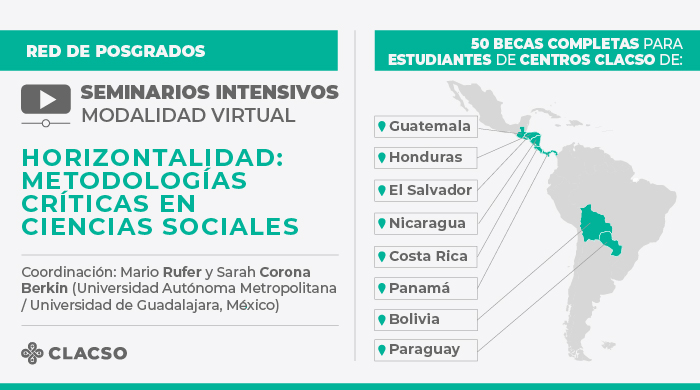
Intensive Virtual Seminar
Chair: CLACSO
Coordination: Mario Rufer and Sarah Corona Berkin (Autonomous Metropolitan University/University of Guadalajara, Mexico)
Teaching team: Carmen de la Peza Casares (CONACyT, Mexico), Gustavo Blázquez (CONICET-Argentina), Inés Cornejo Portugal (UAM, Mexico), Beatriz Nogueira Beltrao (U de G, Mexico – Brazil), Rebeca Pérez Daniel (University of Colima, Mexico)
Start date: 21/09 | Application period: 21/8 to 17/09
Duration: 4 weeks
Virtual Modality: 5 synchronous and 3 asynchronous meetings
Full scholarships – Intensive seminars
The Virtual Intensive Seminars These are intensive training proposals specifically aimed at students from CLACSO centers, which address diverse topics, putting a range of current issues on the agenda for debate in the region.
The first edition of the Virtual Intensive Seminars was conceived in coordination with representatives from the Centers in Central America, Bolivia and Paraguay.
CLACSO offers 200 full scholarships (50 per seminar) to students from CLACSO Member Centers in Paraguay, Bolivia, Honduras, Guatemala, El Salvador, Panama, Costa Rica and Nicaragua.
The scholarships cover 100% of the tuition cost.
RESULTS
Having concluded the evaluation process of the applications received within the framework of the Call for 200 scholarships for Intensive Virtual Seminars – aimed at CLACSO Member Centers in Central America, Bolivia and Paraguay.
- that the applications were subjected to a technical evaluation, verifying that all of them met the criteria and requirements established in the competition rules;
- which were then sent to the jury members for evaluation;
- That, according to the evaluations carried out, the Academic Committee has selected the following applicants to be awarded the vacancies in accordance with the specifications in the terms and conditions, as detailed below:
SELECTED APPLICANTS
(They will have 100% of their tuition covered)
| Name | Last Name | Member Center | Country |
| Ana Belén | Castellón Subia | JAINA Study Community [JAINA] | Bolivia |
| Ana Lucia | Reiche Garcia | Institute of Political and Social Research. School of Political Science. University of San Carlos of Guatemala [IIPS/USAC] | Guatemala |
| Anania Alhelí | González Cáceres | Center for Interdisciplinary Rural Studies [CERI] | Paraguay |
| Azucena Patricia | Heinrich Ramirez | Faculty of Social Sciences-UNA. National University of Asunción [FACSO-UNA] | Paraguay |
| Belinda Montserrat | Garcia Alonzo | Faculty of Social Sciences-UNA. National University of Asunción [FACSO-UNA] | Paraguay |
| Camila Sofia | Ventura Cervellon | Departments of Social Sciences and Humanities – UCA. Central American University [DCSH-UCA] | El Salvador |
| Daniela Elizabeth | Marroquín Salamanca | Departments of Social Sciences and Humanities – UCA. Central American University [DCSH-UCA] | El Salvador |
| Elisa Cristina | Salanic Coti | Institute of Political and Social Research. School of Political Science. University of San Carlos of Guatemala [IIPS/USAC] | Guatemala |
| Erick | Aguirre Godínez | Central American Association of Sociology [ACAS] | Guatemala |
| Fernando | Aguilar Saravia | Center for Higher University Studies. Universidad Mayor de San Simón [CESU-UMSS] | Bolivia |
| Frankarlo | Núñez Bravo | Department of Social Sciences. Faculty of Humanities. Central American University [DCS/UCA] | Nicaragua |
| Gustavo Gerardo | Fernandez Estrada | Institute of Political and Social Research. School of Political Science. University of San Carlos of Guatemala [IIPS/USAC] | Guatemala |
| Jazmin Judith | Romero Castillo | Departments of Social Sciences and Humanities – UCA. Central American University [DCSH-UCA] | El Salvador |
| Jeimy Carolina | Fuentes Alvarado | Directorate of Scientific Research. National Autonomous University of Honduras [DICU/UNAH] | Honduras |
| Jorge Alberto | Vásquez Rodríguez | Center for Research in Culture and Development. Vice-Rectorate for Research. National Distance Education University [CICDE/UNED] | Costa Rica |
| José Alberto | Quiñónez Castro | Departments of Social Sciences and Humanities – UCA. Central American University [DCSH-UCA] | El Salvador |
| Juan | Garcia | Latin American Faculty of Social Sciences, El Salvador [FLACSO] | El Salvador |
| Julia Gabriela | Munguia Hernandez | Institute of Political and Social Research. School of Political Science. University of San Carlos of Guatemala [IIPS/USAC] | Guatemala |
| Karla Maria | Gomez Santos | Institute of Political and Social Research. School of Political Science. University of San Carlos of Guatemala [IIPS/USAC] | Guatemala |
| Karla Maria | López Del Valle | Institute of Political and Social Research. School of Political Science. University of San Carlos of Guatemala [IIPS/USAC] | Guatemala |
| Kevin Evandro | Sánchez Saavedra | Institute of National Studies. University of Panama [IDEN/UP] | Panama |
| Lester Bismarck | Hernández | Department of Social Sciences. Faculty of Humanities. Central American University [DCS/UCA] | Nicaragua |
| Lisbeth Iveth | Hernández Sabá | Institute of Political and Social Research. School of Political Science. University of San Carlos of Guatemala [IIPS/USAC] | Guatemala |
| Lisseth Eunice | Bautista Velásquez | Association for the Advancement of Social Sciences [AVANCSO] | Guatemala |
| Luis Alfredo | Alvarez Sagüil | Institute of Political and Social Research. School of Political Science. University of San Carlos of Guatemala [IIPS/USAC] | Guatemala |
| Luis Carlos Ariel | Ruiz Chow | Faculty of Humanities and Legal Sciences. National Autonomous University of Nicaragua [UNAN-Managua] | Nicaragua |
| Maria Belen | Torres Leiva | Faculty of Social Sciences-UNA. National University of Asunción [FACSO-UNA] | Paraguay |
| Maria del Carmen | Speratti Mendoza | General Directorate of Postgraduate Studies and International Relations. National University of Asunción [UNA] | Paraguay |
| Maria Elena | Guardado Abrego | Departments of Social Sciences and Humanities – UCA. Central American University [DCSH-UCA] | El Salvador |
| Maria paz | Gonzalez Mendoza | Faculty of Social Sciences-UNA. National University of Asunción [FACSO-UNA] | Paraguay |
| Maria Alejandra | Gámez Herrera | Institute of Political and Social Research. School of Political Science. University of San Carlos of Guatemala [IIPS/USAC] | Guatemala |
| Miguel Angel | Canaza Canaviri | Postgraduate Program in Development Sciences. Universidad Mayor de San Andrés [CIDES/UMSA] | Bolivia |
| Mirian Clarissa | Martinez Avila | Directorate of Scientific Research. National Autonomous University of Honduras [DICU/UNAH] | Honduras |
| Monica Alessandra | Williams Díaz | General Coordination of Postgraduate Studies of the Faculty of Social Sciences. -National Autonomous University of Honduras [UNAH] | Honduras |
| Nelson Gabriel | García Mendoza | Faculty of Humanities and Legal Sciences. National Autonomous University of Nicaragua [UNAN-Managua] | Nicaragua |
| Omar Claudio | Ramos Ancasi | Agroecology, University of Cochabamba. Faculty of Agricultural, Livestock and Forestry Sciences. Universidad Mayor de San Simón [AGRUCO] | Bolivia |
| Oscar Miguel | Caal Asig | Institute of Political and Social Research. School of Political Science. University of San Carlos of Guatemala [IIPS/USAC] | Guatemala |
| Pastor Ricardo | Ricardo Martinez | Directorate of Scientific Research. National Autonomous University of Honduras [DICU/UNAH] | Honduras |
| Paulo Joaquin Gustavo | Gonzalez Paciello | Seeds for Democracy [SPD] | Paraguay |
| Rodrigo | Guzman | JAINA Study Community [JAINA] | Bolivia |
| Rosa Elizabeth | Flores Gómez | Faculty of Social Sciences-UNA. National University of Asunción [FACSO-UNA] | Paraguay |
| Rosa Maria | Ruffinelli | General Coordination of Postgraduate Studies of the Faculty of Social Sciences. -National Autonomous University of Honduras [UNAH] | Honduras |
| Saul Nehemiah | Aguilar González | Institute of Political and Social Research. School of Political Science. University of San Carlos of Guatemala [IIPS/USAC] | Guatemala |
| Sebastian Andrés | Morales Padilla | Directorate of Scientific Research. National Autonomous University of Honduras [DICU/UNAH] | Honduras |
| Xavier Ernesto | Rodriguez Corea | Faculty of Humanities and Legal Sciences. National Autonomous University of Nicaragua [UNAN-Managua] | Nicaragua |
This course explores some questions that have been addressed by critical methodological approaches in the social sciences in recent years. What are the methodological obstacles to creating new answers? with the other instead of reproducing the same opinions about The other? How can we do justice to the multiple bodies of knowledge that respond in their own way to social problems? How can we reverse the research situation where the other Is it an object situated outside the research and only mentioned in the researcher's discourse? The answers to these questions lie in ways of understanding the social world under different research conditions. In this program, we propose exploring certain clues as starting points for horizontal practice in the processes of constructing social knowledge.
In the pedagogical underpinnings of the practices that shape us lies concealment: hiding passions, harshness, and obvious hierarchies. We are taught “not to write about that” in the pursuit of objectivity. To what extent are our knowledge-production practices permeated by concurrent exercises of internalized repression, by mandates based on what Pierre Bourdieu called the “scholastic reason” of social science—that is, writing less about “what happens in the world of practice” than about what is “expected” in the field of study in which we are engaged? Why are some practices more permissible than others in fieldwork, in order to preserve something like “impartiality” and the “zero-point of view” of the scientific statement? Why are some ways of “being other,” of producing objects, more permissible than others: that is, what happens when the subjects we try to understand are neither so traditional, nor so docile, nor so pure, nor so atavistic: that is, when they do not respond to the domesticity of other allowed What have neoliberal extensions of sovereignty produced under the labels of pluri-multi-culturality or diversity? Is there room to write about ambiguity and contradiction in our academic and political spaces? We will try to explore these questions throughout the seminar.
- Class 1. Presentation: horizontality, dialogue, situated knowledge
- Class 2. Social Sciences, Collaboration and Geopolitics of Knowledge: Latin American Perspectives
- Class 3. Listening, recording, eroticizing: on certain uncomfortable thoughts and their methods
- Class 4. Questioning racism and epistemic sexism from the colonial body
- Class 5. Nuances of memory and its methodological approaches. Migrants and returnees in Yucatán
- Class 6. The light and shadows of interculturality
- Class 7. Polyphonic texts to account for horizontal processes of knowledge construction
- Class 8. The Dark Side of the Horizon. Critical Views and Closing
- Blázquez, Gustavo (in press). Horizontal Methodologies and Excited Knowledge. On the Pleasures of Fieldwork, in Inés Cornejo and Mario Rufer (eds). Towards a critique of methodologyBuenos Aires. CALAS-CLACSO.
- Briones, Claudia (in press). “Horizontality as a horizon of work: from epistemic violence to co-labor”, ", in Inés Cornejo and Mario Rufer (eds). Towards a critique of methodologyBuenos Aires. CALAS-CLACSO.
- Bruce, Jorge (2008). We had made fun of each other so much. Psychoanalysis and racismSan Martín de Porres University Publishing Fund. Peru. Chapter 4.
- Cornejo Portugal, Inés (2017). “Young Mayan-speaking migrant”, in Inés Cornejo Portugal (ed). Rural youth and Mayan-speaking migration: Stalking, observing, and investigating an emerging theme Mexico: UAM-C.
- Corona Berkin, Sarah (2011). Postcards of difference. The city as seen by Wixaritari photographersMexico. Conaculta
- Corona Berkin, Sarah (2019). Horizontal production of knowledge. Guadalajara: CALAS. (Chapters: “Introduction”, “Naming”, “Transforming”).
- De la Peza Casares, Carmen (in press). “Interpellations of horizontal methodologies to think about the conditions of possibility of a local science”, in Inés Cornejo and Mario Rufer (eds). Towards a critique of methodologyBuenos Aires. CALAS-CLACSO.
- Audio documentary: “Voices that fade away, words that fade away”
- Documentaries: “Returning, Yucatecan Migrants” and “Mayan Migrant Stories.”
- Hernández Castillo Rosalva Aída (2018). “Towards a socially committed anthropology from a dialogical and feminist perspective” in Xochitl Leyva Solano (ed.). Other practices of knowledge(s): Between crises, between wars. Volume II. Buenos Aires: CLACSO. (pp.: 83-106).
- Jorge Luis Borges (1972). “The Ethnographer”, in The praise of the shadow, several editions (short story).
- Mahmood, Sabah (2009): “Feminist theory and the docile social agent”, in Suarez Navaz, Liliana; Hernández, Rosalva Aída (coords). Decolonizing feminism: theories and practices from the marginsChair: Madrid.
- Miner, Horace (1956): “The ritual of the body among the Nacirema”, American Anthropologist, 58, 1956. Translation and notes: Ricardo Esandi(5 pages)
- Nogueira Beltrao, Beatriz (in press). “Body-to-body knowledge as a form of resistance against epistemic racism/sexism”, in Inés Cornejo and Mario Rufer (eds). Towards a critique of methodologyBuenos Aires. CALAS-CLACSO.
- Movie: Peasants to the mafia, Dir. Juan Manuel López-Roberto Sántiz, Chamula Producciones, 53', 2011.
- Pérez Daniel, Myriam Rebeca and Sartorello, Stefano (Coords.) (2012) Horizontality, dialogue and reciprocity in social and cultural research methodsAguascalientes/San Cristóbal de las Casas/San Luis Potosí: CENEJUS-UNACH-UASLP-COCYTECH. ISBN 978-607-8062-24-9
- Rojas, Hugo (2017) "The subtle everyday violence in the (trans)border mercantile context of Mexico-Guatemala. A retrospective look at an ethnographic investigation into the construction of stereotypes” in Castro, Yerko and Adèle Blazquez (coord.) Micropolitics of Violence: Reflections on Fieldwork in Contexts of War, Conflict, and ViolenceMESO Workbooks. No. 5.
- Rufer, Mario (2012). “Speech, listening, writing. Horizontality and subalternity from postcolonial perspectives”, in Sarah Corona and Olaf Kaltmeier (eds). In dialogue. Horizontal methodologies in social and cultural sciences Mexico: Gedisa.
- Rufer, Mario (in press). “We are not going to translate. Install a secret, deny the gift, redefine the game”, in Inés Cornejo and Mario Rufer (eds). Towards a critique of methodologyBuenos Aires. CALAS-CLACSO.
- Seth, Suman (2009). “Putting knowledge in its place: science, colonialism, and the postcolonial”, Postcolonial Studies, 12, 4, p. 373-388.
- Shoshan, Nitzan (2015). “Beyond Empathy: The Ethnographic Writing of the Unpleasant.” New anthropology, No. 28, vol. 83.
- Yeh, Rihan (in press). “Anacleto”, Virajes Magazine, Vol. 23 (1).
FAQ
The basic requirements for taking an intensive online seminar are:
- Availability of at least 4 hours per day (2 hours in the morning and 2 hours in the afternoon) for synchronous meetings during the first week of the course and 4 hours per week for asynchronous classes in the following 3 weeks
- Internet access.
- Reasonable handling of communication and computer tools.
- Language proficiency in the language in which the course will be taught. The official languages are Spanish and Portuguese.
Inquiries to [email protected]

