
History and memory: conceptual distinctions, political possibilities of their articulation and proposals for their teaching in the curricular field of social sciences
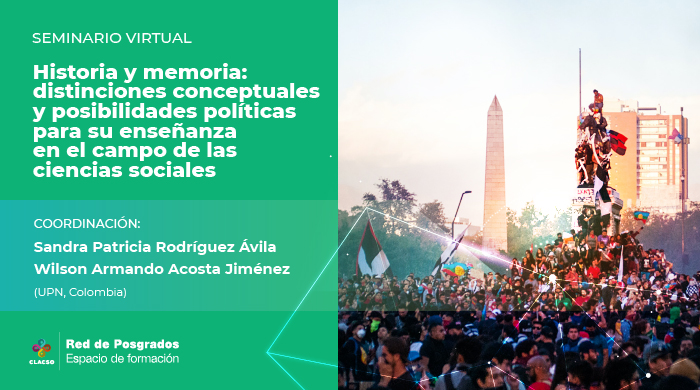
Seminar 2150
Coordination: Sandra Patricia Rodríguez Ávila and Wilson Armando Acosta Jiménez (National Pedagogical University, Colombia)
Home: 08 / 09 / 2021 | Registration: 4/06/2021 al 06/09/2021
Workload: 12 weeks – 90 hours.
Currently, the recent past taught in schools is a subject of debate because its treatment involves a conflictive relationship between memory and history, and because the themes that constitute it are part of the social and political experience of students and teachers, from where the effects of that past on identity, on the understanding of justice, and on the political actions that guide the present are questioned.
Based on this premise, this course initially aims to analyze history as a disciplinary field and memory as a transdisciplinary category, within the framework of current debates about temporality, the past, and its political uses in the present. In the process of establishing the conceptual distinctions between these two fields, the course will address the cultural history of memory, the sociology of memory, the culture of memory, and memory studies from cross-cutting fields such as media, image, and literature.
Building on this broad understanding of the relationship between memory and history, the second phase seeks to address the didactic discussions of the social sciences and history through three of their appropriations: the pedagogy of memory, the teaching of recent history, and the teaching of contemporary history. This second phase will consider the specificities of the participants' national contexts with the aim of strengthening the production of knowledge situated within their specific contexts, while always remaining connected to the concerns arising from the first phase of the analysis of the relationship between memory and history.
- History and memory: conceptual distinctions, political possibilities of their articulation and proposals for their teaching in the curricular field of social sciences
- Relationships between memory and history: Concepts and categories of work
- Configurations of the sociology of memory: the problems of collective memory and social memory
- Memory, culture and temporality
- Relationships between memory and justice: ethical debates on truth and reparation in processes of political and legal transition
- Cross-cutting studies of memory: literature, image and media
- Emergency conditions of the pedagogy of memory and the teaching of recent history
- Conceptual foundations of the pedagogy of memory, the teaching of recent history and social memory in education
- Research on pedagogies of memory and the teaching of recent history
- Analysis of experiences: Colombia, Chile, Brazil, Argentina and Uruguay.
- Bárcena, F. (2011). “Pedagogy of memory and transmission of the world. Notes for reflection”. In: Social Conscience, 15, pp. 109-118.
- Broquetas, M., & Frega, A. (2008). “The assault on memory. Experiences on its historical approach inside and outside the classroom.” In: Clio & Associates. History Taught, 12, pp. 56-72.
- Candau, J. (2002). Anthropology of memory(1st ed.). Buenos Aires: Nueva Visión.
- Castillejo Cuéllar, A. (2012). They illuminate as much as they obscure: on violence and memories in contemporary Colombia. In: Peacebuilding in Colombia(Angelika Rettberg editor). Colombia: Universidad de los Andes, Colombia, pp. 117-140.
- Charney-Berdichewky, J. (2019). “The right to truth and its contribution to collective memory”. In: Law Review (Valdivia), 32(2), p. 207-230.
- Cuesta Bustillo, J. (1998). “Memory and history. A state of the question”.In: Yesterday , 1998, 32, pp. 203-246
- Cuesta Fernández, R. (2011). “History with memory and critical didactics”. In: Social Conscience, 15, pp. 15-30.
- De Amézola, G., Dicroce, CA, and Garriga, MC (2009). “The teaching of recent history and past-present relations in the classroom: An approach from didactic discourses.” In: Clio & Associates, 13, pp. 1-28.
- De Amézola, G., and D'Achary, C. (2016). The Frozen Dictatorship. School events, commemorative classes and posters about the last Argentine military dictatorship in primary schools of the Province of Buenos Aires (2008-2015). In: Colombian Magazine of Education, 71, pp. 137-161.
- González, P. and Pagés, J. (2014) “History, memory and the teaching of history: European and Latin American concepts, debates and perspectives”. In: History and Memory Magazine, 9, pp. 275-311.
- Herrera, M., & Pertuz Bedoya, C. (2016). “Education and memory policies on the recent history of Latin America.” In: Colombian Magazine of Education, 71, pp. 79-108.
- Kriger, M. (2011) “The teaching of recent history as a key tool of political education”. In: Person and Society, 3, pp. 29-52.
- Kuri Pineda, E. (2017). “The social construction of memory in space: a sociological approach”. In: Peninsula, 12 (1), pp. 9-30.
- Levín, F. (2021). “Trauma and history. Reflections from behind the scenes”. In: Sociohistorical, 47, e130.
- Ortega Valencia, P., Merchán Díaz, J., and Vélez Villafañe, G. (2014). “Teaching recent history and pedagogy of memory: emerging from a necessary debate”. In: Pedagogy and Knowledge, 40, pp. 59.70.
- Rivaud Delgado, F. (2011). “The social making of the past: notes for a sociology of memory”. In: Journal of Social Research; VIII (13), pp. 9-29.
- Rodríguez Ávila, SP (2012). “Teacher training for the present: memory and teaching of recent history”. In: Colombian Magazine of Education, 62, pp. 165.188.
- Rubio, G. (2016). “Hegemonic memory and social memory. Tensions and pedagogical challenges surrounding the recent past in Chile.” In: Colombian Magazine of Education, 71, pp. 109-135.
- Saban, (2020). “From cultural memory to the transculturation of memory: a theoretical journey”. In: Chilean Journal of Literature, 101, pp. 379-404.
- Sacavino, S. (2015). “Pedagogy of memory and education for “never again” for the construction of democracy”. In: folios, 41, pp. 69-85.
- Traverso, E. (2007). The past, user manual. History, memory and politics.(A. González de Cuenca, Trans.) Madrid, Spain: Marcial Pons.
|
|
Discount on one payment if paying by 31/8 |
In one payment from 1/9 to 6/9 |
|
CM Plenos |
$75 |
$150 |
|
CM Associates |
$95 |
$190 |
|
No link |
$95 |
$190 |
FAQ
The basic requirements for taking a seminar are:
- Availability of at least 4 hours per week to dedicate to the seminar course.
- Internet access.
- Reasonable handling of communication and computer tools.
- Language proficiency in the language in which the course will be taught. The official languages are Spanish and Portuguese.
|
|
Discount on one payment if paying by 31/8 |
In one payment from 1/9 to 6/9 |
|
CM Plenos |
$75 |
$150 |
|
CM Associates |
$95 |
$190 |
|
No link |
$95 |
$190 |

